AQA · A-Level · English Literature
Course version: 7717 · Version from Sept 2026
Indeed, the specification takes into account the fact that writers often…
Full specification wording
Subject content – A-level: Indeed, the specification takes into account the fact that writers often subvert the genre in which they are writing.
Genre study in AQA A-level English Literature B requires you to recognise that writers do not simply follow conventions; they frequently subvert them.
Checked against the AQA 7717 specification (opens in a new tab) on .
- Point 3 of 9
- 4 key terms
Study notes
From the checked teaching notes for this specification point.
The idea
Genre study in AQA A-level English Literature B requires you to recognise that writers do not simply follow conventions; they frequently subvert them. Subversion may involve rejecting, reversing, parodying or hybridising established features. For example, a tragedy might refuse a clear downfall, or a crime novel might leave the crime unsolved. When analysing, identify the conventional expectation first, then show how the text departs from it and consider the effects on meaning, character, mood and reader response. The specification explicitly acknowledges this, so exam responses should treat subversion as a central analytical move, not an optional extra. Linking subversion to the writer’s purposes and the text’s context strengthens interpretation.
What earns the marks
- Identify a specific genre convention that the text establishes or evokes, such as a tragic hero’s fatal flaw or a detective’s rational solution.
- Explain precisely how the text subverts that convention, for example by denying resolution, reversing a character type or blending genres.
- Analyse the effects of the subversion on meaning, such as unsettling the reader, challenging ideological assumptions or complicating characterisation.
- Support the analysis with close reference to textual detail, including form, structure and language choices that signal the subversion.
- Connect the subversion to the writer’s possible purposes and relevant contextual factors without reducing the text to a single interpretation.
Common mistakes and how to put them right
Treating genre as a fixed checklist and ignoring moments where the text breaks the rules.
Put it right: Identify the convention and then analyse the departure.
Assuming that subversion always means criticism or rejection.
Put it right: Consider that it may be playful, affectionate or used to refresh a genre.
Describing a subversion without explaining its effect.
Put it right: Link the deviation to meaning, reader response or the writer’s thematic concerns.
Exam tips
- Plan your response around two or three clear conventions and their subversions, so your argument has a sharp analytical focus.
- Use precise genre terminology, such as ‘anti-hero’, ‘unreliable narrator’ or ‘open ending’, and immediately explain how the example fits or challenges the term.
- Embed short quotations that demonstrate the subversion, then analyse the language or structural choice rather than paraphrasing the plot.
Try the lesson
The start of the Subject content – A-level: Indeed, the specification takes into account the fact that writers often subvert the genre in which they are writing. lesson, made from checked teaching notes for this specification point.
Have a go first
In literary studies, what is meant by the assertion that a writer 'subverts' a genre?
Listen
Genre study in AQA A-level English Literature B requires you to recognise that writers do not simply follow conventions; they frequently subvert them. Subversion may involve rejecting, reversing, parodying or hybridising established features. For example, a tragedy might refuse a clear downfall, or a crime novel might leave the crime unsolved. When analysing, identify the conventional expectation first, then show how the text departs from it and consider the effects on meaning, character, mood and reader response. The specification explicitly acknowledges this, so exam responses should treat subversion as a central analytical move, not an optional extra. Linking subversion to the writer’s purposes and the text’s context strengthens interpretation. A strong answer earns marks for these points. Identify a specific genre convention that the text establishes or evokes, such as a tragic hero’s fatal flaw or a detective’s rational solution. Explain precisely how the text subverts that convention, for example by denying resolution, reversing a character type or blending genres. Analyse the effects of the subversion on meaning, such as unsettling the reader, challenging ideological assumptions or complicating characterisation. Support the analysis with close reference to textual detail, including form, structure and language choices that signal the subversion. A common slip: Treating genre as a fixed checklist and ignoring moments where the text breaks the rules. Instead, identify the convention and then analyse the departure. Exam tip: Plan your response around two or three clear conventions and their subversions, so your argument has a sharp analytical focus.
See it
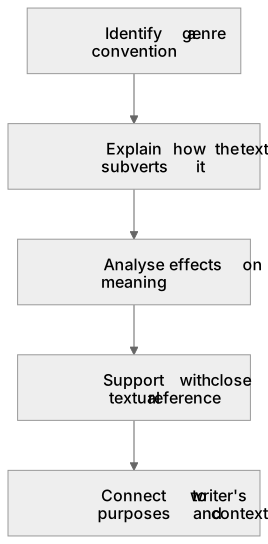
Put it in order
Put these steps in the order they happen.
- 1. Explain how the text subverts it
- 2. Analyse effects on meaning
- 3. Identify a genre convention
- 4. Connect to writer's purposes and context
- 5. Support with close textual reference
Key words
Say what each word means before you turn the card.
Subversion
Try answering aloud or in your head before turning the card.
Genre conventions
Try answering aloud or in your head before turning the card.
Writer’s purposes
Try answering aloud or in your head before turning the card.
Reader response
Try answering aloud or in your head before turning the card.
See every definition
- Subversion
- Rejecting, reversing, parodying or hybridising established features of the genre in which a writer is writing.
- Genre conventions
- Established features of a genre which writers do not simply follow but frequently subvert.
- Writer’s purposes
- What the writer may be aiming to achieve, to which subversion can be linked to strengthen interpretation.
- Reader response
- The effect on the reader, which should be considered when analysing how a text departs from conventional expectation.
Label the diagram
Some boxes have lost their names. Pick the right name for each number.
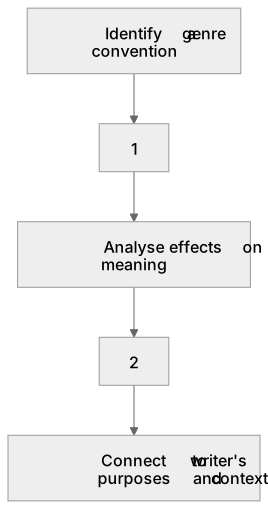
1Box 1
2Box 2
There is more to this lesson
The full lesson goes on to check your understanding and help you earn the marks. Create a free account to carry on, with your progress saved.
A week of Premium from your first lesson · Then the free plan continues · No card, no charge
Test your understanding of Subject content – A-level: Indeed, the specification takes into account the fact that writers often subvert the genre in which they are writing.
Active recall beats re-reading. Take an instant quiz now to test what you’ve learned and lock it into long-term memory.
A week of Premium from your first lesson · Then the free plan continues · No card, no charge