AQA · A-Level · English Literature
Course version: 7717 · Version from Sept 2026
Working with genre involves looking at ways in which authors shape…
Full specification wording
Subject content – A-level: Working with genre involves looking at ways in which authors shape meanings within their texts.
Working with genre means examining how authors use, adapt and manipulate generic conventions to shape meaning.
Checked against the AQA 7717 specification (opens in a new tab) on .
- Point 4 of 9
- 4 key terms
Study notes
From the checked teaching notes for this specification point.
The idea
Working with genre means examining how authors use, adapt and manipulate generic conventions to shape meaning. You should not treat genre as a simple label; instead, analyse how specific choices of form, structure and language create, reinforce or challenge expectations. For example, an author might use the conventions of Gothic doubling to explore identity, or deploy a sonnet’s volta to pivot an argument. Effective analysis moves from identifying a convention to explaining how it produces particular effects, such as tension, sympathy or ambiguity. The specification expects you to consider authorial shaping, so your responses should connect textual details to the meanings they generate and to the author’s possible intentions.
What earns the marks
- Identify a generic convention or feature and explain how it operates within the text, such as a first-person narrator in a ghost story.
- Analyse how the author uses that convention to shape meaning, for example by controlling information to create suspense or irony.
- Examine how form, structure and language choices work together to produce effects associated with the genre.
- Consider how the author’s shaping of genre influences the reader’s response, such as challenging assumptions or eliciting empathy.
- Relate the author’s shaping of meaning to relevant contextual factors or literary traditions without losing focus on the text.
Common mistakes and how to put them right
Listing genre features without explaining how they shape meaning.
Put it right: Analyse the effect of each feature on the text’s themes or reader response.
Confusing genre with plot type alone.
Put it right: Consider form, structure, language and stylistic conventions as well.
Ignoring the author’s active role and treating genre as a fixed container.
Put it right: Show how the author selects, combines or transforms conventions.
Exam tips
- Use the wording of the question to frame your argument around authorial shaping, for example ‘the author shapes meaning by…’.
- Select two or three key moments where generic conventions are most clearly at work, and analyse them in depth rather than surveying the whole text.
- Link your analysis of genre to the assessment objectives by discussing writer’s methods and the effects of those methods on meaning.
Try the lesson
The start of the Subject content – A-level: Working with genre involves looking at ways in which authors shape meanings within their texts. lesson, made from checked teaching notes for this specification point.
Have a go first
When working with literary genre, what is the primary purpose of analysing how a text engages with generic conventions?
Listen
Working with genre means examining how authors use, adapt and manipulate generic conventions to shape meaning. You should not treat genre as a simple label; instead, analyse how specific choices of form, structure and language create, reinforce or challenge expectations. For example, an author might use the conventions of Gothic doubling to explore identity, or deploy a sonnet’s volta to pivot an argument. Effective analysis moves from identifying a convention to explaining how it produces particular effects, such as tension, sympathy or ambiguity. The specification expects you to consider authorial shaping, so your responses should connect textual details to the meanings they generate and to the author’s possible intentions. A strong answer earns marks for these points. Identify a generic convention or feature and explain how it operates within the text, such as a first-person narrator in a ghost story. Analyse how the author uses that convention to shape meaning, for example by controlling information to create suspense or irony. Examine how form, structure and language choices work together to produce effects associated with the genre. Consider how the author’s shaping of genre influences the reader’s response, such as challenging assumptions or eliciting empathy. A common slip: Listing genre features without explaining how they shape meaning. Instead, analyse the effect of each feature on the text’s themes or reader response. Exam tip: Use the wording of the question to frame your argument around authorial shaping, for example ‘the author shapes meaning by…
See it
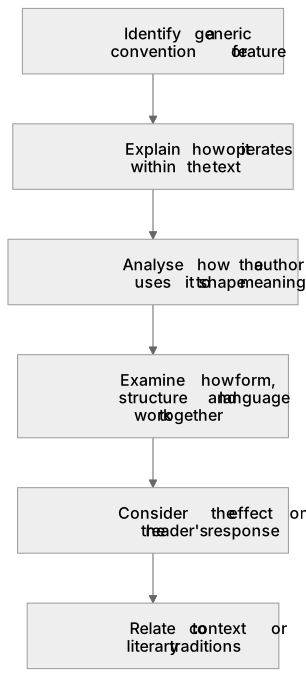
Put it in order
Put these steps in the order they happen.
- 1. Analyse how the author uses it to shape meaning
- 2. Explain how it operates within the text
- 3. Identify a generic convention or feature
- 4. Relate to context or literary traditions
- 5. Consider the effect on the reader's response
- 6. Examine how form, structure and language work together
Key words
Say what each word means before you turn the card.
Authorial shaping of meaning
Try answering aloud or in your head before turning the card.
Genre as a dynamic system of conventions
Try answering aloud or in your head before turning the card.
Form, structure and language
Try answering aloud or in your head before turning the card.
Reader response and interpretation
Try answering aloud or in your head before turning the card.
See every definition
- Authorial shaping of meaning
- The ways in which authors shape meanings within their texts, connecting textual details to the meanings they generate and to the author's possible intentions.
- Genre as a dynamic system of conventions
- Examining how authors use, adapt and manipulate generic conventions to shape meaning, rather than treating genre as a simple label or a fixed container.
- Form, structure and language
- Specific choices of form, structure and language that create, reinforce or challenge expectations, working together to produce effects associated with the genre.
- Reader response and interpretation
- How the author's shaping of genre influences the reader's response, such as challenging assumptions or eliciting empathy.
Label the diagram
Some boxes have lost their names. Pick the right name for each number.
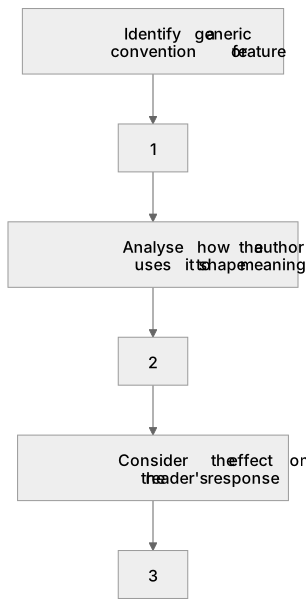
1Box 1
2Box 2
3Box 3
There is more to this lesson
The full lesson goes on to check your understanding and help you earn the marks. Create a free account to carry on, with your progress saved.
A week of Premium from your first lesson · Then the free plan continues · No card, no charge
Test your understanding of Subject content – A-level: Working with genre involves looking at ways in which authors shape meanings within their texts.
Active recall beats re-reading. Take an instant quiz now to test what you’ve learned and lock it into long-term memory.
A week of Premium from your first lesson · Then the free plan continues · No card, no charge