AQA · A-Level · English Literature
Course version: 7717 · Version from Sept 2026
Looking at texts as generic works involves connecting individual texts…
Full specification wording
Subject content – A-level: Looking at texts as generic works involves connecting individual texts with others, as the whole idea of genre is a connective one.
Genre study is comparative by nature.
Checked against the AQA 7717 specification (opens in a new tab) on .
- Point 6 of 9
- 4 key terms
Study notes
From the checked teaching notes for this specification point.
The idea
Genre study is comparative by nature. To read a text generically is to place it beside others that share conventions, motifs or modes, and to ask what it borrows, adapts or rejects. A student might set a tragedy against classical models to show how it follows the fall of a noble figure yet bends the pattern, or compare two crime novels to show how one keeps the detective's restoration of order while another denies it. The connective work is the point: genre is not a label to stick on a text but a relationship between texts. Analysis should therefore name shared features, cite specific moments, and judge how far the text conforms, innovates or blends genres.
What earns the marks
- Places a text in relation to at least one other text or recognised generic tradition.
- Identifies specific conventions, motifs or structural patterns shared or varied.
- Uses textual evidence from both texts to support the comparison.
- Judges degrees of conformity, adaptation or hybridity rather than labelling.
- Explains how generic expectations shape a reader's response.
Common mistakes and how to put them right
Listing genre features without comparing texts.
Put it right by pairing each feature with a second text.
Treating genre as a fixed box.
Put it right by discussing variation, blending and challenge.
Comparing plots only; correct by comparing form, structure and language too.
Exam tips
- Choose comparison texts you know well enough to quote or cite precisely.
- Use connectives such as 'whereas' and 'similarly' to keep the comparison explicit.
- Return to how generic expectation affects meaning, not just similarity.
Try the lesson
The start of the Subject content – A-level: Looking at texts as generic works involves connecting individual texts with others, as the whole idea of genre is a connective one. lesson, made from checked teaching notes for this specification point.
Have a go first
A student is comparing the use of a 'fatal flaw' in a modern play with its use in Shakespearean drama. How does this approach reflect the concept of genre?
Listen
Genre study is comparative by nature. To read a text generically is to place it beside others that share conventions, motifs or modes, and to ask what it borrows, adapts or rejects. A student might set a tragedy against classical models to show how it follows the fall of a noble figure yet bends the pattern, or compare two crime novels to show how one keeps the detective's restoration of order while another denies it. The connective work is the point: genre is not a label to stick on a text but a relationship between texts. Analysis should therefore name shared features, cite specific moments, and judge how far the text conforms, innovates or blends genres. A strong answer earns marks for these points. Places a text in relation to at least one other text or recognised generic tradition. Identifies specific conventions, motifs or structural patterns shared or varied. Uses textual evidence from both texts to support the comparison. Judges degrees of conformity, adaptation or hybridity rather than labelling. A common slip: Listing genre features without comparing texts. Instead, pairing each feature with a second text. Exam tip: Choose comparison texts you know well enough to quote or cite precisely.
See it
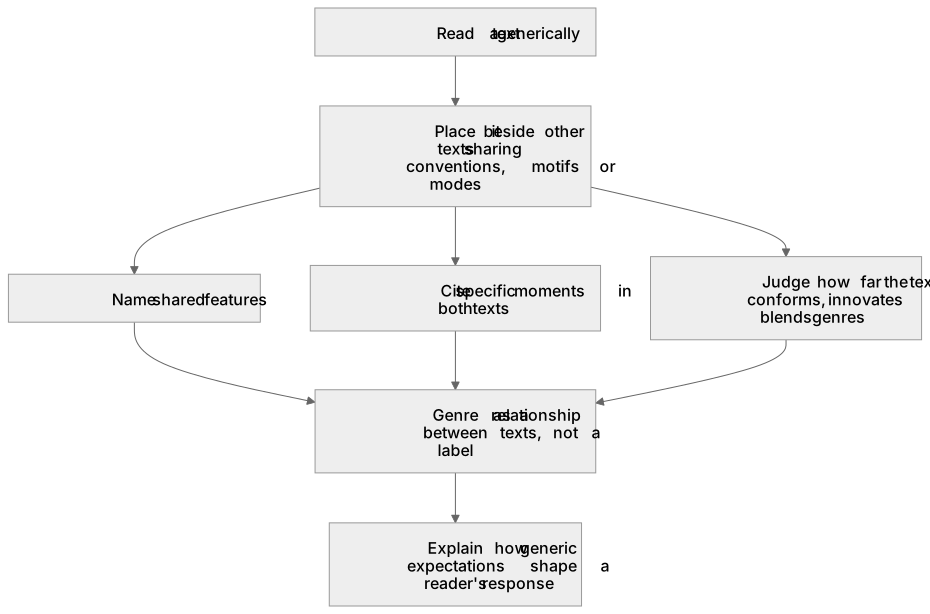
Key words
Say what each word means before you turn the card.
Genre as connection
Try answering aloud or in your head before turning the card.
Comparative analysis
Try answering aloud or in your head before turning the card.
Reader expectation
Try answering aloud or in your head before turning the card.
Convention and innovation
Try answering aloud or in your head before turning the card.
See every definition
- Genre as connection
- The whole idea of genre is a connective one, connecting individual texts with others.
- Comparative analysis
- Genre study is comparative by nature, placing a text beside others that share conventions, motifs or modes.
- Reader expectation
- Generic expectations shape a reader's response and how genre shapes interpretation.
- Convention and innovation
- Analysis should judge how far the text conforms, innovates or blends genres rather than labelling.
Label the diagram
Some boxes have lost their names. Pick the right name for each number.
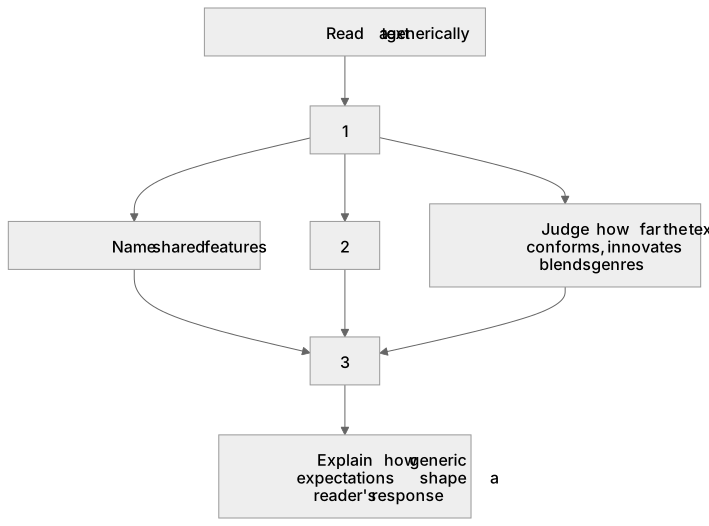
1Box 1
2Box 2
3Box 3
There is more to this lesson
The full lesson goes on to check your understanding and help you earn the marks. Create a free account to carry on, with your progress saved.
A week of Premium from your first lesson · Then the free plan continues · No card, no charge
Test your understanding of Subject content – A-level: Looking at texts as generic works involves connecting individual texts with others, as the whole idea of genre is a connective one.
Active recall beats re-reading. Take an instant quiz now to test what you’ve learned and lock it into long-term memory.
A week of Premium from your first lesson · Then the free plan continues · No card, no charge