AQA · A-Level · English Literature
Course version: 7717 · Version from Sept 2026
And finally, because genres and their qualities are not fixed, this means…
Full specification wording
Subject content – A-level: And finally, because genres and their qualities are not fixed, this means that interpretation is not fixed, and that multiple interpretations are possible.
Genre is best understood as a set of shifting conventions rather than a fixed container.
Checked against the AQA 7717 specification (opens in a new tab) on .
- Point 7 of 9
- 4 key terms
Study notes
From the checked teaching notes for this specification point.
The idea
Genre is best understood as a set of shifting conventions rather than a fixed container. Because those conventions change across time, culture and medium, the qualities we attach to a genre are provisional, so meaning cannot be settled once and for all. A text may be read as tragedy by one reader and as domestic realism by another, and both readings can be defended from the text. This does not mean 'anything goes': interpretations must be grounded in textual evidence, contextual awareness and theoretical framing. The consequence is that interpretation is plural and provisional, and that different critical positions can coexist.
What earns the marks
- Explains that genre qualities are conventions shaped by historical and cultural change rather than permanent essences.
- Shows how unstable genre boundaries produce more than one defensible reading of the same text.
- Requires interpretations to be supported by close textual reference, not asserted as personal preference.
- Distinguishes plural interpretation from relativism by demanding reasoned evaluation of competing readings.
- Connects genre theory to the act of constructing an argument in an essay or extract-based response.
Common mistakes and how to put them right
Treating genre as a fixed checklist and then forcing the text to fit it.
Put it right: Treat genre markers as prompts for debate about how the text conforms, adapts or resists them.
Claiming that because interpretations differ, all readings are equally valid.
Put it right: Rank readings by the quality and range of textual and contextual evidence.
Offering a single reading and ignoring alternatives.
Put it right: Acknowledge at least one competing interpretation and explain why your reading is stronger.
Exam tips
- Anchor every interpretive claim to a short quotation or precise structural detail so plurality stays evidence-based.
- Use comparative phrasing such as 'a tragic reading emphasises X, whereas a realist reading foregrounds Y' to show awareness of multiple positions.
- Reserve time to evaluate the implications of your reading rather than simply listing genre features.
Try the lesson
The start of the Subject content – A-level: And finally, because genres and their qualities are not fixed, this means that interpretation is not fixed, and that multiple interpretations are possible. lesson, made from checked teaching notes for this specification point.
Have a go first
In the context of literary study, why is it possible to have multiple valid interpretations of a text?
Listen
Genre is best understood as a set of shifting conventions rather than a fixed container. Because those conventions change across time, culture and medium, the qualities we attach to a genre are provisional, so meaning cannot be settled once and for all. A text may be read as tragedy by one reader and as domestic realism by another, and both readings can be defended from the text. This does not mean 'anything goes': interpretations must be grounded in textual evidence, contextual awareness and theoretical framing. The consequence is that interpretation is plural and provisional, and that different critical positions can coexist. A strong answer earns marks for these points. Explains that genre qualities are conventions shaped by historical and cultural change rather than permanent essences. Shows how unstable genre boundaries produce more than one defensible reading of the same text. Requires interpretations to be supported by close textual reference, not asserted as personal preference. Distinguishes plural interpretation from relativism by demanding reasoned evaluation of competing readings. A common slip: Treating genre as a fixed checklist and then forcing the text to fit it. Instead, treat genre markers as prompts for debate about how the text conforms, adapts or resists them. Exam tip: Anchor every interpretive claim to a short quotation or precise structural detail so plurality stays evidence-based.
See it
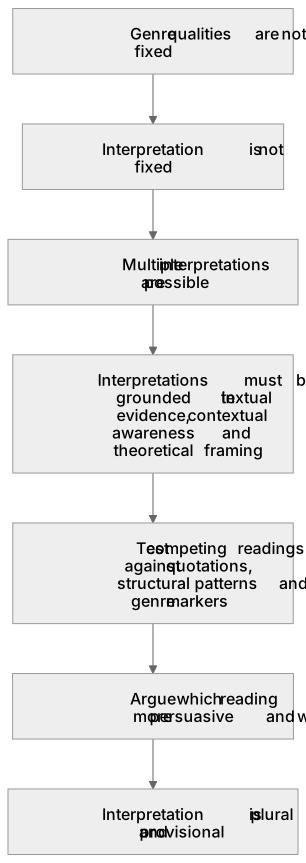
Put it in order
Put these steps in the order they happen.
- 1. Interpretation is plural and provisional
- 2. Argue which reading is more persuasive and why
- 3. Multiple interpretations are possible
- 4. Test competing readings against quotations, structural patterns and genre markers
- 5. Genre qualities are not fixed
- 6. Interpretation is not fixed
- 7. Interpretations must be grounded in textual evidence, contextual awareness and theoretical framing
Key words
Say what each word means before you turn the card.
Genre as social and historical convention
Try answering aloud or in your head before turning the card.
Plurality of interpretation
Try answering aloud or in your head before turning the card.
Textual evidence and warrant
Try answering aloud or in your head before turning the card.
Critical evaluation and argument
Try answering aloud or in your head before turning the card.
See every definition
- Genre as social and historical convention
- A set of shifting conventions rather than a fixed container, shaped by historical and cultural change rather than permanent essences.
- Plurality of interpretation
- The consequence that interpretation is not fixed and that multiple interpretations are possible, with different critical positions able to coexist.
- Textual evidence and warrant
- Interpretations must be grounded in textual evidence, contextual awareness and theoretical framing, tested against specific quotations, structural patterns and genre markers.
- Critical evaluation and argument
- Competing readings are argued over, with reasoned evaluation of which reading is more persuasive and why, distinguishing plural interpretation from relativism.
Label the diagram
Some boxes have lost their names. Pick the right name for each number.
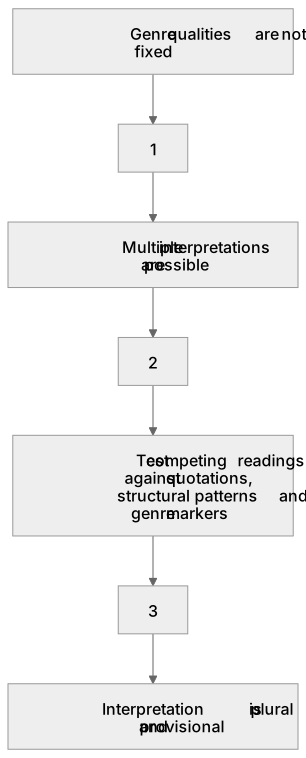
1Box 1
2Box 2
3Box 3
There is more to this lesson
The full lesson goes on to check your understanding and help you earn the marks. Create a free account to carry on, with your progress saved.
A week of Premium from your first lesson · Then the free plan continues · No card, no charge
Test your understanding of Subject content – A-level: And finally, because genres and their qualities are not fixed, this means that interpretation is not fixed, and that multiple interpretations are possible.
Active recall beats re-reading. Take an instant quiz now to test what you’ve learned and lock it into long-term memory.
A week of Premium from your first lesson · Then the free plan continues · No card, no charge