AQA · A-Level · English Literature
Course version: 7717 · Version from Sept 2026
This component is designed to allow students to read widely, to choose…
Full specification wording
Theory and independence: This component is designed to allow students to read widely, to choose their own texts (if appropriate) and to understand that contemporary study of literature needs to be informed by the fact that different theoretical and critical methods can be applied to the subject.
Theory and independence asks you to read beyond the set texts and to see criticism as a toolkit rather than a verdict.
Checked against the AQA 7717 specification (opens in a new tab) on .
- Point 1 of 3
- 4 key terms
Study notes
From the checked teaching notes for this specification point.
The idea
Theory and independence asks you to read beyond the set texts and to see criticism as a toolkit rather than a verdict. You read widely: poetry, prose, drama, non-fiction, across periods and voices, so your sense of the literary field widens. Where the brief allows, you choose your own texts, which builds ownership and lets you pursue genuine interests. Crucially, you learn that contemporary study is informed by the fact that different theoretical and critical methods can be applied: feminist, Marxist, psychoanalytic, postcolonial, ecocritical, narrative and others. Applying a method means asking what it foregrounds and what it silences. For example, reading a novel through a feminist lens might examine how domestic space is gendered, while a Marxist reading might trace who profits. Neither is simply 'right'; each is a disciplined way of generating interpretation.
What earns the marks
- Wide reading is evidenced by range across form, period and voice, not by listing titles; annotations should show what each text taught you about reading.
- Text choice, where permitted, must be justified in terms of the critical question you want to pursue, not merely personal enjoyment.
- Understanding that contemporary study is informed by theoretical and critical methods means naming a method and showing how it shapes interpretation.
- Applying a method involves selecting textual detail that the method makes significant, then explaining the interpretive payoff and its limits.
- Independent study is assessed through sustained, self-directed argument that connects primary texts with critical reading rather than through coverage alone.
Common mistakes and how to put them right
Treating theory as a label to attach to a text, for example announcing a feminist reading without showing how gender shapes specific language choices.
Put it right by anchoring each claim in quotation and analysis.
Choosing texts only because they are short or familiar, which weakens the independent study.
Put it right by selecting texts that genuinely open up your critical question.
Assuming one method gives the complete truth about a text.
Put it right by acknowledging what your chosen lens overlooks and what another lens might reveal.
Exam tips
- Keep a reading log that records, for each text, one method it rewards and one passage that method illuminates.
- In independent work, state your critical approach early, then let analysis, not assertion, carry the argument.
- Practise comparing two readings of the same passage so you can discuss how method changes interpretation.
Try the lesson
The start of the Theory and independence: This component is designed to allow students to read widely, to choose their own texts (if appropriate) and to understand that contemporary study of literature needs to be informed by the fact that different theoretical and critical methods can be applied to the subject. lesson, made from checked teaching notes for this specification point.
Have a go first
When applying a Marxist critical method to a literary text, which of the following aspects is a reader most likely to focus on?
Listen
Theory and independence asks you to read beyond the set texts and to see criticism as a toolkit rather than a verdict. You read widely: poetry, prose, drama, non-fiction, across periods and voices, so your sense of the literary field widens. Where the brief allows, you choose your own texts, which builds ownership and lets you pursue genuine interests. Crucially, you learn that contemporary study is informed by the fact that different theoretical and critical methods can be applied: feminist, Marxist, psychoanalytic, postcolonial, ecocritical, narrative and others. Applying a method means asking what it foregrounds and what it silences. For example, reading a novel through a feminist lens might examine how domestic space is gendered, while a Marxist reading might trace who profits. Neither is simply 'right'; each is a disciplined way of generating interpretation. A strong answer earns marks for these points. Wide reading is evidenced by range across form, period and voice, not by listing titles; annotations should show what each text taught you about reading. Text choice, where permitted, must be justified in terms of the critical question you want to pursue, not merely personal enjoyment. Understanding that contemporary study is informed by theoretical and critical methods means naming a method and showing how it shapes interpretation. Applying a method involves selecting textual detail that the method makes significant, then explaining the interpretive payoff and its limits. A common slip: Treating theory as a label to attach to a text, for example announcing a feminist reading without showing how gender shapes specific language choices. Instead, anchoring each claim in quotation and analysis. Exam tip: Keep a reading log that records, for each text, one method it rewards and one passage that method illuminates.
See it
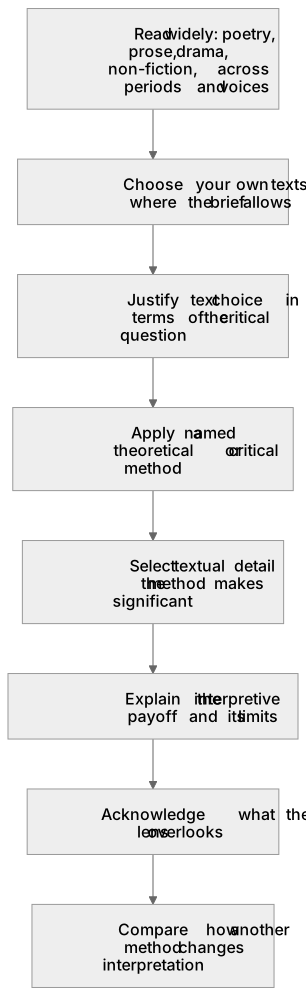
Put it in order
Put these steps in the order they happen.
- 1. Select textual detail the method makes significant
- 2. Compare how another method changes interpretation
- 3. Explain the interpretive payoff and its limits
- 4. Read widely: poetry, prose, drama, non-fiction, across periods and voices
- 5. Choose your own texts where the brief allows
- 6. Acknowledge what the lens overlooks
- 7. Justify text choice in terms of the critical question
- 8. Apply a named theoretical or critical method
Key words
Say what each word means before you turn the card.
Wide and independent reading
Try answering aloud or in your head before turning the card.
Critical and theoretical methods
Try answering aloud or in your head before turning the card.
Interpretive plurality
Try answering aloud or in your head before turning the card.
Textual analysis and evidence
Try answering aloud or in your head before turning the card.
See every definition
- Wide and independent reading
- Reading beyond the set texts across poetry, prose, drama and non-fiction, across periods and voices, so your sense of the literary field widens.
- Critical and theoretical methods
- Approaches such as feminist, Marxist, psychoanalytic, postcolonial, ecocritical and narrative that can be applied to the subject, each a disciplined way of generating interpretation.
- Interpretive plurality
- The understanding that neither reading is simply 'right', since each method is a disciplined way of generating interpretation and one method does not give the complete truth about a text.
- Textual analysis and evidence
- Selecting textual detail that a method makes significant, then explaining the interpretive payoff and its limits, anchoring each claim in quotation and analysis.
Label the diagram
Some boxes have lost their names. Pick the right name for each number.
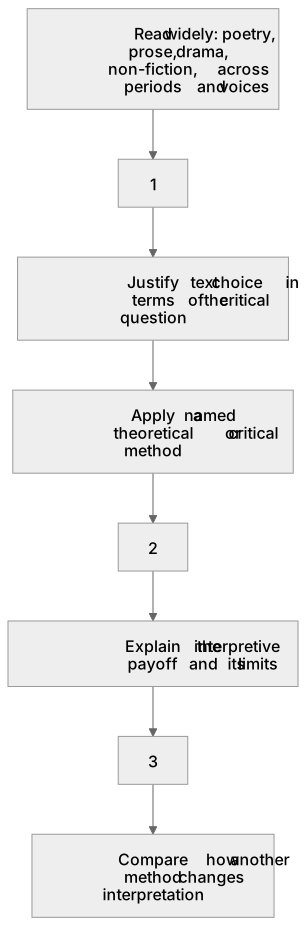
1Box 1
2Box 2
3Box 3
There is more to this lesson
The full lesson goes on to check your understanding and help you earn the marks. Create a free account to carry on, with your progress saved.
A week of Premium from your first lesson · Then the free plan continues · No card, no charge
Test your understanding of Theory and independence: This component is designed to allow students to read widely, to choose their own texts (if appropriate) and to understand that contemporary study of literature needs to be informed by the fact that different theoretical and critical methods can be applied to the subject.
Active recall beats re-reading. Take an instant quiz now to test what you’ve learned and lock it into long-term memory.
A week of Premium from your first lesson · Then the free plan continues · No card, no charge