AQA · A-Level · English Literature
Course version: 7717 · Version from Sept 2026
This process is supported by the AQA Critical anthology, which has…
Full specification wording
Theory and independence: This process is supported by the AQA Critical anthology, which has accessible extracts on the following critical methods and ideas: narrative theory, feminist theory, Marxist theory, eco-critical theory, post-colonial theory, literary value and the canon.
The AQA Critical anthology is a set resource that supports your independent study by providing accessible extracts on seven critical approaches: narrative theory, feminist theory, Marxist theory,…
Checked against the AQA 7717 specification (opens in a new tab) on .
- Point 2 of 3
- 3 key terms
Study notes
From the checked teaching notes for this specification point.
The idea
The AQA Critical anthology is a set resource that supports your independent study by providing accessible extracts on seven critical approaches: narrative theory, feminist theory, Marxist theory, eco-critical theory, post-colonial theory, literary value and the canon. You use these extracts to develop your own critical reading of your chosen texts. For example, after reading a feminist extract, you might analyse how a poem presents gender roles, or after reading a Marxist extract, you might examine how a novel represents class conflict. The anthology is not a set of answers but a toolkit: you select ideas, apply them to your texts, and evaluate how well they fit. This process means reading critically, selecting relevant concepts, and integrating them into your argument. Assessment focuses on your ability to apply critical ideas independently and to write coherently about your texts.
What earns the marks
- Demonstrates understanding of at least one critical method from the anthology and applies it accurately to a chosen text.
- Uses critical ideas to illuminate specific textual details rather than making general statements.
- Shows awareness that critical methods are interpretive lenses, not fixed truths, and can be evaluated.
- Integrates critical concepts into a coherent argument about the text, maintaining focus on the literary text itself.
- References the anthology or critical ideas appropriately to support independent interpretation.
Common mistakes and how to put them right
Summarising a critical extract without linking it to the chosen text.
Put it right: Connect the critical idea to specific words, images, or structural features in the text.
Treating a critical method as the only correct interpretation.
Put it right: Present it as one possible reading and consider its strengths and limitations.
Using critical terminology without explaining it.
Put it right: Briefly define or explain the concept in your own words before applying it.
Exam tips
- Choose critical extracts that genuinely interest you; your engagement will be more convincing and easier to write about.
- Plan how each critical idea will support your overall argument before you start writing.
- Use precise textual evidence to anchor your critical interpretation; avoid vague references.
Try the lesson
The start of the Theory and independence: This process is supported by the AQA Critical anthology, which has accessible extracts on the following critical methods and ideas: narrative theory, feminist theory, Marxist theory, eco-critical theory, post-colonial theory, literary value and the canon. lesson, made from checked teaching notes for this specification point.
Have a go first
Which critical method in the AQA Critical anthology examines how stories are structured and how narrators shape what readers are told?
Listen
The AQA Critical anthology is a set resource that supports your independent study by providing accessible extracts on seven critical approaches: narrative theory, feminist theory, Marxist theory, eco-critical theory, post-colonial theory, literary value and the canon. You use these extracts to develop your own critical reading of your chosen texts. For example, after reading a feminist extract, you might analyse how a poem presents gender roles, or after reading a Marxist extract, you might examine how a novel represents class conflict. The anthology is not a set of answers but a toolkit: you select ideas, apply them to your texts, and evaluate how well they fit. This process means reading critically, selecting relevant concepts, and integrating them into your argument. Assessment focuses on your ability to apply critical ideas independently and to write coherently about your texts. A strong answer earns marks for these points. Demonstrates understanding of at least one critical method from the anthology and applies it accurately to a chosen text. Uses critical ideas to illuminate specific textual details rather than making general statements. Shows awareness that critical methods are interpretive lenses, not fixed truths, and can be evaluated. Integrates critical concepts into a coherent argument about the text, maintaining focus on the literary text itself. A common slip: summarising a critical extract without linking it to the chosen text. Instead, connect the critical idea to specific words, images, or structural features in the text. Exam tip: Choose critical extracts that genuinely interest you; your engagement will be more convincing and easier to write about.
See it
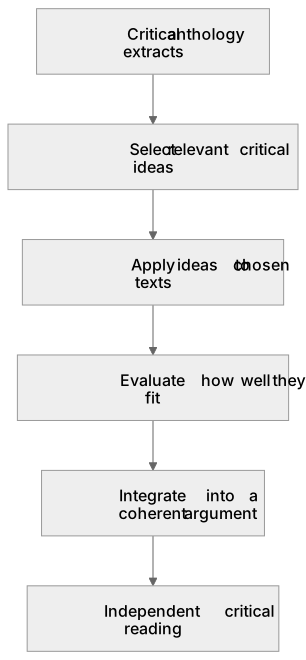
Put it in order
Put these steps in the order they happen.
- 1. Apply ideas to chosen texts
- 2. Select relevant critical ideas
- 3. Critical anthology extracts
- 4. Independent critical reading
- 5. Integrate into a coherent argument
- 6. Evaluate how well they fit
Key words
Say what each word means before you turn the card.
Critical interpretation
Try answering aloud or in your head before turning the card.
Independent reading
Try answering aloud or in your head before turning the card.
Application of theory
Try answering aloud or in your head before turning the card.
See every definition
- Critical interpretation
- A reading of a text shaped by ideas selected from the Critical anthology and applied to the text.
- Independent reading
- Developing your own critical reading of your chosen texts using extracts from the anthology.
- Application of theory
- Selecting ideas from the anthology, applying them to your texts, and evaluating how well they fit.
Label the diagram
Some boxes have lost their names. Pick the right name for each number.
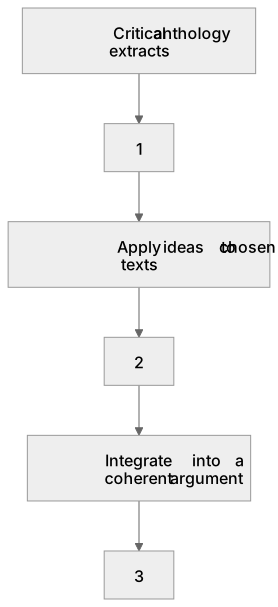
1Box 1
2Box 2
3Box 3
There is more to this lesson
The full lesson goes on to check your understanding and help you earn the marks. Create a free account to carry on, with your progress saved.
A week of Premium from your first lesson · Then the free plan continues · No card, no charge
Test your understanding of Theory and independence: This process is supported by the AQA Critical anthology, which has accessible extracts on the following critical methods and ideas: narrative theory, feminist theory, Marxist theory, eco-critical theory, post-colonial theory, literary value and the canon.
Active recall beats re-reading. Take an instant quiz now to test what you’ve learned and lock it into long-term memory.
A week of Premium from your first lesson · Then the free plan continues · No card, no charge