AQA · GCSE · English Literature
A Christmas Carol
A Christmas Carol is a powerful moral fable that explores the consequences of greed and the redemptive power of compassion. Studying this novella offers rich opportunities to analyse Dickens's masterful use of allegory, structural motifs, and sharp social commentary on Victorian poverty.
- 8 min read
- 2 worked examples
- 4 practice questions
- 8 key terms
Study Notes
Overview
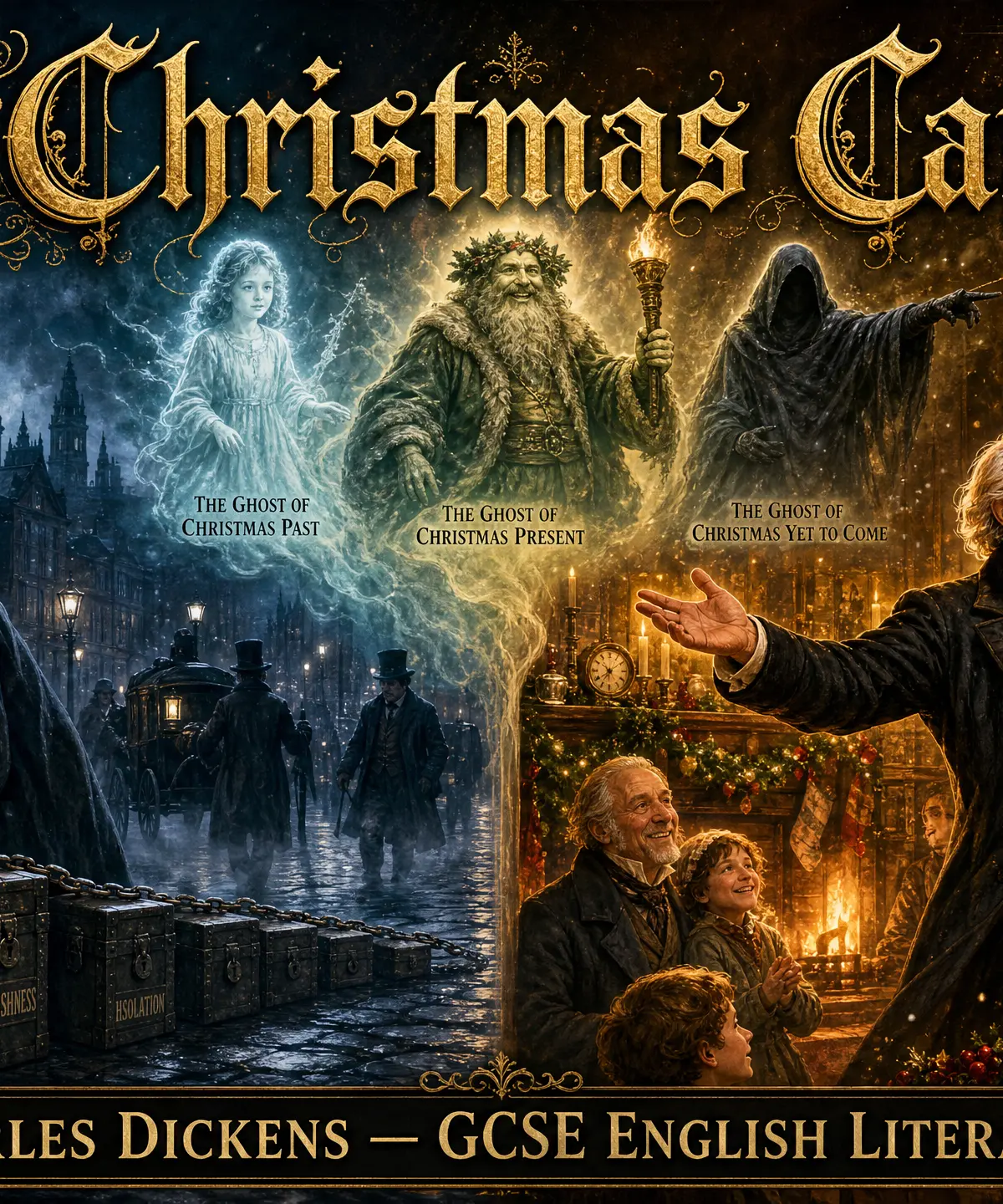
Charles Dickens's A Christmas Carol (1843) is a foundational text for GCSE English Literature, offering profound insights into Victorian social attitudes, the consequences of unregulated capitalism, and the possibility of human redemption. Examiners consistently reward candidates who can move beyond character summary to analyse Dickens's allegorical methods, his deliberate structural choices (such as the five 'Staves'), and his impassioned critique of the 1834 Poor Law. A high-level response will treat the novella not just as a ghost story, but as a deliberate political intervention designed to awaken the conscience of its wealthy Victorian readership.
Listen to our revision podcast for an in-depth discussion of key themes and exam techniques:
Plot/Content Overview
- Stave 1: Marley's Ghost: We are introduced to Ebenezer Scrooge, a miserly misanthrope who rejects his nephew Fred's Christmas invitation and refuses to donate to charity. That night, he is visited by the chained ghost of his former partner, Jacob Marley, who warns him of his impending fate and announces the arrival of three spirits.
- Stave 2: The First of the Three Spirits: The Ghost of Christmas Past takes Scrooge to his childhood, revealing his solitary school days, the warmth of his former employer Fezziwig, and the heartbreaking moment his fiancée, Belle, leaves him because of his growing obsession with wealth.
- Stave 3: The Second of the Three Spirits: The Ghost of Christmas Present shows Scrooge the joy of Christmas across the city, focusing on the impoverished but loving Cratchit family and the fragile health of Tiny Tim. The spirit ends by revealing two horrific, allegorical children hidden beneath his robes: Ignorance and Want.
- Stave 4: The Last of the Spirits: The silent, terrifying Ghost of Christmas Yet to Come shows Scrooge the aftermath of his own unmourned death, the callousness of those stealing his belongings, and the devastating grief of the Cratchit family over the death of Tiny Tim. Scrooge begs for a chance to change.
- Stave 5: The End of It: Scrooge wakes up on Christmas morning, utterly transformed. He anonymously sends a prize turkey to the Cratchits, donates generously to charity, reconciles with Fred, and becomes a second father to Tiny Tim, who survives.
Themes
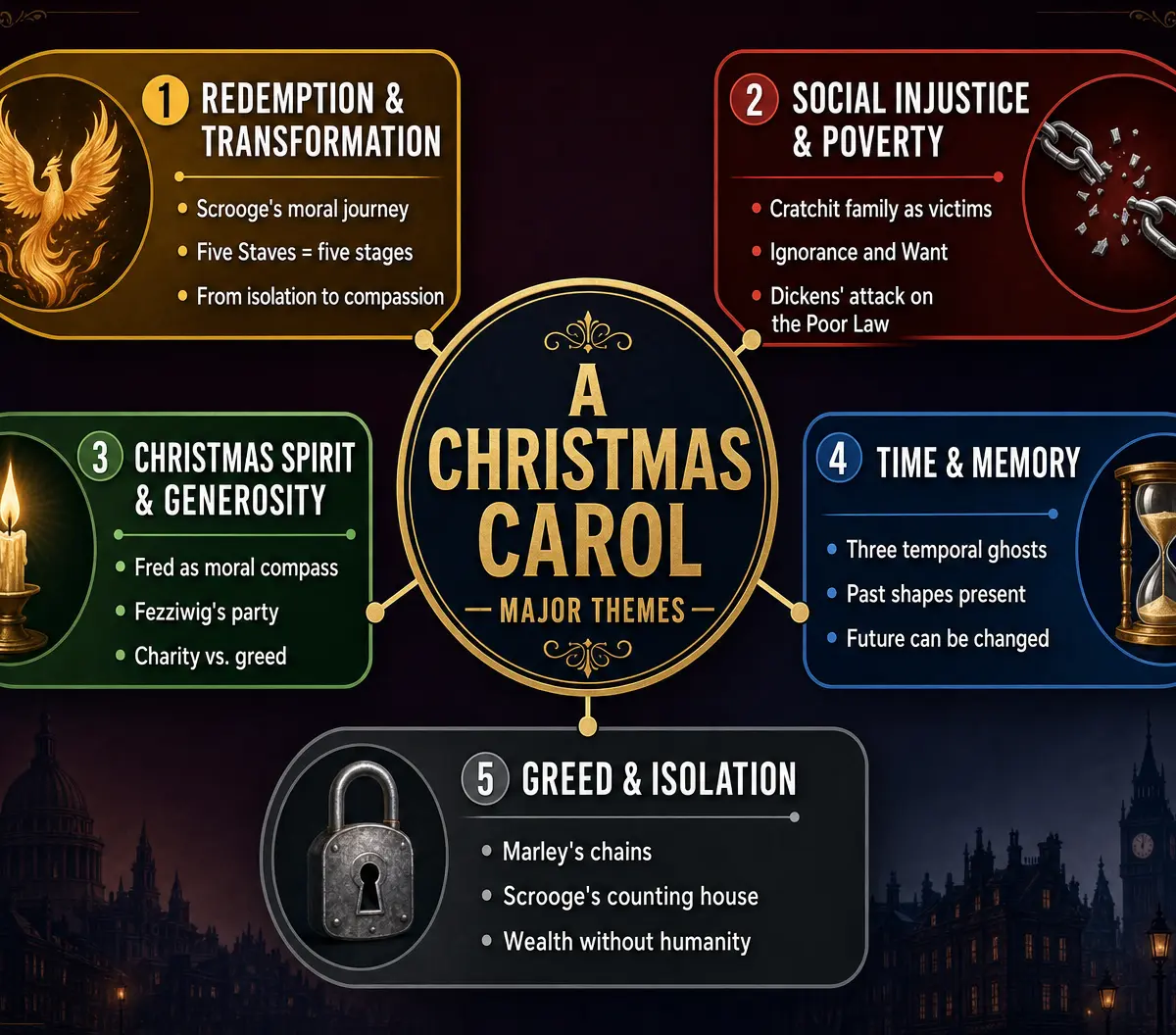
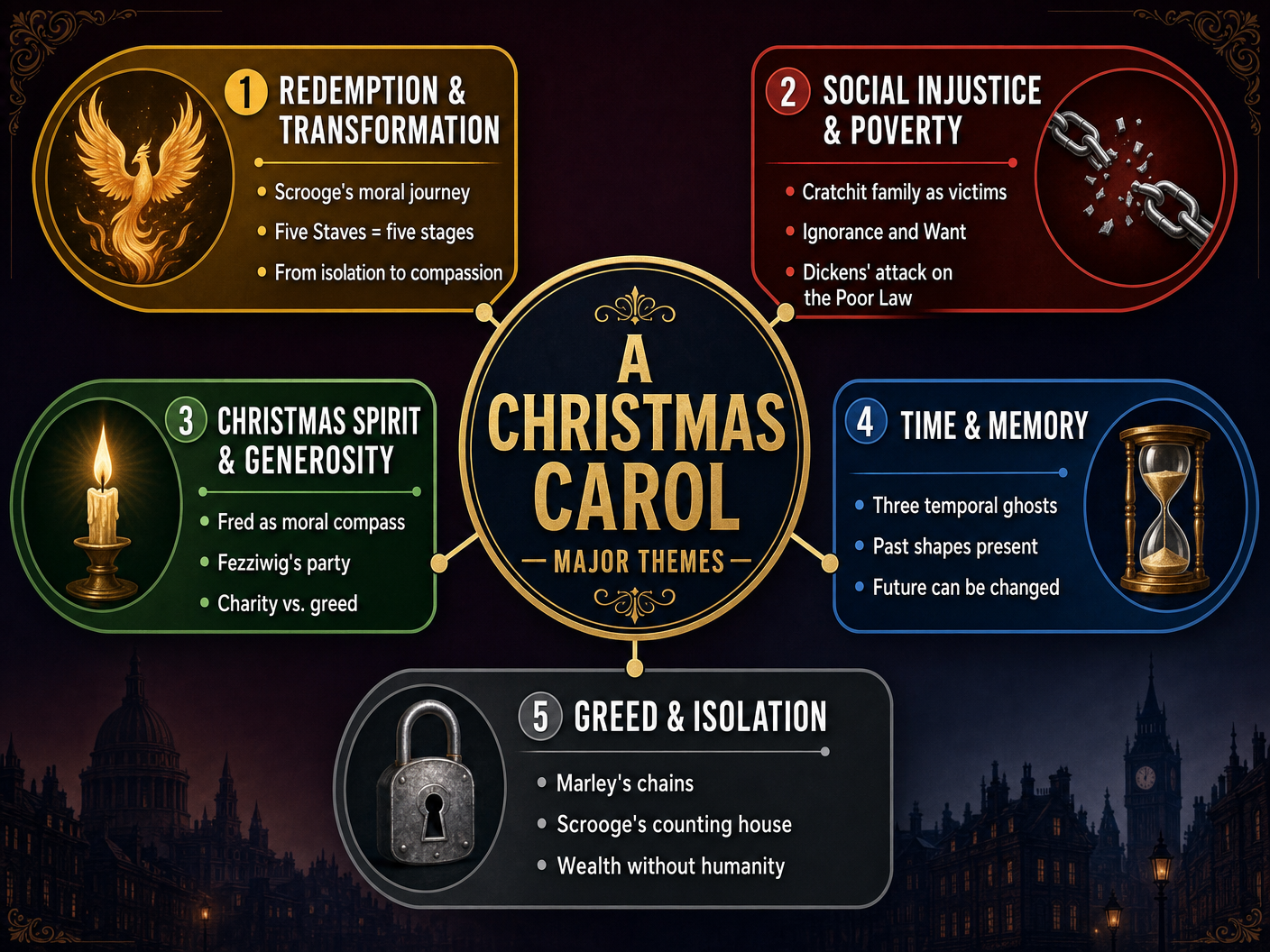
Theme 1: Redemption and Transformation
Dickens structures the entire novella around the possibility of change. Scrooge's journey from a "squeezing, wrenching, grasping" miser to a man who knows how to "keep Christmas well" is not presented as easy; it requires painful psychological confrontation with his past, present, and future. This theme asserts that no one is beyond saving, challenging the deterministic views of the era.
Key Quotes:
- "I wear the chain I forged in life." (Stave 1) - Marley's warning highlights that our actions have eternal consequences; the verb "forged" implies deliberate, continuous effort.
- "I am as light as a feather, I am as happy as an angel, I am as merry as a schoolboy." (Stave 5) - The accumulation of joyous similes in Stave 5 sharply contrasts with the heavy, restrictive imagery of Stave 1, symbolising his complete spiritual rebirth.
Theme 2: Social Injustice and Poverty
Dickens uses the text as a direct attack on the callousness of the wealthy elite and the cruelty of the 1834 Poor Law. He forces the reader to confront the human cost of poverty, arguing that the rich have a moral obligation to care for the destitute.
Key Quotes:
- "Are there no prisons?" / "And the Union workhouses?" (Stave 1) - Scrooge echoes the Malthusian and utilitarian rhetoric of the time, treating the poor as a surplus population rather than human beings.
- "This boy is Ignorance. This girl is Want. Beware them both..." (Stave 3) - The personification of social ills; Dickens warns that failing to educate and provide for the poor will lead to societal ruin (symbolised by the "Doom" written on the boy's brow).
Theme 3: The Christmas Spirit
For Dickens, Christmas is not merely a religious festival, but a time when people "open their shut-up hearts freely." It is a catalyst for generosity, community, and forgiveness, acting as an antidote to the isolation of greed.
Key Quotes:
- "...a good time; a kind, forgiving, charitable, pleasant time..." (Stave 1) - Fred's definition of Christmas establishes the moral benchmark against which Scrooge is judged.
- "He had the power to render us happy or unhappy; to make our service light or burdensome." (Stave 2) - Scrooge's reflection on Fezziwig demonstrates that true wealth lies in the ability to bring joy to others, regardless of the financial cost.
Character Analysis
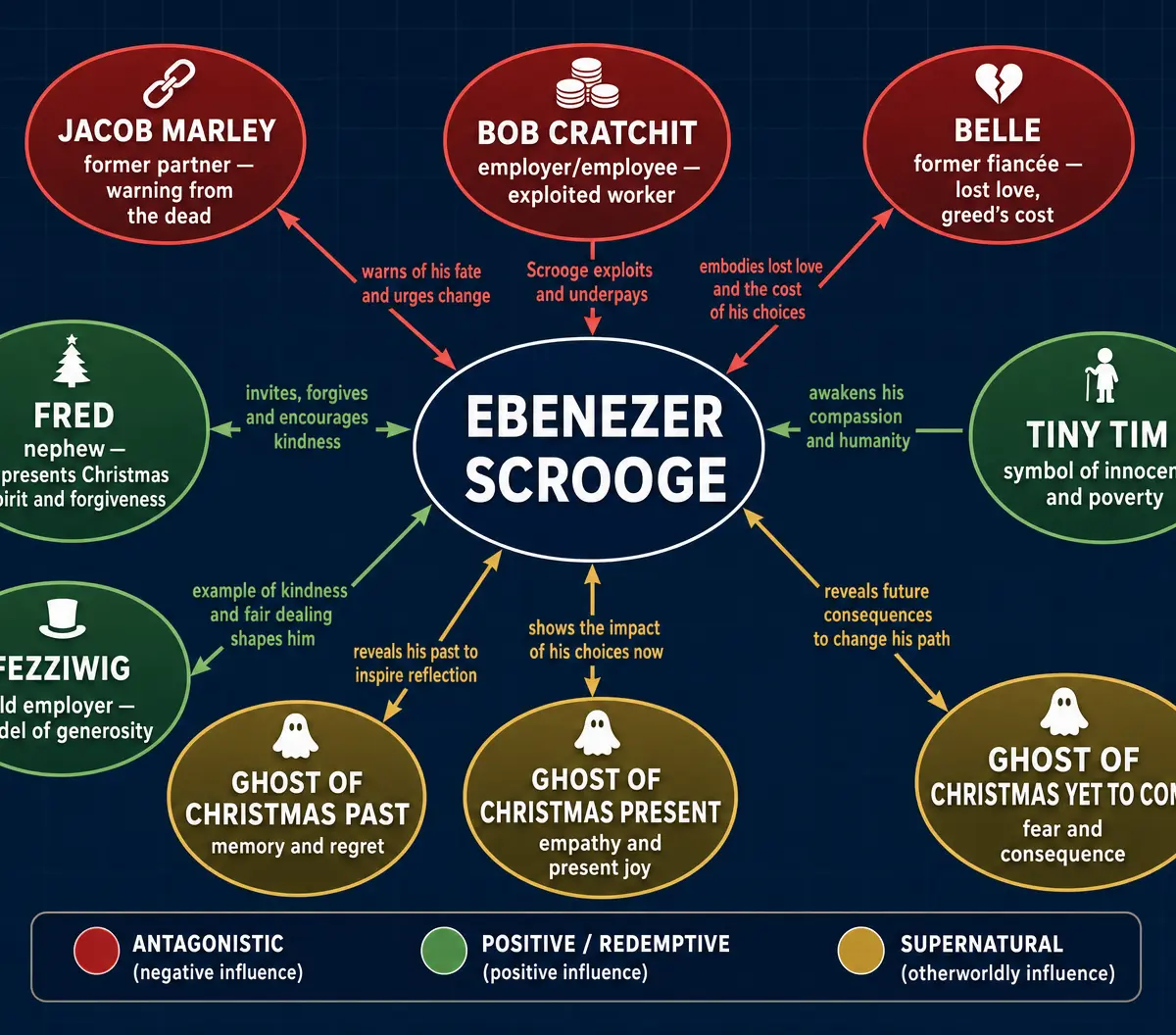
Ebenezer Scrooge
Role: The protagonist and the embodiment of Victorian capitalist greed.
Key Traits: Miserly, isolated, misanthropic, cold, rigid.
Character Arc: Moves from complete emotional and social isolation to becoming a benefactor and a central figure in the community.
Essential Quotes:
- "Hard and sharp as flint, from which no steel had ever struck out generous fire; secret, and self-contained, and solitary as an oyster." (Stave 1)
- "I will honour Christmas in my heart, and try to keep it all the year. I will live in the Past, the Present, and the Future." (Stave 4)
Bob Cratchit
Role: The exploited worker; represents the struggles and dignity of the working class.
Key Traits: Loyal, loving, resilient, grateful, impoverished.
Character Arc: Remains morally consistent throughout, but his material circumstances are transformed by Scrooge's redemption.
Essential Quotes:
- "The clerk, who cold as he was, was warmer than Scrooge; for he returned them cordially." (Stave 1)
- "I'll give you Mr. Scrooge, the Founder of the Feast!" (Stave 3)
The Ghosts (Past, Present, Yet to Come)
Role: Supernatural agents of change; allegorical figures representing memory, empathy, and consequence.
Key Traits: Past is ephemeral and illuminating; Present is abundant and joyful but carries a warning; Yet to Come is silent, dark, and terrifying.
Essential Quotes:
- Past: "Would you so soon put out, with worldly hands, the light I give?"
- Present: "Come in! and know me better, man!"
- Yet to Come: "The Spirit answered not, but pointed onward with its hand."
Writer's Methods
- Allegory and Symbolism: Dickens frequently uses characters and objects to represent abstract ideas. Marley's chains symbolise the burden of greed; Ignorance and Want represent the destructive forces of societal neglect; the changing weather (from dense fog to clear sunshine) mirrors Scrooge's psychological state.
- Narrative Voice: The intrusive, omniscient narrator frequently addresses the reader directly (e.g., "You will therefore permit me to repeat, emphatically, that Marley was as dead as a door-nail."). This conversational, sometimes ironic tone creates intimacy and guides the reader's moral judgment.
- Structure: The division into five 'Staves' links the novella to a musical carol, emphasising its intended function as a song of joy and redemption. The chronological journey (Past, Present, Future) provides a clear psychological framework for Scrooge's transformation.
- Contrast and Juxtaposition: Dickens constantly contrasts cold and warmth, light and dark, wealth and poverty (e.g., Scrooge's dark, cold house vs. the warm, bustling Cratchit household) to highlight moral differences.
Context
- The 1834 Poor Law: This legislation made poverty essentially a crime. Those unable to support themselves were forced into workhouses, where conditions were deliberately harsh to deter people from seeking help. Scrooge's initial support for these institutions reflects the harsh utilitarian views Dickens despised.
- Thomas Malthus: An economist who argued that population growth would outpace food supply, suggesting that famine and poverty were natural checks. Scrooge's comment about decreasing the "surplus population" is a direct attack on Malthusian theory.
- The 'Hungry Forties': The 1840s were a period of severe economic depression and social unrest in Britain. Dickens wrote the novella partly in response to a parliamentary report detailing the horrific conditions of child labour in mines and factories.
- The Victorian Christmas: Dickens is often credited with helping to popularise and shape the modern idea of Christmas—focusing on family gatherings, seasonal food, and charitable giving, rather than purely religious observance.
Visual Resources
2 diagrams and illustrations
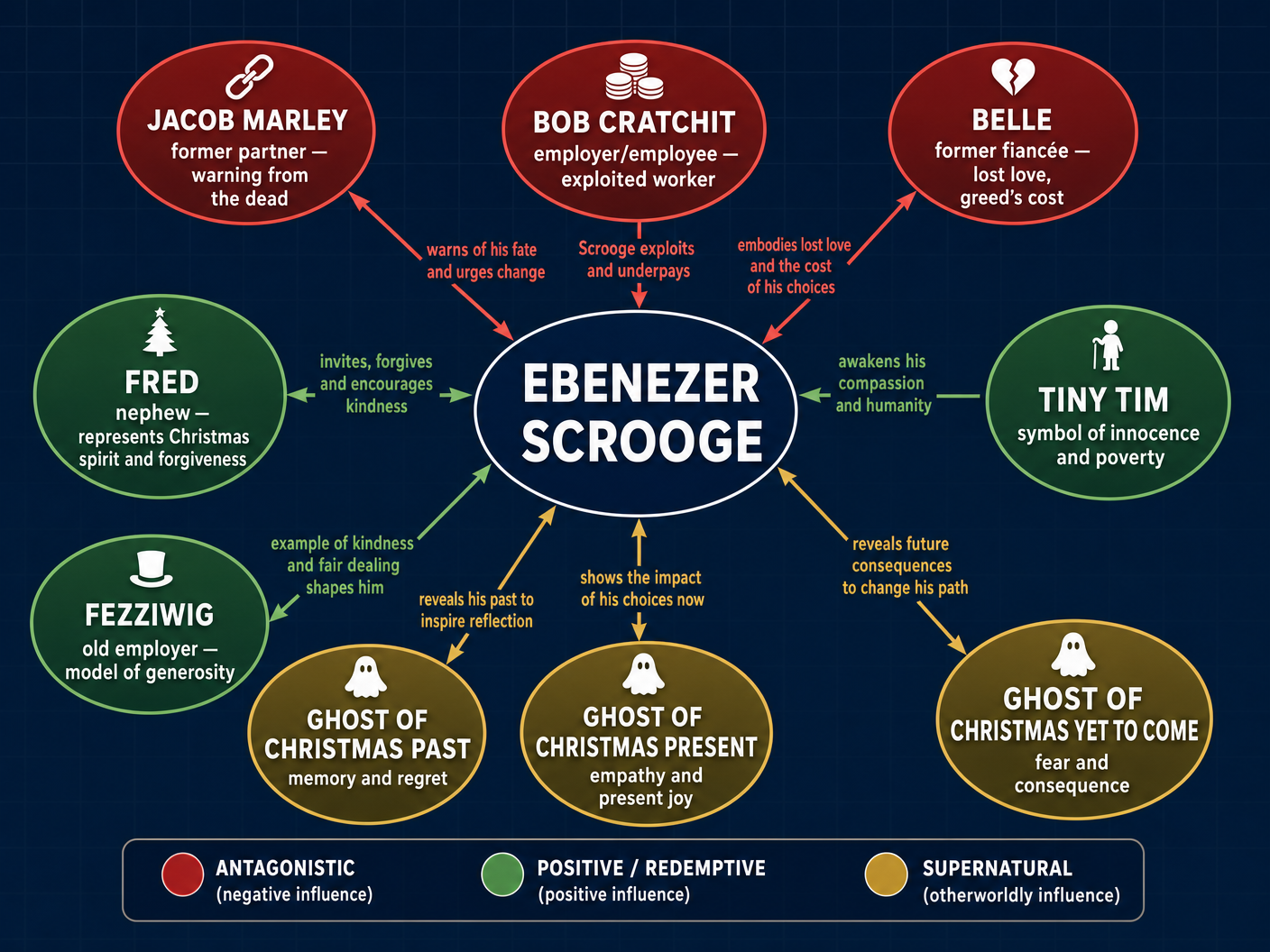
Interactive Diagrams
1 interactive diagram to visualise key concepts
Conceptual Flow Outline
Scrooge's Arc of Redemption across the Five Staves
Worked Examples
2 worked examples — open one to explore the question and available guidance.
Practice Questions
Test your understanding — click to reveal model answers
Explore how Dickens presents the theme of poverty in A Christmas Carol. (30 marks + 4 AO4)
Hint: Consider the different types of poverty shown: the extreme destitution of Ignorance and Want, and the 'respectable' working-class poverty of the Cratchits. Don't forget to link to Scrooge's changing attitude.
Explore how Dickens presents the importance of family in A Christmas Carol. (30 marks + 4 AO4)
Hint: Contrast Scrooge's chosen isolation with the warmth of the Cratchit family and Fred's persistence. Also, consider Scrooge's own childhood.
Explore how Dickens presents the character of Bob Cratchit. (30 marks + 4 AO4)
Hint: Focus on his role as an employee, a father, and a symbol of the deserving poor.
Explore how Dickens creates a sense of fear and tension in A Christmas Carol. (30 marks + 4 AO4)
Hint: Look at the gothic elements in Stave 1, the terrifying reveal of Ignorance and Want, and the grim silence of the Ghost of Christmas Yet to Come.
Test your understanding of A Christmas Carol
Active recall beats re-reading. Take an instant quiz now to test what you’ve learned and lock it into long-term memory.
7 days Premium · Then free forever · No card, no charge