AQA · GCSE · English Literature
Modern texts and poetry
Master Modern Texts and Poetry with this comprehensive, examiner-focused study guide. Covering post-1914 drama/prose and the poetry anthology, this resource equips you with high-level analysis, essential context, and the exact techniques needed to hit Level 6 in Paper 3.2.
- 3 min read
- 2 worked examples
- 4 practice questions
- 8 key terms
Study Notes
Overview
Paper 3.2 (Modern Texts and Poetry) is a rigorous test of your ability to engage critically with post-1914 literature and poetry. Examiners are looking for candidates who can move beyond basic plot summary and instead construct a conceptualised, well-evidenced argument. To achieve the top bands, you must demonstrate a perceptive understanding of the writer's methods (AO2) and seamlessly integrate relevant historical and social context (AO3) into your analysis. This guide will show you exactly how to structure your responses, embed quotations fluently, and use sophisticated subject terminology to impress the examiner.
Assessment Objectives & Marking
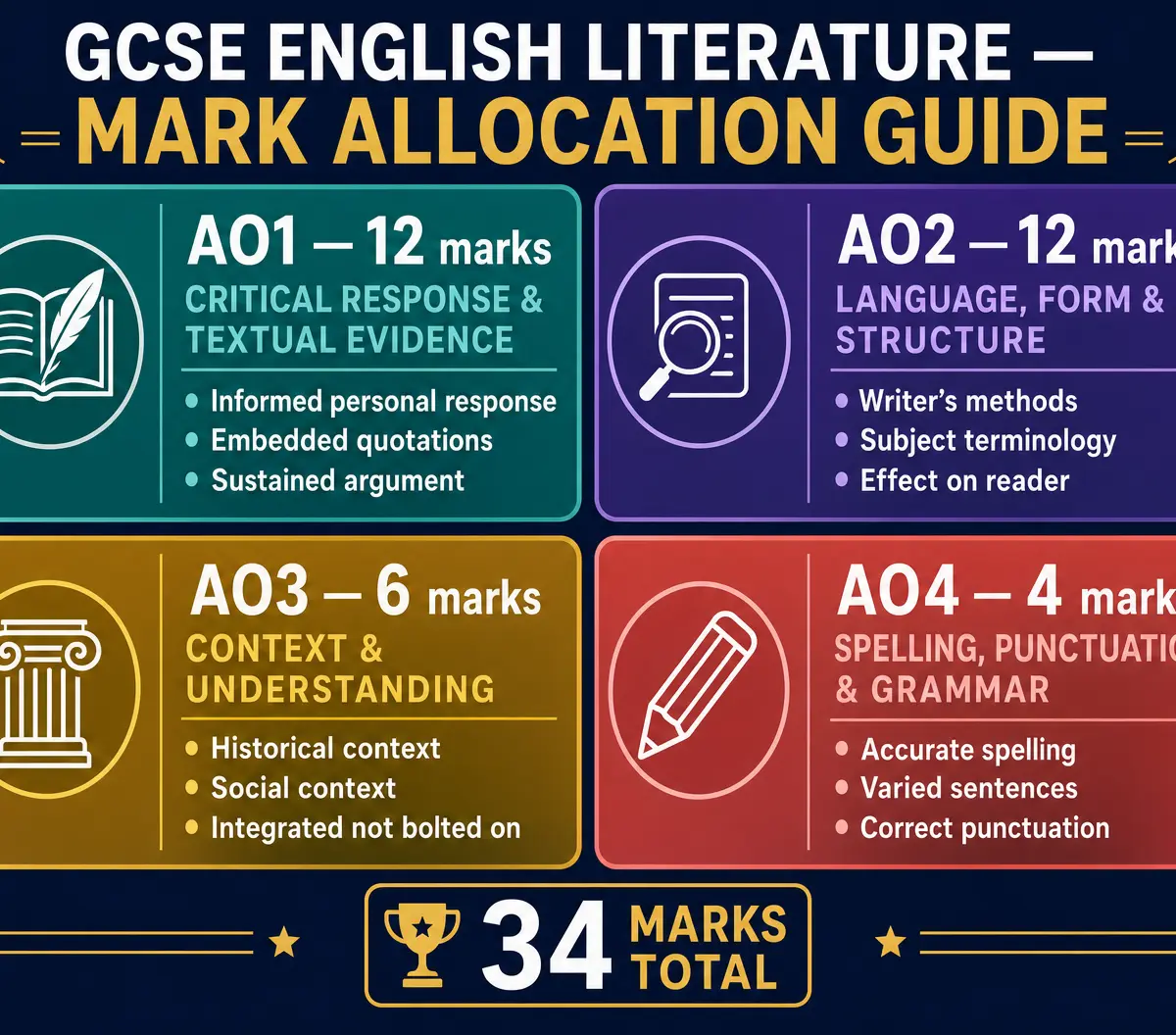
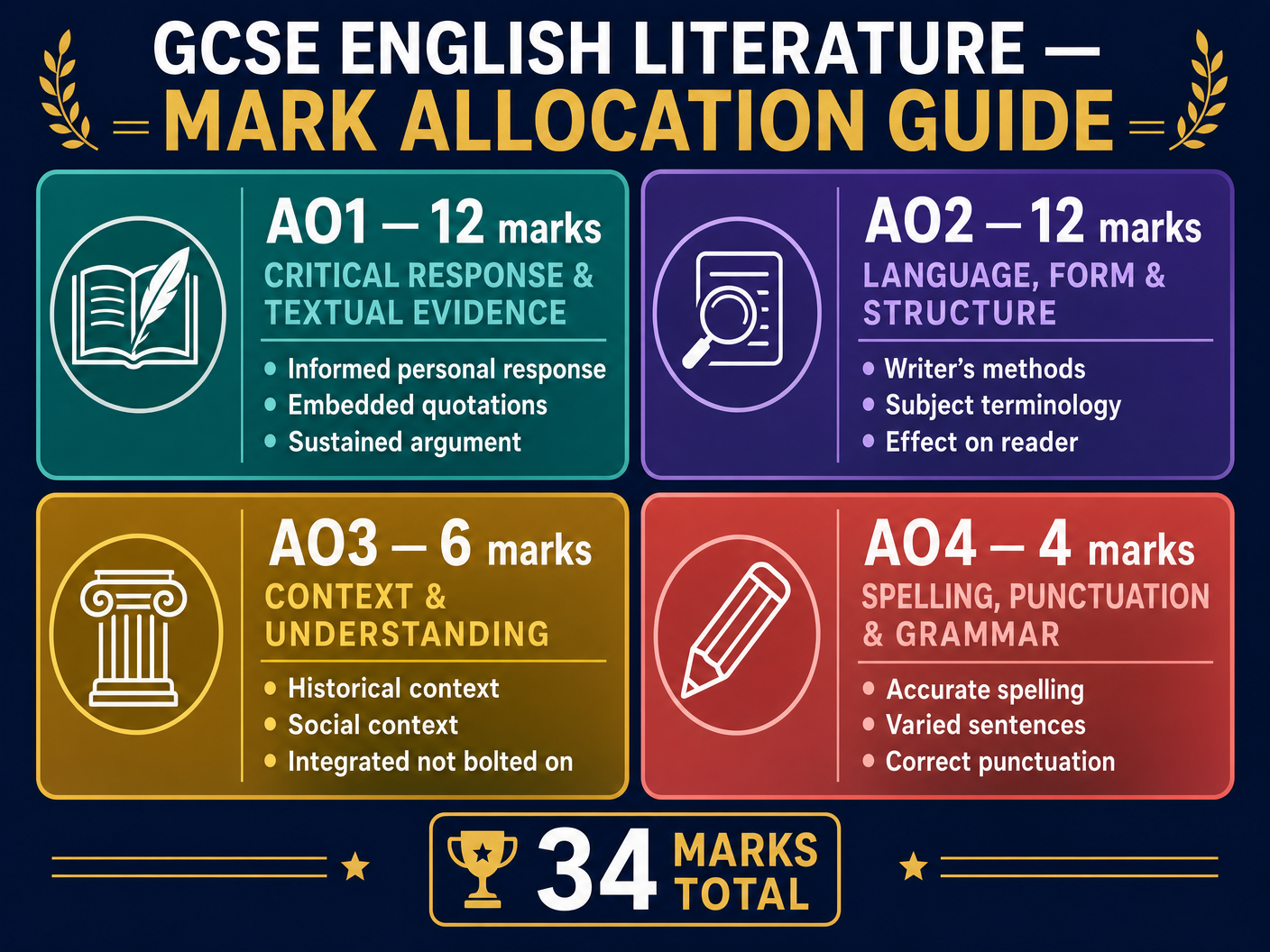
Understanding how you are marked is the first step to success. Your essay is marked out of 34: 30 marks for the content of your essay (AO1, AO2, AO3) and 4 marks for spelling, punctuation, and grammar (AO4).
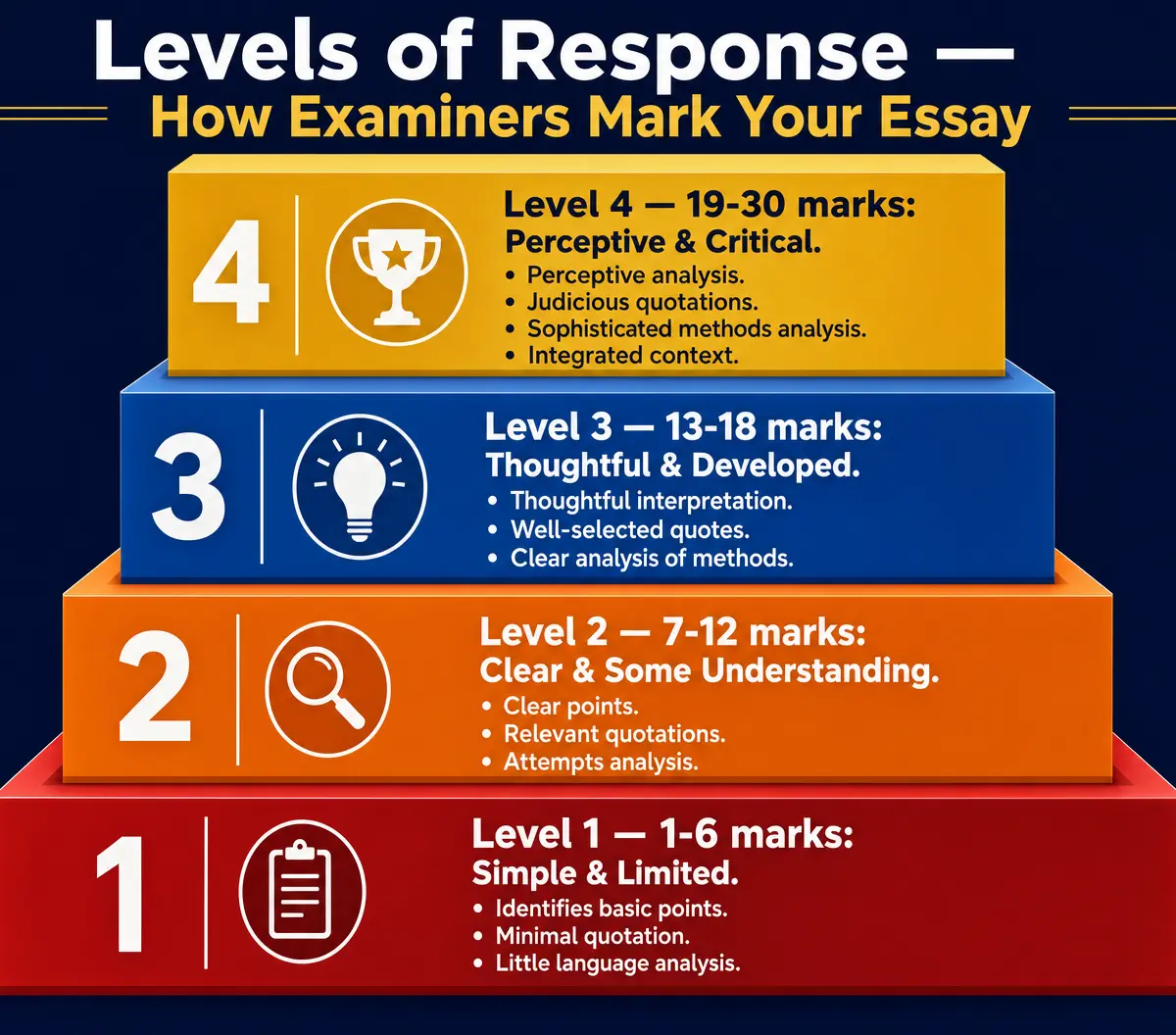
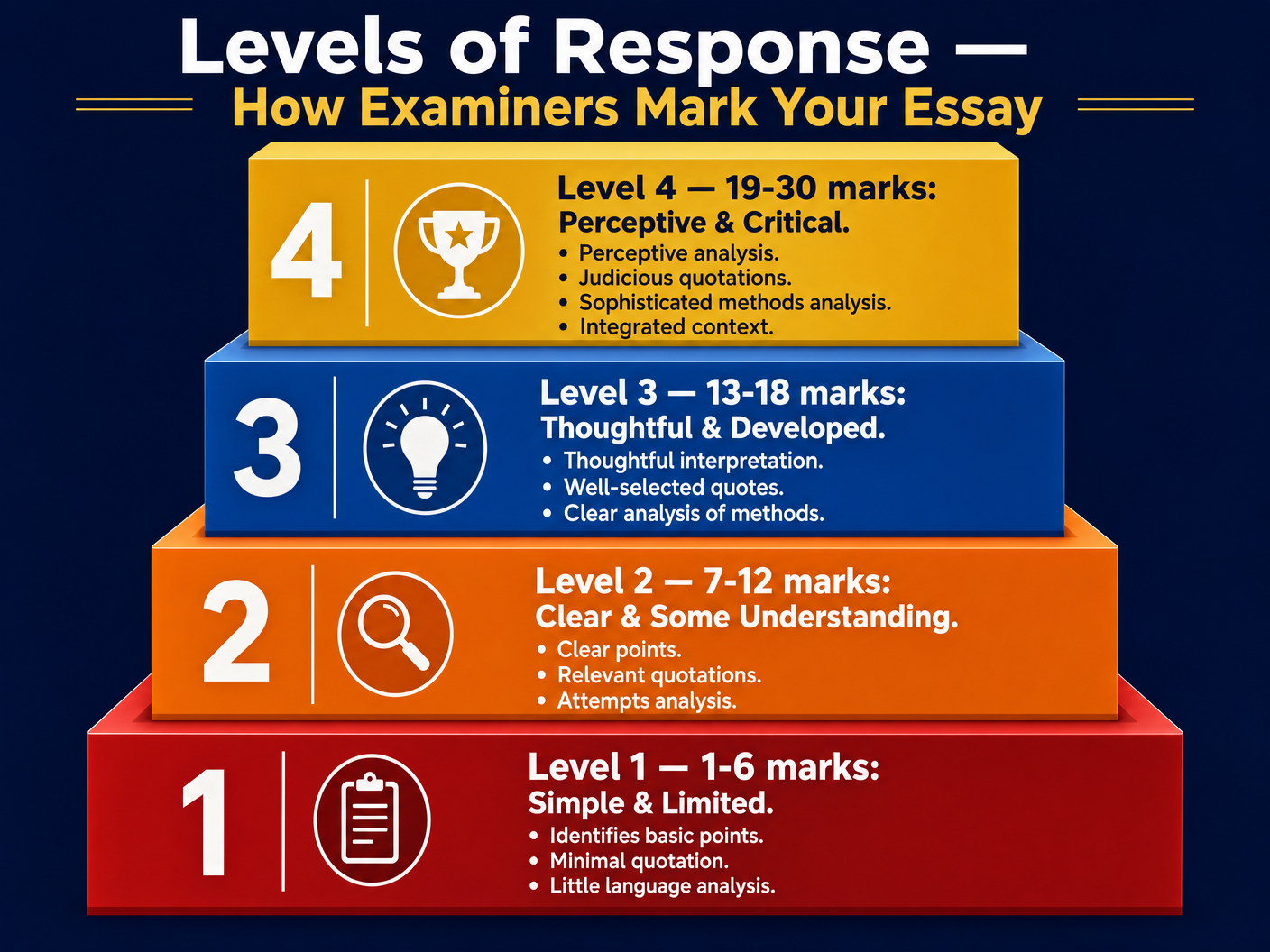
Examiners use a 'Levels of Response' mark scheme. To move from Level 3 (Clear/Thoughtful) to Level 4 (Perceptive/Critical), you must stop 'feature spotting' and start exploring why a writer has made specific choices and how those choices affect the reader's understanding of the text's core themes.
The Writer's Methods (AO2)
Examiners repeatedly state in their reports that weak candidates simply identify techniques (e.g., 'The writer uses a simile'). Strong candidates analyse the effect of those techniques.
Language
When analysing language, zoom in on specific words. Explore connotations and multiple meanings.
- Instead of: 'The writer uses the adjective "dark" to show it is night.'
- Write: 'The adjective "dark" carries ominous connotations, foreshadowing the tragic events to come and reflecting the moral ambiguity of the protagonist's actions.'
Form
Form is the type of text (e.g., a play, a novel, a sonnet). If you are studying a play, you must write about it as a piece of drama meant to be performed. Discuss stage directions, lighting, dramatic irony, and audience reaction.
Structure
Structure refers to how the text is put together. This could be the chronological order of events, shifts in narrative perspective, cyclical structures, or how a character changes from the beginning to the end of the text.
Structuring Your Essay
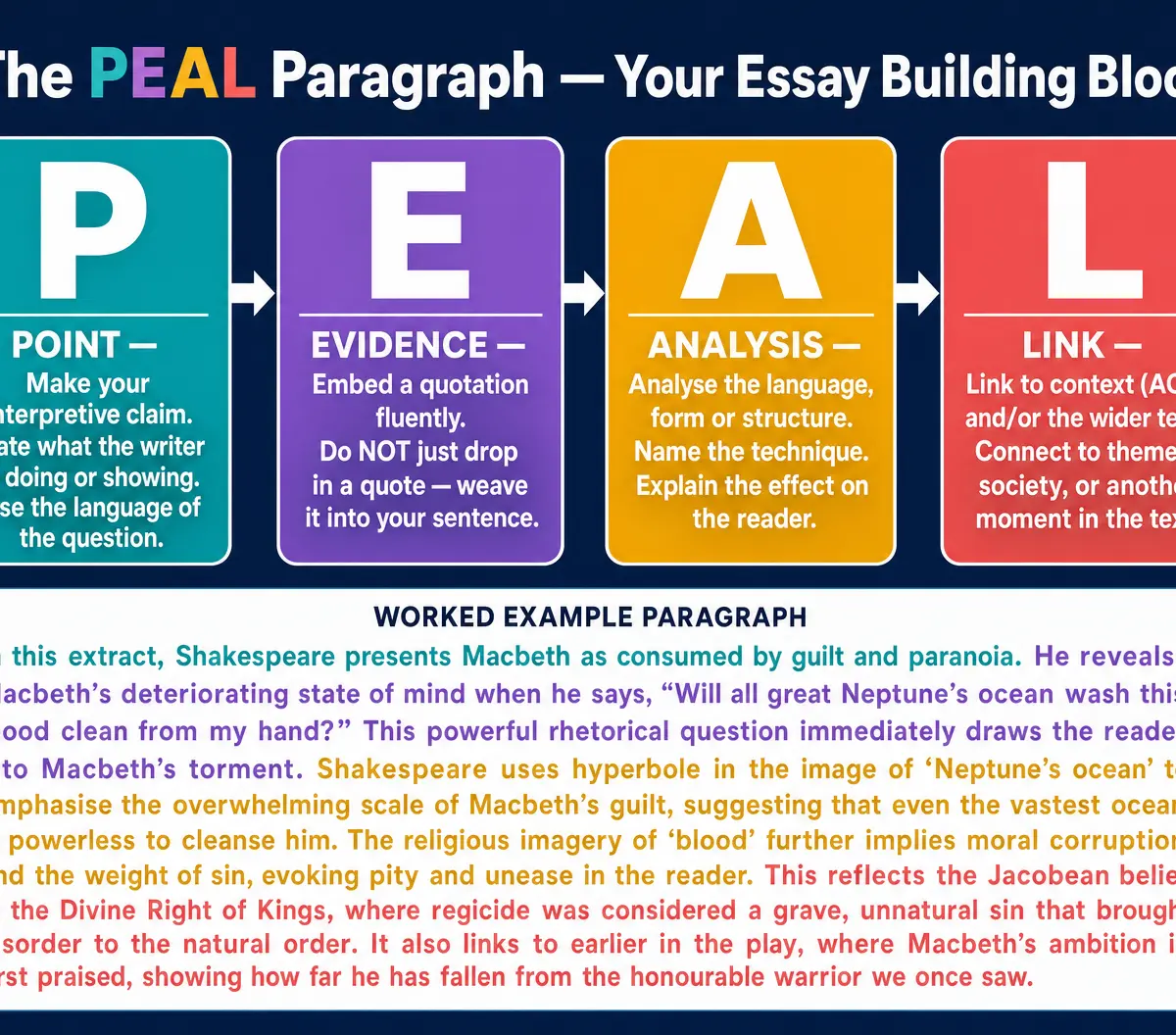
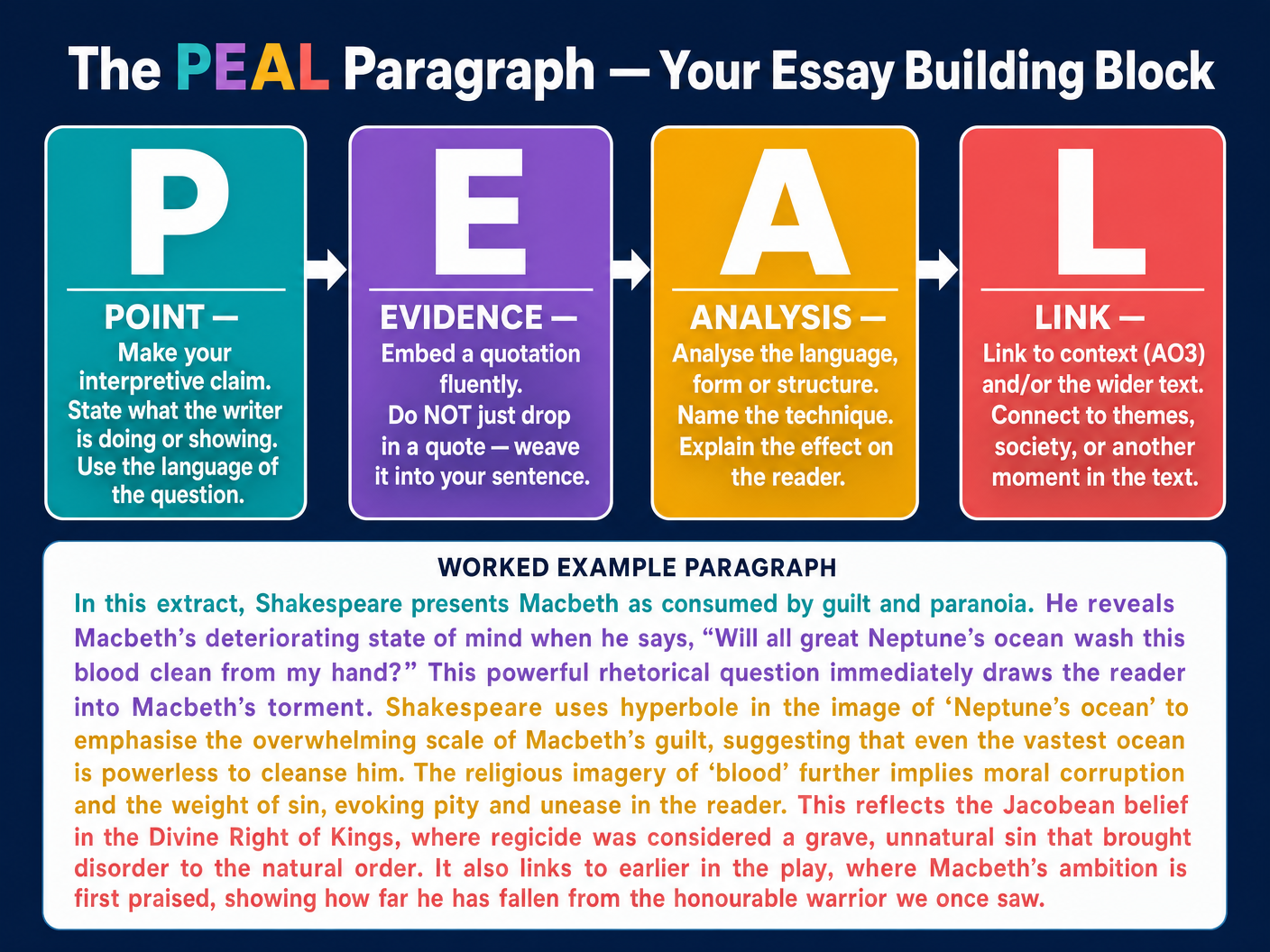
Your essay must be coherent and sustained. The most effective way to build a strong argument is using PEAL paragraphs: Point, Evidence, Analysis, Link. Ensure every paragraph begins with a clear interpretive claim that directly answers the question.
Podcast: The 10-Minute Grade Booster
Listen to our examiner-focused podcast for a complete breakdown of Paper 3.2, including common pitfalls and a quick-fire recall quiz.
Visual Resources
3 diagrams and illustrations
Interactive Diagrams
1 interactive diagram to visualise key concepts
Conceptual Flow Outline
The 5-Step Essay Planning Process
Worked Examples
2 worked examples — open one to explore the question and available guidance.
Practice Questions
Test your understanding — click to reveal model answers
Explore how the writer presents the conflict between different generations in the text. (30 marks + 4 AO4)
Hint: Consider how the older generation represents entrenched historical attitudes, while the younger generation represents the possibility of change.
Compare how poets present the power of nature in 'Poem X' and one other poem. (30 marks)
Hint: Look for one poem where nature is aggressive and destructive, and another where it is enduring or awe-inspiring.
How does the writer use setting to create atmosphere in the text? (30 marks + 4 AO4)
Hint: Think about pathetic fallacy, isolation, claustrophobia, or how the setting reflects the social status of the characters.
Explore the presentation of guilt and conscience in the text. (30 marks + 4 AO4)
Hint: Contrast characters who feel guilt with those who refuse to accept it.
Test your understanding of Modern texts and poetry
Active recall beats re-reading. Take an instant quiz now to test what you’ve learned and lock it into long-term memory.
7 days Premium · Then free forever · No card, no charge