AQA · GCSE · English Literature
Course version: 8702 · Version from Sept 2015
Poetry anthology: Worlds and Lives: A Wider View
Seni Seneviratne's 'A Wider View' explores the connection between past and present through the speaker's imaginative reconstruction of her Sri Lankan great-great-grandfather's life in industrial…
Checked against the AQA 8702 specification (opens in a new tab) on .
- Point 3 of 15
- 4 key terms
Study notes
From the checked teaching notes for this specification point.
The idea
Seni Seneviratne's 'A Wider View' explores the connection between past and present through the speaker's imaginative reconstruction of her Sri Lankan great-great-grandfather's life in industrial Leeds in 1869. The poem contrasts the harsh realities of his existence—long workdays combing flax, a 'smoke-filled sky', cramped housing—with his enduring inner life and hope. Despite his oppressive environment, he is shown to 'stack his dreams' and crave 'a wider view', representing a universal human desire for space, safety, and a better future. The speaker forges a tangible link to him through the city's historic architecture, which stands as a witness to both their lives, creating a 'curve of past and future generations' and celebrating the resilience of migrant experience.
What earns the marks
- AO1: Select precise textual references that show the contrast between the ancestor's harsh reality and his hopes for the future.
- AO1: Develop a clear argument about how the speaker connects her own modern experience with her ancestor's past.
- AO1: When comparing, explain how another poet explores a similar theme, such as urban life or heritage, but with a different focus or tone.
- AO2: Analyse how the use of free verse and enjambment helps to create a link between the past and the present.
- AO2: Explain the effect of specific metaphors, such as 'stack his dreams', in conveying the ancestor's inner life and resilience.
- AO2: Discuss how the poem's structure, with stanzas separating time periods, emphasises both the distance and the connection between generations.
- AO3: Link the poem's descriptions of 'smoke-filled' Leeds and 'twelve hours combing flax' to the historical context of the Industrial Revolution.
- AO3: Consider how the great-great-grandfather's Sri Lankan heritage adds a layer of meaning related to migration and the British Empire.
- AO3: Explain how the poem reflects a modern interest in genealogy and connecting with one's personal and family history.
Common mistakes and how to put them right
The poem is a factual biography of the poet's great-great-grandfather.
Put it right: The poem is a work of imagination, where the speaker pieces together a vision of her ancestor's life. While based on family history, it is a creative interpretation, not a historical document.
The poem is entirely negative about life in the past.
Put it right: While the poem details significant hardships like pollution and hard labour, it also emphasises the ancestor's resilience, hope, and his search for 'the comfort of a wider view', creating a more complex picture.
The speaker feels completely disconnected from her ancestor's experience.
Put it right: The opposite is true. The central purpose of the poem is to forge a connection. The speaker uses shared locations and historic architecture to bridge the gap of time and imagine a link across 'the curve of past and future generations'.
Exam tips
- Compare with In a London Drawingroom: The negative experience of life in an industrialised city. Difference: While both poems depict oppressive urban environments, Seneviratne's speaker finds a hopeful connection to an ancestor's resilience. In contrast, Eliot's poem offers a bleak view of London, culminating in the metaphor of 'one huge prison-house' to convey monotony and alienation. Useful when: How poets present attitudes towards city life.
- Compare with Homing: Connecting with the life and identity of an ancestor. Difference: 'A Wider View' focuses on imagining an ancestor's physical hardships and environment in a specific historical setting. 'Homing' focuses on recovering an ancestor's suppressed voice and dialect, an internal aspect of heritage that the speaker wants to 'let...spill out'. Useful when: How poets explore the importance of family heritage.
- Compare with Name Journeys: The challenges and complexities of migration and identity. Difference: Seneviratne explores the physical and economic struggles of a 19th-century migrant. Mundair's poem focuses more on the linguistic and spiritual challenges of preserving cultural identity in a new country, exploring how a name can become difficult on 'infertile English soil'. Useful when: How poets present the experience of migration.
- Compare with England in 1819: A critical view of England during a period of social and industrial change. Difference: Shelley's poem is a direct, furious political protest against the ruling class of his time, describing a 'fainting country'. Seneviratne's poem is a personal, historical reflection on the life of an ordinary individual within that system, focusing on personal hope rather than political revolution. Useful when: How poets use poetry to comment on the state of society.
Try the lesson
The start of the Poetry anthology: Worlds and Lives: A Wider View lesson, made from checked teaching notes for this specification point.
Have a go first
In 'A Wider View', whose life is the speaker imagining in 1869 Leeds?
Listen
Seni Seneviratne's 'A Wider View' explores the connection between past and present through the speaker's imaginative reconstruction of her Sri Lankan great-great-grandfather's life in industrial Leeds in 1869. The poem contrasts the harsh realities of his existence—long workdays combing flax, a 'smoke-filled sky', cramped housing—with his enduring inner life and hope. Despite his oppressive environment, he is shown to 'stack his dreams' and crave 'a wider view', representing a universal human desire for space, safety, and a better future. The speaker forges a tangible link to him through the city's historic architecture, which stands as a witness to both their lives, creating a 'curve of past and future generations' and celebrating the resilience of migrant experience. A strong answer earns marks for these points. Select precise textual references that show the contrast between the ancestor's harsh reality and his hopes for the future. Develop a clear argument about how the speaker connects her own modern experience with her ancestor's past. When comparing, explain how another poet explores a similar theme, such as urban life or heritage, but with a different focus or tone. Analyse how the use of free verse and enjambment helps to create a link between the past and the present. A common slip: The poem is a factual biography of the poet's great-great-grandfather. Instead, The poem is a work of imagination, where the speaker pieces together a vision of her ancestor's life. While based on family history, it is a creative interpretation, not a historical document. Exam tip: Compare with In a London Drawingroom: The negative experience of life in an industrialised city. Difference: While both poems depict oppressive urban environments, Seneviratne's speaker finds a hopeful connection to an ancestor's resilience. In contrast, Eliot's poem offers a bleak view of London, culminating in the metaphor of 'one huge prison-house' to convey monotony and alienation. Useful when: How poets present attitudes towards city life.
See it
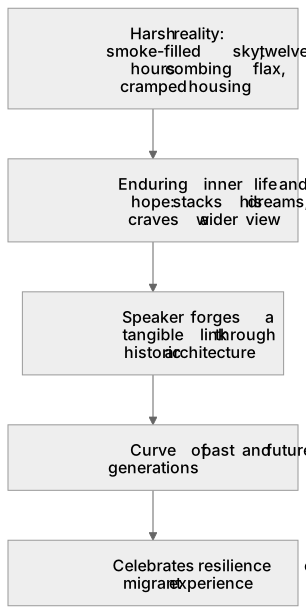
Put it in order
Put these steps in the order they happen.
- 1. Enduring inner life and hope: stacks his dreams, craves a wider view
- 2. Speaker forges a tangible link through historic architecture
- 3. Harsh reality: smoke-filled sky, twelve hours combing flax, cramped housing
- 4. Celebrates resilience of migrant experience
- 5. Curve of past and future generations
Watch it explained
What is the one idea the video explains? Say it in a sentence.
Read the described scene instead
Seni Seneviratne's 'A Wider View' imagines her Sri Lankan great-great-grandfather's life in industrial Leeds in 1869. The poem links past and present through the speaker's creative reconstruction, not a factual biography. The poem grounds his experience in industrial Leeds. A 'smoke-filled sky' shows pollution and unhealthy conditions. 'Twelve hours combing flax' gives factual detail of long, repetitive manual labour for migrant workers. Despite this environment, the ancestor has an enduring inner life. He does not only endure; he can 'stack his dreams' and he 'craved the comfort of a wider view'. This hope is both literal, space beyond cramped housing, and metaphorical. The speaker forges a tangible link through Leeds' historic architecture. Pause to consider how shared places bridge time. The poem's structure and free verse help bridge time. The metaphor 'the curve of past and future generations' summarises an unbroken connection. Remember, the poem is not a factual biography; it is an imaginative reconstruction. It is not entirely negative about the past because it stresses resilience and hope. The speaker does not feel disconnected; she deliberately forges a connection. In 'A Wider View', migration and heritage meet industrial urban life. The poem contrasts harsh conditions with hope and resilience, connecting past and present through one family's story.
Key words
Say what each word means before you turn the card.
Migration and Heritage
Try answering aloud or in your head before turning the card.
Past and Present
Try answering aloud or in your head before turning the card.
Industrialisation and Urban Life
Try answering aloud or in your head before turning the card.
Hope and Resilience
Try answering aloud or in your head before turning the card.
See every definition
- Migration and Heritage
- The poem adds a layer of meaning related to migration and the British Empire through the great-great-grandfather's Sri Lankan heritage.
- Past and Present
- The poem explores the connection between past and present through the speaker's imaginative reconstruction of her ancestor's life.
- Industrialisation and Urban Life
- The poem's descriptions of 'smoke-filled' Leeds and 'twelve hours combing flax' link to the historical context of the Industrial Revolution.
- Hope and Resilience
- Despite his oppressive environment, the ancestor is shown to 'stack his dreams' and crave 'a wider view', representing a universal human desire for space, safety, and a better future.
Label the diagram
Some boxes have lost their names. Pick the right name for each number.
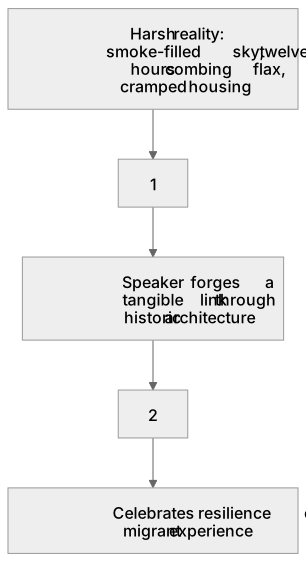
1Box 1
2Box 2
There is more to this lesson
The full lesson goes on to check your understanding and help you earn the marks. Create a free account to carry on, with your progress saved.
A week of Premium from your first lesson · Then the free plan continues · No card, no charge
Test your understanding of Poetry anthology: Worlds and Lives: A Wider View
Active recall beats re-reading. Take an instant quiz now to test what you’ve learned and lock it into long-term memory.
A week of Premium from your first lesson · Then the free plan continues · No card, no charge