AQA · GCSE · English Literature
Course version: 8702 · Version from Sept 2015
Poetry anthology: Worlds and Lives: England in 1819
Shelley's sonnet is a furious political protest against the state of England in 1819.
Checked against the AQA 8702 specification (opens in a new tab) on .
- Point 4 of 15
- 4 key terms
Study notes
From the checked teaching notes for this specification point.
The idea
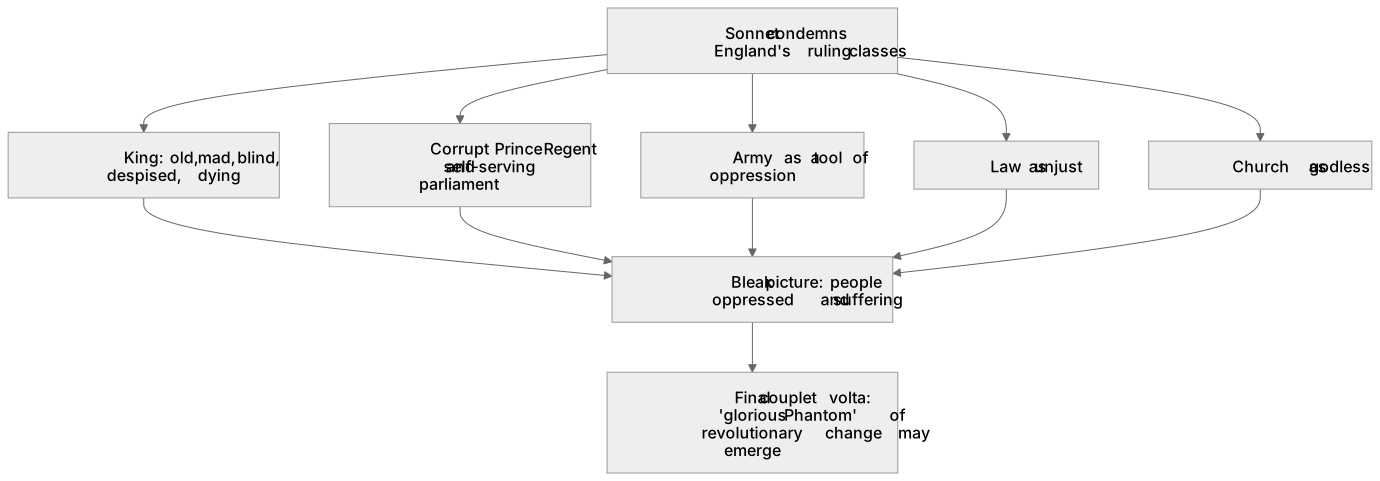
Shelley's sonnet is a furious political protest against the state of England in 1819. It systematically condemns the ruling classes: the 'old, mad, blind, despised, and dying king' (George III), the corrupt Prince Regent, and a self-serving parliament. He criticises the army as a tool of oppression, the law as unjust, and the Church as godless. The poem paints a bleak picture of a nation where the people are oppressed and suffering. However, the final couplet offers a glimmer of hope, suggesting that from this decay, a 'glorious Phantom' of revolutionary change might emerge, bringing light and renewal to the 'fainting country'. It is a powerful indictment of tyranny and a call for radical transformation.
What earns the marks
- AO1: Select precise references to show how Shelley builds a systematic critique of England's key institutions: monarchy, aristocracy, parliament, army, law and Church.
- AO1: Compare Shelley's direct, angry tone with the more melancholic or observational tones used by other poets who criticise society, such as Wordsworth or Eliot.
- AO1: Understand the poem's core argument: that the corruption of the ruling class is destroying the nation, but that this decay may lead to revolutionary renewal.
- AO2: Analyse Shelley's use of a sonnet, a form with an established tradition in political and religious as well as love poetry, to express political rage, subverting the reader's expectations.
- AO2: Explore the effect of the relentless listing structure in the first twelve lines, which creates a sense of overwhelming corruption and decay.
- AO2: Comment on the impact of the final couplet, which acts as a volta, shifting the poem from despair to a tentative, revolutionary hope embodied in the metaphor of the 'glorious Phantom'.
- AO3: Connect the poem's imagery of an oppressed people and a violent army to the historical context of the 1819 Peterloo Massacre.
- AO3: Relate the attacks on the 'old, mad, blind, despised, and dying king' and his 'princes' to the specific political situation involving King George III and the Prince Regent.
- AO3: Explain how Shelley's radical political beliefs, typical of the second-generation Romantic poets, inform the poem's revolutionary message and its critique of established power.
Common mistakes and how to put them right
The poem is entirely negative and hopeless.
Put it right: While the first twelve lines present a bleak picture of England's corruption, the final couplet introduces a powerful sense of hope for revolutionary change, suggesting a 'glorious Phantom' may rise from the decay.
Shelley is describing a literal ghost or phantom at the end.
Put it right: The 'glorious Phantom' is a metaphor. It represents the spirit of revolution or a new, reformed England that Shelley hopes will emerge from the ruins of the old, corrupt state.
The poem is a standard, traditional sonnet.
Put it right: Shelley uses the sonnet form but subverts its traditional association with love. He also uses an unusual rhyme scheme, perhaps to reflect the broken and disordered state of the nation he is describing.
Exam tips
- Compare with Lines Written in Early Spring: Criticism of the state of humanity and society. Difference: Shelley's poem is a direct, furious political attack on specific English institutions, whereas Wordsworth's critique is more philosophical and indirect, contrasting the harmony of nature with the discord of human society ('What man has made of man'). Useful when: How poets present ideas about society.
- Compare with In a London Drawingroom: A critical perspective on a specific English location and its negative effects on people. Difference: Shelley focuses on the political corruption of the ruling class as the source of England's problems. Eliot focuses on the dehumanising effects of the urban, industrial environment of Victorian London, describing it as a 'huge prison-house' of conformity and alienation. Useful when: How poets explore the relationship between place and people.
- Compare with Thirteen: The abuse of power by state authorities against individuals. Difference: Shelley's poem critiques the entire system of power in 1819, from the monarchy to the army. Femi's poem focuses on a specific, modern manifestation of state power: the racial profiling and stop-and-search of a young Black boy by the police. Useful when: How poets present conflict between the powerful and the powerless.
- Compare with A Century Later: The idea of resistance and hope in the face of oppression. Difference: Shelley's hope for change is presented as a future, abstract possibility, a 'glorious Phantom' that 'may' emerge from ruin. Dharker's poem presents resistance as a current, tangible reality, embodied by schoolgirls who continue to 'walk on' despite facing violence. Useful when: How poets explore ideas about hope and resistance.
Try the lesson
The start of the Poetry anthology: Worlds and Lives: England in 1819 lesson, made from checked teaching notes for this specification point.
Have a go first
In 'England in 1819', which group of words does Shelley use to describe the king?
Listen
Shelley's sonnet is a furious political protest against the state of England in 1819. It systematically condemns the ruling classes: the 'old, mad, blind, despised, and dying king' (George III), the corrupt Prince Regent, and a self-serving parliament. He criticises the army as a tool of oppression, the law as unjust, and the Church as godless. The poem paints a bleak picture of a nation where the people are oppressed and suffering. However, the final couplet offers a glimmer of hope, suggesting that from this decay, a 'glorious Phantom' of revolutionary change might emerge, bringing light and renewal to the 'fainting country'. It is a powerful indictment of tyranny and a call for radical transformation. A strong answer earns marks for these points. Select precise references to show how Shelley builds a systematic critique of England's key institutions: monarchy, aristocracy, parliament, army, law and Church. Compare Shelley's direct, angry tone with the more melancholic or observational tones used by other poets who criticise society, such as Wordsworth or Eliot. Understand the poem's core argument: that the corruption of the ruling class is destroying the nation, but that this decay may lead to revolutionary renewal. Analyse Shelley's use of a sonnet, a form with an established tradition in political and religious as well as love poetry, to express political rage, subverting the reader's expectations. A common slip: The poem is entirely negative and hopeless. Instead, While the first twelve lines present a bleak picture of England's corruption, the final couplet introduces a powerful sense of hope for revolutionary change, suggesting a 'glorious Phantom' may rise from the decay. Exam tip: Compare with Lines Written in Early Spring: Criticism of the state of humanity and society. Difference: Shelley's poem is a direct, furious political attack on specific English institutions, whereas Wordsworth's critique is more philosophical and indirect, contrasting the harmony of nature with the discord of human society ('What man has made of man'). Useful when: How poets present ideas about society.
See it
Watch it explained
What is the one idea the video explains? Say it in a sentence.
Read the described scene instead
Percy Bysshe Shelley's 'England in 1819' is a furious political sonnet. It attacks the corruption of England's ruling institutions and asks whether decay might lead to revolutionary renewal. Shelley builds a systematic critique. He condemns the 'old, mad, blind, despised, and dying king' and the corrupt Prince Regent. He attacks a self-serving parliament, an oppressive army, unjust law, and a godless Church. The relentless listing makes corruption feel overwhelming. Shelley uses a sonnet, a form associated with love and also political or religious verse, to express political rage. That choice subverts expectations. The first twelve lines list corruption relentlessly. The final couplet acts as a volta, shifting from despair to a tentative, revolutionary hope. Consider how one adjective can carry a political argument. Pause to think about the word 'blind' for King George III. It suggests not only physical blindness but moral and intellectual blindness: the monarchy lacks vision and connection to its people. 'Dying' also symbolises an obsolete old order, while the personified 'fainting country' shows a nation overwhelmed by oppression. Two misreadings are common. First, the poem is not entirely hopeless: the final couplet offers a glimmer of revolutionary hope. Second, the 'glorious Phantom' is not a literal ghost. It is a metaphor for the spirit of revolution or a reformed England that may emerge from decay. The modal verb 'may' keeps that renewal uncertain. Historically, the imagery of an oppressed people and a violent army connects to the 1819 Peterloo Massacre. Shelley's radical politics, typical of second-generation Romantic poets, inform the poem's revolutionary message. Its core argument is that the corruption of the ruling class is destroying the nation, but that this decay may lead to renewal.
Key words
Say what each word means before you turn the card.
Power and corruption
Try answering aloud or in your head before turning the card.
Social injustice and oppression
Try answering aloud or in your head before turning the card.
Revolution and hope
Try answering aloud or in your head before turning the card.
The state of the nation
Try answering aloud or in your head before turning the card.
See every definition
- Power and corruption
- Shelley systematically condemns the ruling classes, criticising the army as a tool of oppression, the law as unjust, and the Church as godless.
- Social injustice and oppression
- The poem paints a bleak picture of a nation where the people are oppressed and suffering, with the army's brutal treatment described as 'starved and stabbed'.
- Revolution and hope
- The final couplet offers a glimmer of hope, suggesting that from this decay a 'glorious Phantom' of revolutionary change might emerge, bringing light and renewal.
- The state of the nation
- Shelley's sonnet is a furious political protest against the state of England in 1819, personifying England as a 'fainting country' on the brink of collapse.
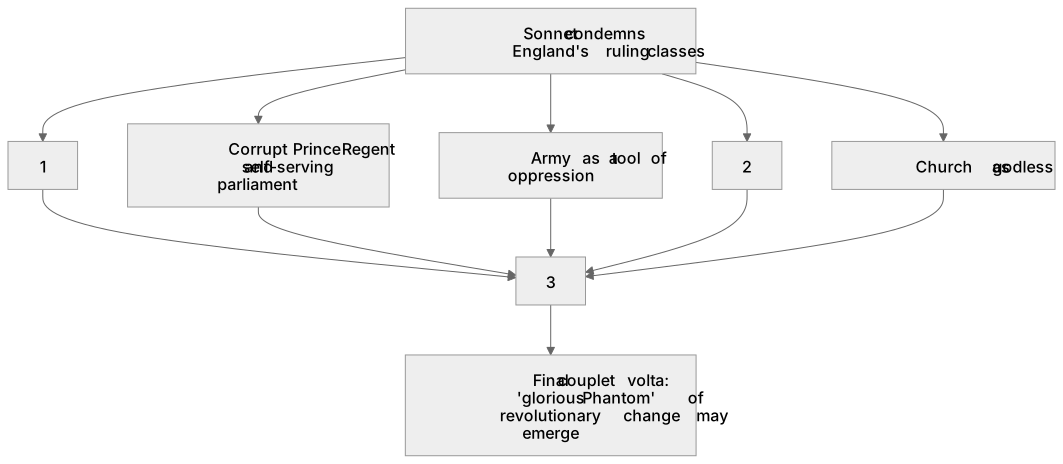
Label the diagram
Some boxes have lost their names. Pick the right name for each number.
1Box 1
2Box 2
3Box 3
There is more to this lesson
The full lesson goes on to check your understanding and help you earn the marks. Create a free account to carry on, with your progress saved.
A week of Premium from your first lesson · Then the free plan continues · No card, no charge
Test your understanding of Poetry anthology: Worlds and Lives: England in 1819
Active recall beats re-reading. Take an instant quiz now to test what you’ve learned and lock it into long-term memory.
A week of Premium from your first lesson · Then the free plan continues · No card, no charge