AQA · GCSE · English Literature
Course version: 8702 · Version from Sept 2015
Poetry anthology: Worlds and Lives: Homing
Liz Berry's 'Homing' is an intimate address to a relative from the Black Country whose regional accent was suppressed through elocution lessons.
Checked against the AQA 8702 specification (opens in a new tab) on .
- Point 5 of 15
- 4 key terms
Study notes
From the checked teaching notes for this specification point.
The idea
Liz Berry's 'Homing' is an intimate address to a relative from the Black Country whose regional accent was suppressed through elocution lessons. The speaker uses a central metaphor of a box to represent how this authentic voice was hidden away due to social pressure to conform to a 'correct' way of speaking. The poem is not about a physical return home, but a metaphorical one: the speaker wishes to unlock this box, allowing the 'lost words' to be released. It is a powerful celebration of regional identity, dialect and heritage, expressing a desire to recover and proudly carry forward a voice that was almost erased. The poem argues that our accents are a vital part of who we are and should be cherished rather than silenced.
What earns the marks
- AO1: Understand that the poem is an address, or apostrophe, to a relative, which creates a personal and intimate tone.
- AO1: Explain the central idea: the speaker wants to recover and celebrate a suppressed family dialect, not physically return to a place.
- AO1: When comparing, focus on shared ideas about identity, heritage or language, using quotations from both poems to support your points.
- AO2: Analyse the central metaphor of the accent being kept 'in a box' to explore themes of suppression, shame and confinement.
- AO2: Analyse how the poem's free verse form, with its lack of regular rhyme and metre, reflects the idea of breaking free from restrictive rules about 'proper' speech.
- AO2: Explore the effect of powerful verbs like 'spill' and 'forge', which suggest first a liberating release and then a creative, powerful act of reclamation.
- AO2: Examine how enjambment and line breaks in the free verse create a sense of words spilling out, mirroring the release of the suppressed dialect.
- AO3: Link the poem to the context of the Black Country dialect and its cultural significance as a marker of regional identity.
- AO3: Discuss the historical and social context of elocution lessons and the pressure for people to lose regional accents to achieve social mobility.
- AO3: Consider how the poem is part of a wider contemporary movement by writers and artists to celebrate and preserve regional languages and dialects against standardisation.
Common mistakes and how to put them right
The poem is about the speaker physically going back to her childhood home.
Put it right: The title 'Homing' is metaphorical. The speaker is 'homing in' on a lost part of her family's identity – the suppressed accent – rather than making a physical journey.
The speaker is angry with her relative for hiding their accent.
Put it right: The speaker's tone is loving and sympathetic. She blames the social pressures and formal training ('hours of elocution') that forced the relative to conceal their natural way of speaking.
The Black Country accent has been lost forever.
Put it right: The poem ends on a hopeful and determined note. The speaker believes the voice can be recovered and remade, suggesting that heritage can be actively reclaimed by future generations.
Exam tips
- Compare with Name Journeys: Language and Identity Difference: While both poems explore how language shapes identity, 'Homing' focuses on the suppression and reclamation of a regional English dialect, whereas 'Name Journeys' explores the dislocation of a heritage language (Punjabi) and personal names through migration to a new country. Useful when: How poets present the connection between language and a sense of self.
- Compare with pot: Reclaiming Lost Heritage Difference: 'Homing' is about recovering an intangible part of heritage – a voice and its associated culture. In contrast, 'pot' focuses on a domestic cooking pot as a symbol of cultural heritage and the continuity of tradition, exploring how everyday objects carry cultural memory. Useful when: How poets explore ideas about loss and recovery of cultural heritage.
- Compare with A Wider View: Connecting with Ancestors Difference: Both speakers connect with their family history, but the speaker in 'Homing' focuses on an ancestor's internal, linguistic struggle. The speaker in 'A Wider View' imagines her ancestor's physical experience of labour, migration and living conditions in industrial Leeds. Useful when: How poets present the relationship between past and present generations.
- Compare with On an Afternoon Train from Purley to Victoria, 1955: Accents and Communication Difference: 'Homing' is an internal monologue about a lost accent that was a source of shame for its owner. 'On an Afternoon Train...' depicts a live conversation where different ways of speaking, including non-standard English, become a means of building connection between strangers. Useful when: How poets explore the social significance of the way people speak.
Try the lesson
The start of the Poetry anthology: Worlds and Lives: Homing lesson, made from checked teaching notes for this specification point.
Have a go first
In Liz Berry's 'Homing', what does the speaker mean by saying the relative 'kept your accent in a box'?
Listen
Liz Berry's 'Homing' is an intimate address to a relative from the Black Country whose regional accent was suppressed through elocution lessons. The speaker uses a central metaphor of a box to represent how this authentic voice was hidden away due to social pressure to conform to a 'correct' way of speaking. The poem is not about a physical return home, but a metaphorical one: the speaker wishes to unlock this box, allowing the 'lost words' to be released. It is a powerful celebration of regional identity, dialect and heritage, expressing a desire to recover and proudly carry forward a voice that was almost erased. The poem argues that our accents are a vital part of who we are and should be cherished rather than silenced. A strong answer earns marks for these points. Understand that the poem is an address, or apostrophe, to a relative, which creates a personal and intimate tone. Explain the central idea: the speaker wants to recover and celebrate a suppressed family dialect, not physically return to a place. When comparing, focus on shared ideas about identity, heritage or language, using quotations from both poems to support your points. Analyse the central metaphor of the accent being kept 'in a box' to explore themes of suppression, shame and confinement. A common slip: The poem is about the speaker physically going back to her childhood home. Instead, The title 'Homing' is metaphorical. The speaker is 'homing in' on a lost part of her family's identity – the suppressed accent – rather than making a physical journey. Exam tip: Compare with Name Journeys: Language and Identity Difference: While both poems explore how language shapes identity, 'Homing' focuses on the suppression and reclamation of a regional English dialect, whereas 'Name Journeys' explores the dislocation of a heritage language (Punjabi) and personal names through migration to a new country. Useful when: How poets present the connection between language and a sense of self.
See it
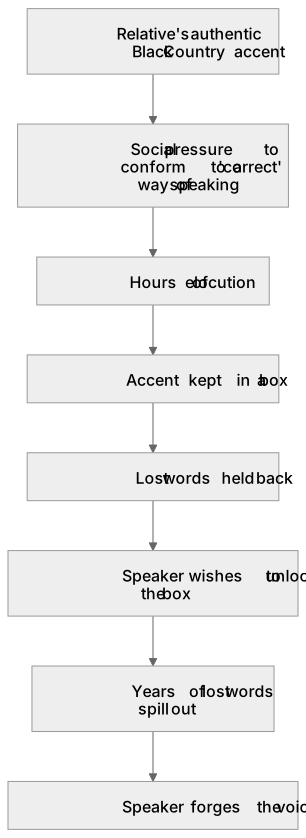
Put it in order
Put these steps in the order they happen.
- 1. Lost words held back
- 2. Speaker forges the voice
- 3. Speaker wishes to unlock the box
- 4. Relative's authentic Black Country accent
- 5. Social pressure to conform to a 'correct' way of speaking
- 6. Years of lost words spill out
- 7. Hours of elocution
- 8. Accent kept in a box
Watch it explained
What is the one idea the video explains? Say it in a sentence.
Read the described scene instead
Liz Berry's 'Homing' is an intimate address to a relative from the Black Country. The relative's regional accent was suppressed through elocution lessons. This is not a physical journey home. It is a metaphorical return to a voice that was hidden. The central metaphor is the accent kept in a box. The box suggests confinement: a key part of identity is locked away and treated as shameful or dangerous. The phrase 'hours of elocution' points to formal, repeated training that pressured the relative to adopt a more socially acceptable accent. The speaker's tone is loving, not angry. She says 'I loved its thick drawl', celebrating the accent's distinctiveness and musicality. She wants to 'let years of lost words spill out'. The verb 'spill' suggests a sudden, liberating release from confinement, as if stories have waited to be heard. The free verse lacks regular rhyme and metre, reflecting a break from restrictive rules about 'proper' speech. Enjambment and line breaks can make words seem to spill out. Pause and consider how form and the phrase 'forge your voice' work together. The verb 'forge' suggests a powerful act of creation, like a blacksmith shaping metal, making the recovered voice strong and resilient. First, 'Homing' is not about physically returning to a childhood home; the title is metaphorical. Second, the speaker is not angry with her relative. She blames social pressures and formal training for hiding the accent. Third, the accent is not presented as lost forever. The ending is hopeful and determined, suggesting heritage can be reclaimed by future generations. The Black Country dialect is a marker of regional identity. The poem draws on the historical pressure of elocution lessons, when people were encouraged to lose regional accents for social mobility. It also belongs to a wider contemporary movement by writers and artists to celebrate and preserve regional languages and dialects against standardisation. Berry's 'Homing' celebrates a suppressed family dialect. Its box metaphor shows confinement; free verse and verbs like 'spill' and 'forge' show release and creative reclamation. When comparing, focus on shared ideas about identity, heritage or language, using quotations from both poems. For example, compare 'Homing' with 'Name Journeys' on language and identity, or with 'pot' on recovering cultural heritage.
Key words
Say what each word means before you turn the card.
Identity and Heritage
Try answering aloud or in your head before turning the card.
Language and Voice
Try answering aloud or in your head before turning the card.
Memory and Loss
Try answering aloud or in your head before turning the card.
Family and Ancestry
Try answering aloud or in your head before turning the card.
See every definition
- Identity and Heritage
- The regional accent and dialect that form a vital part of who we are and should be cherished rather than silenced.
- Language and Voice
- The authentic way of speaking that was hidden away due to social pressure to conform to a 'correct' way of speaking.
- Memory and Loss
- The 'lost words' held back over years, waiting to be heard and celebrated after being almost erased.
- Family and Ancestry
- The suppressed family dialect that the speaker wishes to recover and proudly carry forward.
Label the diagram
Some boxes have lost their names. Pick the right name for each number.
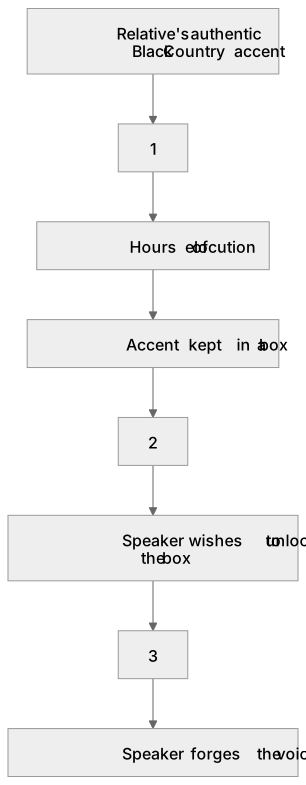
1Box 1
2Box 2
3Box 3
There is more to this lesson
The full lesson goes on to check your understanding and help you earn the marks. Create a free account to carry on, with your progress saved.
A week of Premium from your first lesson · Then the free plan continues · No card, no charge
Test your understanding of Poetry anthology: Worlds and Lives: Homing
Active recall beats re-reading. Take an instant quiz now to test what you’ve learned and lock it into long-term memory.
A week of Premium from your first lesson · Then the free plan continues · No card, no charge