AQA · GCSE · English Literature
Course version: 8702 · Version from Sept 2015
Poetry anthology: Worlds and Lives: In a London Drawingroom
George Eliot’s poem offers a bleak, critical perspective on life in Victorian London.
Checked against the AQA 8702 specification (opens in a new tab) on .
- Point 6 of 15
- 4 key terms
Study notes
From the checked teaching notes for this specification point.
The idea
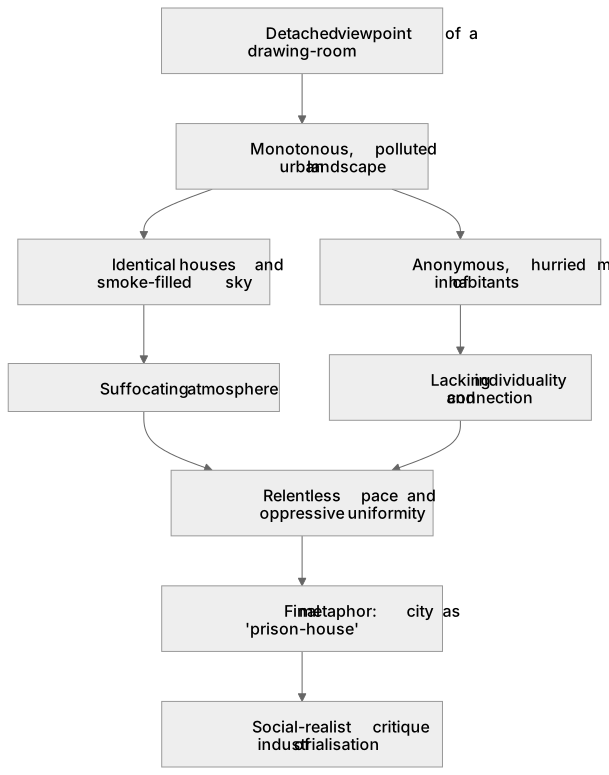
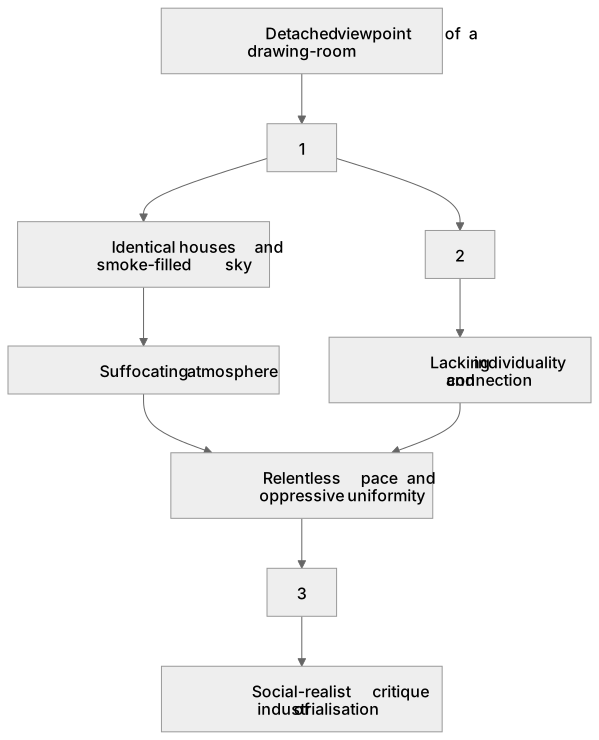
George Eliot’s poem offers a bleak, critical perspective on life in Victorian London. From the detached viewpoint of a drawing-room, the speaker observes a monotonous and polluted urban landscape where identical houses and a smoke-filled sky create a suffocating atmosphere. The city's inhabitants are depicted as an anonymous, hurried mass, lacking individuality and connection. This relentless pace and oppressive uniformity culminate in the final, powerful metaphor of the city as a 'prison-house'. The poem can be read as a social-realist critique of industrialisation, arguing that the modern city traps and dehumanises its population, severing their connection to nature and to each other. (Note: 'social-realist' is a critical interpretation, not an established fact.)
What earns the marks
- AO1: Develop an informed interpretation of the speaker's perspective as one of detached, critical observation of a dehumanising environment.
- AO1: Select precise references to support the argument that the poem critiques both the physical and psychological effects of urban life.
- AO1: In a comparative essay, explore the similar or different ways poets present feelings of confinement or freedom in a particular place.
- AO2: Analyse how the single stanza form and extensive enjambment create a sense of relentless, oppressive motion.
- AO2: Explain how the final metaphor 'one huge prison-house' summarises the poem's critique of London life.
- AO2: Explore how the poem's bleak visual imagery ('yellowed' and 'like solid fog') contributes to its monotonous and oppressive atmosphere.
- AO3: Link the poem's depiction of a polluted, overcrowded city to the context of rapid industrialisation and urban growth in Victorian London.
- AO3: Connect the poem's social-realist critique to George Eliot's wider work as a novelist concerned with the conditions of ordinary people.
- AO3: Discuss how the poem reflects Victorian anxieties about conformity, loss of individuality, and alienation in modern city life.
- AO2: "like solid fog" — Simile: This simile makes the built environment seem dense, heavy and obscuring. It conveys the oppressive quality of the city and the bleak outlook available to its inhabitants.
- AO2: "one huge prison-house" — Metaphor: This concluding metaphor presents the modern city as a vast structure of confinement, linking physical enclosure with social restriction and loss of individual freedom.
Common mistakes and how to put them right
The speaker is George Eliot herself, sitting in her own drawing-room.
Put it right: While the poem reflects views Eliot may have held, the speaker is a created persona. We should analyse the voice in the poem rather than assuming it is a direct biographical account.
The poem is only about air pollution.
Put it right: While pollution ('yellowed by the smoke') is a key element, the poem's critique is much broader. It also focuses on the monotony of the architecture, the hurried and disconnected lives of the people, and the overall psychological impact of the city as an oppressive 'prison-house'.
Because it is a Victorian poem, it must have a regular rhyme scheme.
Put it right: The poem does not have a consistent rhyme scheme. It uses iambic pentameter to create a regular rhythm, but the lack of rhyme contributes to the plain, monotonous, and prose-like description of the dreary London scene.
Exam tips
- Compare with Lines Written in Early Spring: The negative impact of human society. Difference: Eliot focuses specifically on the oppressive, monotonous urban environment of London, whereas Wordsworth contrasts the harmony of the natural world with a broader lament for 'What man has made of man,' criticising human conflict and disconnection from nature. Useful when: How poets present the relationship between humanity and the environment.
- Compare with A Wider View: The experience of life in a 19th-century industrial English city. Difference: Eliot's speaker observes a bleak, impersonal London from a distance, presenting a uniformly negative view. Seneviratne's poem enters the specific experience of a Sri Lankan migrant in 1869 Leeds, contrasting the harsh reality of 'twelve hours combing flax' with his personal search for hope and space. Useful when: How poets explore the challenges of city life.
- Compare with England in 1819: A critical view of the state of England. Difference: Eliot's critique is social and environmental, focusing on the everyday bleakness of industrial London. Shelley's is explicitly political, a sonnet attacking the monarchy, government, and army in response to the Peterloo Massacre and imagining revolution. Useful when: How poets use place to comment on the condition of a nation.
- Compare with Like an Heiress: The negative environmental impact of human activity. Difference: Eliot's poem describes the pervasive, established pollution of Victorian London ('yellowed by the smoke'). Nichols's poem presents a modern ecological anxiety, where the natural world is disrupted by 'a lone wave of rubbish,' prompting reflection on the 'fate of our planet.' Useful when: How poets present polluted or damaged environments.
Try the lesson
The start of the Poetry anthology: Worlds and Lives: In a London Drawingroom lesson, made from checked teaching notes for this specification point.
Have a go first
In 'In a London Drawingroom', which metaphor does the speaker use to describe the city in the poem's conclusion?
Listen
George Eliot’s poem offers a bleak, critical perspective on life in Victorian London. From the detached viewpoint of a drawing-room, the speaker observes a monotonous and polluted urban landscape where identical houses and a smoke-filled sky create a suffocating atmosphere. The city's inhabitants are depicted as an anonymous, hurried mass, lacking individuality and connection. This relentless pace and oppressive uniformity culminate in the final, powerful metaphor of the city as a 'prison-house'. The poem can be read as a social-realist critique of industrialisation, arguing that the modern city traps and dehumanises its population, severing their connection to nature and to each other. Note: 'social-realist' is a critical interpretation, not an established fact. A strong answer earns marks for these points. Develop an informed interpretation of the speaker's perspective as one of detached, critical observation of a dehumanising environment. Select precise references to support the argument that the poem critiques both the physical and psychological effects of urban life. In a comparative essay, explore the similar or different ways poets present feelings of confinement or freedom in a particular place. Analyse how the single stanza form and extensive enjambment create a sense of relentless, oppressive motion. A common slip: The speaker is George Eliot herself, sitting in her own drawing-room. Instead, While the poem reflects views Eliot may have held, the speaker is a created persona. We should analyse the voice in the poem rather than assuming it is a direct biographical account. Exam tip: Compare with Lines Written in Early Spring: The negative impact of human society. Difference: Eliot focuses specifically on the oppressive, monotonous urban environment of London, whereas Wordsworth contrasts the harmony of the natural world with a broader lament for 'What man has made of man,' criticising human conflict and disconnection from nature. Useful when: How poets present the relationship between humanity and the environment.
See it
Watch it explained
What is the one idea the video explains? Say it in a sentence.
Read the described scene instead
George Eliot's poem 'In a London Drawingroom' presents a bleak view of Victorian London. From a detached, critical observation point in a drawing-room, the speaker surveys a monotonous, polluted city. The poem critiques the physical and psychological effects of urban life, not only air pollution. Eliot's speaker is a created persona, so analyse the voice rather than assuming it is Eliot herself. The setting matters: the drawing-room gives distance from the street. That distance helps create a detached, critical voice. The poem's single stanza and extensive enjambment create relentless, oppressive motion. The final metaphor, 'one huge prison-house', summarises the critique of London life as confinement. The poem builds its critique through imagery and form. 'Yellowed by the smoke' uses an adjective to create a sickly, unnatural city stained by pollution. 'Like solid fog' is a simile that makes the built environment seem dense, heavy and obscuring. The concluding metaphor 'one huge prison-house' links physical enclosure with social restriction and loss of individual freedom. Avoid three common misreadings. First, the speaker is a created persona, not simply George Eliot in her own drawing-room. Second, the poem is not only air pollution: it also attacks monotony, disconnected crowds and psychological pressure. Third, it does not have a consistent rhyme scheme; its iambic pentameter and lack of rhyme contribute to a plain, monotonous description. For comparison, keep the focus precise. A useful comparison is with Wordsworth. Pause to consider the contrast. In 'Lines Written in Early Spring', Wordsworth contrasts the harmony of the natural world with a lament for 'What man has made of man'; he does not lament nature itself. With 'A Wider View', Seneviratne enters a migrant's specific experience in 1869 Leeds. 'England in 1819' is explicitly political, while 'Like an Heiress' presents modern ecological anxiety. Eliot's critique remains social and environmental, centred on everyday bleakness in industrial London. Recap the key takeaways. The poem warns about the negative impact of urbanisation. It explores alienation and isolation among anonymous, hurried people. It mourns loss of nature through pollution and a severed connection to the natural world. And it shows monotony and conformity through identical houses and oppressive uniformity, ending with the city as a prison-house.
Key words
Say what each word means before you turn the card.
Alienation and isolation
Try answering aloud or in your head before turning the card.
Loss of nature
Try answering aloud or in your head before turning the card.
Monotony and conformity
Try answering aloud or in your head before turning the card.
The negative impact of urbanisation
Try answering aloud or in your head before turning the card.
See every definition
- Alienation and isolation
- The city's inhabitants are depicted as an anonymous, hurried mass, lacking individuality and connection.
- Loss of nature
- The modern city severs its population's connection to nature, contrasting with the purity of the natural world.
- Monotony and conformity
- Identical houses and a smoke-filled sky create a suffocating atmosphere of oppressive uniformity in the urban landscape.
- The negative impact of urbanisation
- The modern city traps and dehumanises its population, severing their connection to nature and to each other.
Label the diagram
Some boxes have lost their names. Pick the right name for each number.
1Box 1
2Box 2
3Box 3
There is more to this lesson
The full lesson goes on to check your understanding and help you earn the marks. Create a free account to carry on, with your progress saved.
A week of Premium from your first lesson · Then the free plan continues · No card, no charge
Test your understanding of Poetry anthology: Worlds and Lives: In a London Drawingroom
Active recall beats re-reading. Take an instant quiz now to test what you’ve learned and lock it into long-term memory.
A week of Premium from your first lesson · Then the free plan continues · No card, no charge