AQA · GCSE · English Literature
Course version: 8702 · Version from Sept 2015
Poetry anthology: Worlds and Lives: Like an Heiress
The poem explores the speaker’s complex relationship with her Guyanese heritage upon returning.
Checked against the AQA 8702 specification (opens in a new tab) on .
- Point 7 of 15
- 4 key terms
Study notes
From the checked teaching notes for this specification point.
The idea
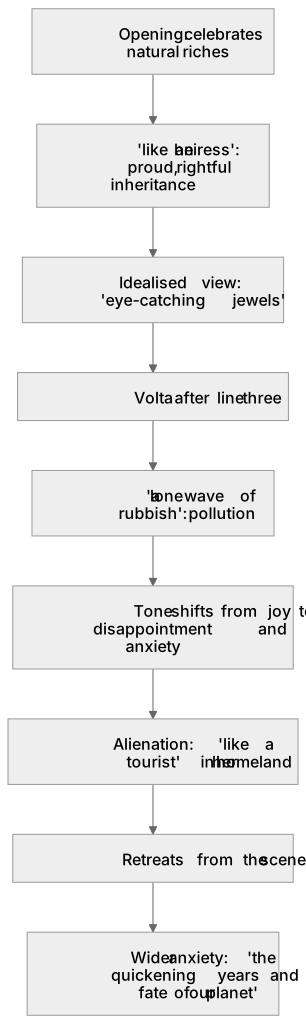
The poem explores the speaker’s complex relationship with her Guyanese heritage upon returning. It opens by celebrating the natural riches, using the simile ‘like an heiress’ to convey a sense of proud, rightful inheritance. This idealised view is shattered by the reality of pollution, captured in the image of ‘a lone wave of rubbish’. This triggers a volta, or turn, in the poem after line three, shifting the tone from joy to disappointment and anxiety. The speaker feels alienated, ‘like a tourist’ in her own homeland, and retreats from the scene. The poem uses this personal experience to comment on broader themes of environmental decay and the tension between love for a place and the painful realities of its present condition, questioning ‘the quickening years and fate of our planet’.
What earns the marks
- AO1: The speaker’s initial feelings are of pride and ownership, conveyed through the simile ‘like an heiress’ inheriting the ‘eye-catching jewels’ of her homeland.
- AO1: This positive view is abruptly challenged by the sight of ‘a lone wave of rubbish’, which creates a turning point in the poem and a shift in tone from joy to disillusionment.
- AO1: The poem ends by shifting from personal disappointment about a specific place to a wider, global anxiety about ‘the quickening years and fate of our planet’.
- AO2: The free-verse sonnet turns unusually early after line three: the brief opening establishes inherited richness, while the remaining eleven lines confront pollution, estrangement and planetary anxiety.
- AO2: The volta after line three is the key structural feature. It marks an abrupt shift in tone and focus, mirroring the speaker’s shock at the sudden intrusion of the rubbish.
- AO2: The simile ‘like a tourist’ is crucial for understanding the speaker’s resulting sense of alienation. Despite her heritage, the reality of the landscape makes her feel like a detached outsider.
- AO3: The poem engages with post-colonial themes by highlighting environmental damage in a specific Caribbean nation, connecting the local problem to a global system of consumption and waste.
- AO3: The poem’s focus on pollution and ‘the quickening years and fate of our planet’ connects the specific experience in Guyana to wider, contemporary global concerns about climate change and ecological disaster.
- AO2: “like an heiress” — Simile: This opening simile establishes the speaker’s sense of entitlement and deep connection to the natural wealth of her Guyanese heritage, which she feels is her birthright.
- AO2: “eye-catching jewels” — Metaphor: This metaphor compares the country’s natural beauty to precious gems, reinforcing the speaker’s initial idealised and romanticised view of her homeland's priceless value.
Common mistakes and how to put them right
The speaker is a wealthy heiress who is literally inheriting land.
Put it right: The phrase ‘like an heiress’ is a simile. It describes the speaker’s feeling of connection to her cultural and natural heritage, suggesting it is a rich inheritance, not that she has literal financial wealth or land ownership.
The poem is only a complaint about litter in Guyana.
Put it right: While the ‘wave of rubbish’ is the catalyst, the poem explores much broader themes: the speaker’s alienation, the pain of seeing a beloved place changed, and a wider anxiety about global climate change and ‘the quickening years and fate of our planet’.
The poem is unstructured because it is in free verse.
Put it right: The poem has a clear two-part structure. The opening three lines establish inherited richness before an early volta after line three abruptly shifts the focus to the reality of pollution and the speaker's resulting alienation.
Exam tips
- Compare with Lines Written in Early Spring: The relationship between humanity and the natural world. Difference: Wordsworth’s speaker finds spiritual harmony in an idealised English nature and laments what ‘man has made of man’. In contrast, Nichols’s speaker finds her idealised view of Guyanese nature destroyed by man-made pollution, leading to anxiety and alienation. Useful when: How poets present the impact of humanity on nature.
- Compare with In a London Drawingroom: The negative impact of a specific environment on the individual. Difference: Eliot presents industrial London as a relentlessly oppressive ‘prison-house’ that traps its inhabitants. Nichols’s speaker experiences a specific, shocking moment of environmental damage in a natural landscape and can retreat, highlighting a personal alienation rather than inescapable collective suffering. Useful when: How poets explore feelings of disconnection from one’s surroundings.
- Compare with A Wider View: Connecting with heritage and a specific place across time. Difference: Seneviratne’s speaker finds a positive, continuous link between her ancestor’s past and her present in Leeds. Nichols’s speaker experiences a jarring disconnect between her memory of Guyana’s natural heritage and its polluted present, which creates a sense of loss and anxiety. Useful when: How poets present the relationship between past and present.
- Compare with pot: Both poems examine heritage through objects and place. Difference: Khan addresses a displaced Nigerian museum artefact and demands repatriation, while Nichols uses a return to Guyana to confront environmental damage within an inherited homeland. Useful when: How poets present cultural inheritance and displacement.
Try the lesson
The start of the Poetry anthology: Worlds and Lives: Like an Heiress lesson, made from checked teaching notes for this specification point.
Have a go first
In 'Like an Heiress', what does the simile 'like an heiress' suggest about the speaker's feelings at the start of the poem?
Listen
The poem explores the speaker’s complex relationship with her Guyanese heritage upon returning. It opens by celebrating the natural riches, using the simile ‘like an heiress’ to convey a sense of proud, rightful inheritance. This idealised view is shattered by the reality of pollution, captured in the image of ‘a lone wave of rubbish’. This triggers a volta, or turn, in the poem after line three, shifting the tone from joy to disappointment and anxiety. The speaker feels alienated, ‘like a tourist’ in her own homeland, and retreats from the scene. The poem uses this personal experience to comment on broader themes of environmental decay and the tension between love for a place and the painful realities of its present condition, questioning ‘the quickening years and fate of our planet’. A strong answer earns marks for these points. The speaker’s initial feelings are of pride and ownership, conveyed through the simile ‘like an heiress’ inheriting the ‘eye-catching jewels’ of her homeland. The poem ends by shifting from personal disappointment about a specific place to a wider, global anxiety about ‘the quickening years and fate of our planet’. The free-verse sonnet turns unusually early after line three: the brief opening establishes inherited richness, while the remaining eleven lines confront pollution, estrangement and planetary anxiety. The volta after line three is the key structural feature. It marks an abrupt shift in tone and focus, mirroring the speaker’s shock at the sudden intrusion of the rubbish. A common slip: The speaker is a wealthy heiress who is literally inheriting land. Instead, The phrase ‘like an heiress’ is a simile. It describes the speaker’s feeling of connection to her cultural and natural heritage, suggesting it is a rich inheritance, not that she has literal financial wealth or land ownership. Exam tip: Compare with Lines Written in Early Spring: The relationship between humanity and the natural world. Difference: Wordsworth’s speaker finds spiritual harmony in an idealised English nature and laments what ‘man has made of man’. In contrast, Nichols’s speaker finds her idealised view of Guyanese nature destroyed by man-made pollution, leading to anxiety and alienation. Useful when: How poets present the impact of humanity on nature.
See it
Watch it explained
What is the one idea the video explains? Say it in a sentence.
Read the described scene instead
Grace Nichols’s ‘Like an Heiress’ explores a return to Guyanese heritage. The speaker first celebrates natural riches, then confronts pollution, alienation and wider anxiety about the planet. This lesson tracks that movement from proud inheritance to disappointment and global concern. The opening builds a sense of rightful inheritance. The simile ‘like an heiress’ shows the speaker feeling entitled to her homeland’s wealth. The metaphor ‘eye-catching jewels’ presents nature as precious, reinforcing an idealised view of Guyanese beauty. The poem is a free-verse sonnet with an unusually early volta. After line three, the positive opening is abruptly challenged by ‘a lone wave of rubbish’. This image creates the turning point, shifting tone from joy to disillusionment and introducing environmental decay. Consider how the speaker feels after seeing the rubbish. Pause briefly to think about the phrase ‘like a tourist’. The simile reveals alienation: despite her heritage, pollution makes her feel like a detached outsider. She retreats, and the personal shock prepares for a wider comment. Three corrections matter. ‘Like an heiress’ is a simile, not literal wealth or land ownership. The poem is not only about litter in Guyana; it also explores alienation and global climate anxiety. Free verse does not mean no structure: the early volta creates a clear two-part shape. The poem moves from personal pride to planetary concern. Its final phrase, ‘the quickening years and fate of our planet’, links Guyana’s pollution to global ecological anxiety. Heritage, nature, disappointment, alienation and belonging all meet in this short, sharply structured poem.
Key words
Say what each word means before you turn the card.
Heritage and Identity
Try answering aloud or in your head before turning the card.
Nature and the Environment
Try answering aloud or in your head before turning the card.
Disappointment and Alienation
Try answering aloud or in your head before turning the card.
Place and Belonging
Try answering aloud or in your head before turning the card.
See every definition
- Heritage and Identity
- The speaker’s complex relationship with her Guyanese heritage, including a sense of proud, rightful inheritance and later feeling like a detached outsider.
- Nature and the Environment
- The poem’s focus on environmental decay, moving from natural riches to pollution and wider anxiety about climate change and ecological disaster.
- Disappointment and Alienation
- The shift from joy to disappointment and anxiety, with the speaker feeling alienated and retreating from the scene.
- Place and Belonging
- The tension between love for a place and the painful realities of its present condition, questioning the fate of our planet.
Label the diagram
Some boxes have lost their names. Pick the right name for each number.
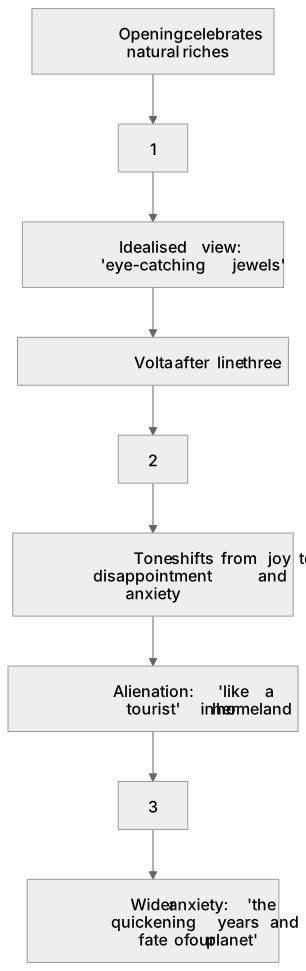
1Box 1
2Box 2
3Box 3
There is more to this lesson
The full lesson goes on to check your understanding and help you earn the marks. Create a free account to carry on, with your progress saved.
A week of Premium from your first lesson · Then the free plan continues · No card, no charge
Test your understanding of Poetry anthology: Worlds and Lives: Like an Heiress
Active recall beats re-reading. Take an instant quiz now to test what you’ve learned and lock it into long-term memory.
A week of Premium from your first lesson · Then the free plan continues · No card, no charge