AQA · GCSE · English Literature
Course version: 8702 · Version from Sept 2015
Poetry anthology: Worlds and Lives: Lines Written in Early Spring
Wordsworth's poem presents a speaker who, while relaxing in a beautiful natural grove, is struck by a profound sadness.
Checked against the AQA 8702 specification (opens in a new tab) on .
- Point 8 of 15
- 4 key terms
Study notes
From the checked teaching notes for this specification point.
The idea
Wordsworth's poem presents a speaker who, while relaxing in a beautiful natural grove, is struck by a profound sadness. The joyful harmony he observes in the birds, flowers, and budding trees contrasts sharply with his thoughts on human society. He sees nature as operating according to a benevolent principle of pleasure and peace, which leads him to lament the conflict, cruelty, and suffering that humanity inflicts upon itself. The poem is a quintessential Romantic meditation on the moral and spiritual superiority of the natural world and a critique of a human world that has become disconnected from it, famously asking the sorrowful question, 'What man has made of man'.
What earns the marks
- AO1: Understand the poem as a lament where the speaker contrasts the perceived joy in nature with the sadness of the human condition.
- AO1: Use textual references to show how the speaker builds this contrast, moving between observations of nature and reflections on humanity.
- AO1: Compare the presentation of nature as a moral guide here with its role as a source of healing in 'Shall earth no more inspire thee'.
- AO2: Discuss Wordsworth's use of personification to give nature agency and feeling, such as the flowers enjoying the air; be careful not to label 'sweet mood' as pathetic fallacy, since the mood is the speaker's own.
- AO3: Link the poem's idealisation of nature and criticism of humanity to the core ideas of the Romantic movement.
- AO3: Connect the speaker's lament to the social and environmental upheaval of the Industrial Revolution in the late 18th century.
- AO3: Consider the poem's publication date (1798) in the context of the political turmoil following the French Revolution, which may inform the phrase 'What man has made of man'.
Common mistakes and how to put them right
The poem is just a simple description of a happy day in the countryside.
Put it right: While it begins with a pleasant natural scene, the poem's core purpose is to use that scene to launch a profound and sorrowful critique of human society and its capacity for causing suffering.
Wordsworth is angry at humanity for destroying nature.
Put it right: The speaker's tone is more of sadness and lament than anger. The focus is less on environmental destruction and more on humanity's failure to live by the joyful, harmonious example nature provides.
The 'holy plan' means Wordsworth is writing a religious, Christian poem.
Put it right: While using religious language, Wordsworth's 'holy plan' refers to a spiritual idea, common in Romanticism, that a divine spirit is present in nature itself. It is a moral and spiritual code found in the natural world, not a specific Christian doctrine, and the conditional phrasing invites an interpretive reading.
Exam tips
- Compare with England in 1819: Both Romantic poems offer a powerful critique of the state of human society. Difference: Wordsworth's speaker finds a moral standard in a tranquil natural setting, from which he laments humanity's general failings. In contrast, Shelley's sonnet is a direct and furious political attack on specific English institutions like the monarchy and government, ending with an abstract hope for revolution. Useful when: How poets present social criticism.
- Compare with Shall earth no more inspire thee: Both poems present the natural world as a positive and restorative force. Difference: In Wordsworth's poem, the speaker is a passive observer of nature whose joy leads him to lament humanity's separation from it. In Brontë's poem, the speaker, who can be read as nature personified, actively addresses and implores a troubled individual to return to nature to be healed. Useful when: How poets explore the relationship between humanity and nature.
- Compare with In a London Drawingroom: Both poems critique the negative impact of industrialised, urban environments on the human spirit. Difference: Wordsworth's poem is set in a natural grove and critiques human society from a distance. Eliot's poem is set deep within the oppressive London cityscape itself, detailing the 'solid fog' and relentless hurry of a world where nature is almost entirely absent. Useful when: How poets present the effects of environment on people.
- Compare with A Wider View: Both poems explore a contrast between the harshness of the industrial world and a desire for something better. Difference: Wordsworth's poem offers a generalised, philosophical lament about humanity's separation from nature's 'holy plan'. Seneviratne's poem focuses on a specific historical individual, her ancestor, whose craving for 'a wider view' is a personal response to the grim realities of industrial labour in Leeds. Useful when: How poets explore responses to difficult environments.
Try the lesson
The start of the Poetry anthology: Worlds and Lives: Lines Written in Early Spring lesson, made from checked teaching notes for this specification point.
Have a go first
In 'Lines Written in Early Spring', what does the speaker hear while sitting in the grove?
Listen
Wordsworth's poem presents a speaker who, while relaxing in a beautiful natural grove, is struck by a profound sadness. The joyful harmony he observes in the birds, flowers, and budding trees contrasts sharply with his thoughts on human society. He sees nature as operating according to a benevolent principle of pleasure and peace, which leads him to lament the conflict, cruelty, and suffering that humanity inflicts upon itself. The poem is a quintessential Romantic meditation on the moral and spiritual superiority of the natural world and a critique of a human world that has become disconnected from it, famously asking the sorrowful question, 'What man has made of man'. A strong answer earns marks for these points. Understand the poem as a lament where the speaker contrasts the perceived joy in nature with the sadness of the human condition. Use textual references to show how the speaker builds this contrast, moving between observations of nature and reflections on humanity. Compare the presentation of nature as a moral guide here with its role as a source of healing in 'Shall earth no more inspire thee'. Analyse how the simple, ballad-like metre and rhyme create a musical quality that reflects the harmony of nature; note that the first stanza is ABCB because 'notes' and 'thoughts' do not rhyme, so the scheme is not uniformly ABAB. A common slip: The poem is just a simple description of a happy day in the countryside. Instead, While it begins with a pleasant natural scene, the poem's core purpose is to use that scene to launch a profound and sorrowful critique of human society and its capacity for causing suffering. Exam tip: Compare with England in 1819: Both Romantic poems offer a powerful critique of the state of human society. Difference: Wordsworth's speaker finds a moral standard in a tranquil natural setting, from which he laments humanity's general failings. In contrast, Shelley's sonnet is a direct and furious political attack on specific English institutions like the monarchy and government, ending with an abstract hope for revolution. Useful when: How poets present social criticism.
See it
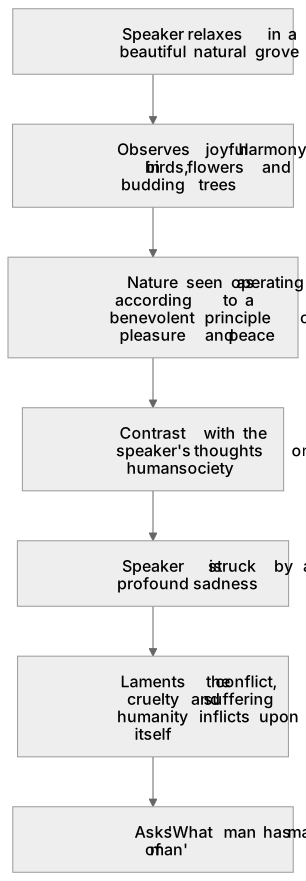
Put it in order
Put these steps in the order they happen.
- 1. Asks 'What man has made of man'
- 2. Laments the conflict, cruelty and suffering humanity inflicts upon itself
- 3. Nature seen as operating according to a benevolent principle of pleasure and peace
- 4. Speaker is struck by a profound sadness
- 5. Speaker relaxes in a beautiful natural grove
- 6. Observes joyful harmony in birds, flowers and budding trees
- 7. Contrast with the speaker's thoughts on human society
Watch it explained
What is the one idea the video explains? Say it in a sentence.
Read the described scene instead
Wordsworth's speaker relaxes in a beautiful grove, yet feels profound sadness. The joyful birds, flowers and budding trees contrast with his thoughts about human society. The poem sets nature's harmony against human conflict, a Romantic contrast. The speaker sees nature as following a benevolent principle of pleasure and peace, a 'holy plan'. Humanity, by contrast, inflicts cruelty and suffering on itself. Wordsworth uses a simple, ballad-like metre and rhyme to create a musical quality. The first stanza is ABCB because 'notes' and 'thoughts' do not rhyme, so the scheme is not uniformly ABAB. This sound reflects nature's harmony. A useful connection is the poem's sorrowful question about human society. Pause to think about what is being lamented. The speaker asks, 'Have I not reason to lament / What man has made of man?' Here, 'What man has made of man' is the object of lament, not a standalone rhetorical question. The repetition of 'man' stresses that humanity causes its own suffering. The poem is not just a happy countryside description; it uses the pleasant scene to critique human society. The speaker's tone is sadness and lament, not anger at humanity for destroying nature. The 'holy plan' uses religious language for a spiritual order in nature, not a specific Christian doctrine. Remember: nature's joyful harmony contrasts with human conflict and suffering. The speaker laments 'What man has made of man', seeing humanity as the source of its own pain. The simple, musical form supports the harmony, and personification gives nature feeling and agency. Nature appears as a moral and spiritual guide.
Key words
Say what each word means before you turn the card.
Nature and Humanity
Try answering aloud or in your head before turning the card.
Spirituality and Morality
Try answering aloud or in your head before turning the card.
Conflict and Suffering
Try answering aloud or in your head before turning the card.
Joy and Sadness
Try answering aloud or in your head before turning the card.
See every definition
- Nature and Humanity
- The joyful harmony the speaker observes in the birds, flowers and budding trees contrasts sharply with his thoughts on human society.
- Spirituality and Morality
- Nature is seen as operating according to a benevolent principle of pleasure and peace, a moral and spiritual order humanity has abandoned.
- Conflict and Suffering
- The speaker laments the conflict, cruelty and suffering that humanity inflicts upon itself, famously asking what man has made of man.
- Joy and Sadness
- A profound sadness strikes the speaker while relaxing in a beautiful natural grove, prompted by the contrast between his mood and the joyful scene.
Label the diagram
Some boxes have lost their names. Pick the right name for each number.
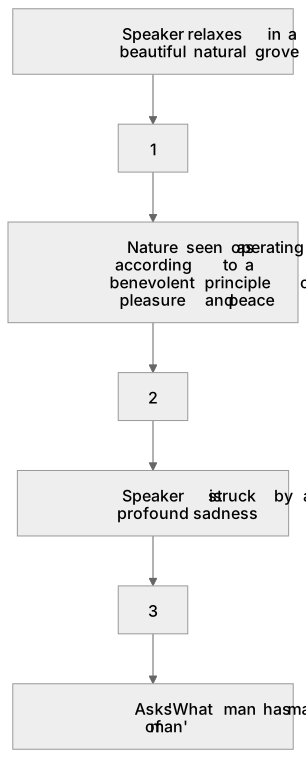
1Box 1
2Box 2
3Box 3
There is more to this lesson
The full lesson goes on to check your understanding and help you earn the marks. Create a free account to carry on, with your progress saved.
A week of Premium from your first lesson · Then the free plan continues · No card, no charge
Test your understanding of Poetry anthology: Worlds and Lives: Lines Written in Early Spring
Active recall beats re-reading. Take an instant quiz now to test what you’ve learned and lock it into long-term memory.
A week of Premium from your first lesson · Then the free plan continues · No card, no charge