AQA · GCSE · English Literature
Course version: 8702 · Version from Sept 2015
Poetry anthology: Worlds and Lives: Name Journeys
Raman Mundair's 'Name Journeys' explores the profound connection between identity, language and migration.
Checked against the AQA 8702 specification (opens in a new tab) on .
- Point 9 of 15
- 4 key terms
Study notes
From the checked teaching notes for this specification point.
The idea
Raman Mundair's 'Name Journeys' explores the profound connection between identity, language and migration. The speaker reflects on the pressure to assimilate, symbolised by the difficulty English speakers have with her name and the feeling of her Punjabi heritage becoming 'dislodged'. This personal experience of cultural displacement is elevated through allusions to significant figures from Hindu epics (Itihasa), such as Rama, Sita and Draupadi. By linking her own journey to these epic stories of exile, trial and endurance, the speaker frames migration not just as a physical move but as a spiritual and emotional ordeal. The poem argues that cultural inheritance is fragile and must be actively preserved against forces that seek to erase it, finding solidarity and strength in shared female experience.
What earns the marks
- AO1: Understand and respond to the poem's exploration of how a name is central to identity and cultural heritage.
- AO1: Select precise references to show how the speaker links her personal journey of migration to the epic journeys of mythological figures.
- AO1: Make clear comparative points about how feelings of displacement or cultural pressure are presented in 'Name Journeys' and another poem.
- AO2: Analyse how Mundair varies the ghazal: she retains couplets but replaces a strict metre and rhyme scheme with free verse and enjambment, linking cultural inheritance with formal adaptation.
- AO2: Explain the effects of metaphors such as 'infertile English soil' and the allusion 'trial by fire' in conveying the challenges of migration.
- AO2: Analyse how the poem's structure moves between personal reflection and mythological allusion, linking the speaker's journey to epic stories of exile.
- AO3: Show understanding of the significance of the allusions to Rama, Sita and Draupadi from Hindu epics like the Ramayana and Mahabharata.
- AO3: Relate the poem's ideas about language to the context of the South Asian diaspora and the pressure for migrants to anglicise their names and assimilate.
- AO3: Explain how the poem's themes of exile and endurance connect to broader historical and contemporary experiences of migration and cultural identity.
- AO2: "trial by fire" — Allusion: A direct reference to Sita's ordeal to prove her purity, this allusion frames the migrant's experience as a painful test of identity and integrity in a new, often hostile, environment.
Common mistakes and how to put them right
The poem is a direct retelling of the stories of Sita and Draupadi.
Put it right: The poem alludes to these figures to enrich the speaker's personal story. The focus is on the speaker's own 'name journey' and feelings of displacement, using the mythological characters as powerful parallels, not as the main subject.
The speaker is rejecting her heritage by moving to England.
Put it right: The poem shows the opposite: the speaker is struggling to hold onto her heritage in an environment she feels is hostile to it ('infertile English soil'). Her reflections show a deep connection to her culture and a sense of loss that it is being eroded.
The poem follows a fully traditional ghazal with a strict rhyme scheme.
Put it right: It varies the ghazal: it retains couplets and the form's concerns with loss, spiritual love and separation, but uses free verse and enjambment instead of a strict metre and rhyme scheme.
Exam tips
- Compare with pot: Both poems explore the displacement of cultural heritage and disconnection from roots. Difference: 'Name Journeys' focuses on an internal experience of linguistic and spiritual displacement, using myth as a framework. In contrast, 'pot' addresses a displaced Nigerian museum artefact to expose colonial appropriation and argue for cultural repatriation. Useful when: How poets present feelings of loss and connection to heritage.
- Compare with Homing: Both poems address the suppression of cultural and linguistic identity within an English-speaking environment. Difference: Mundair's speaker feels her Punjabi language is being 'dislodged' by external pressures in a new country. Berry's poem focuses on a relative's deliberate, internalised suppression of a regional Black Country accent due to elocution lessons, which the speaker now wishes to recover and celebrate. Useful when: How poets explore the relationship between language and identity.
- Compare with A Wider View: Both poems connect a contemporary speaker's experience to that of ancestors or historical figures who have migrated or been displaced. Difference: 'Name Journeys' uses mythological figures (Sita, Draupadi) to explore the spiritual and emotional trials of migration. 'A Wider View' imagines the specific, historical reality of the speaker's ancestor in industrial Leeds, focusing on the physical hardships of labour and poor living conditions. Useful when: How poets link past and present experiences of migration.
- Compare with On an Afternoon Train from Purley to Victoria, 1955: Both poems explore the experience of migration to England and the negotiation of cultural identity in a new environment. Difference: 'Name Journeys' presents a more internal and painful reflection on cultural loss and the struggle to maintain heritage. 'On an Afternoon Train' depicts a specific, conversational encounter between a migrant and another person, exploring the potential for connection and misunderstanding across cultures. Useful when: How poets present the challenges and encounters of migrant experiences.
Try the lesson
The start of the Poetry anthology: Worlds and Lives: Name Journeys lesson, made from checked teaching notes for this specification point.
Have a go first
In Raman Mundair's 'Name Journeys', which metaphor presents England as a place where the speaker's cultural roots cannot flourish?
Listen
Raman Mundair's 'Name Journeys' explores the profound connection between identity, language and migration. The speaker reflects on the pressure to assimilate, symbolised by the difficulty English speakers have with her name and the feeling of her Punjabi heritage becoming 'dislodged'. This personal experience of cultural displacement is elevated through allusions to significant figures from Hindu epics (Itihasa), such as Rama, Sita and Draupadi. By linking her own journey to these epic stories of exile, trial and endurance, the speaker frames migration not just as a physical move but as a spiritual and emotional ordeal. The poem argues that cultural inheritance is fragile and must be actively preserved against forces that seek to erase it, finding solidarity and strength in shared female experience. A strong answer earns marks for these points. Understand and respond to the poem's exploration of how a name is central to identity and cultural heritage. Select precise references to show how the speaker links her personal journey of migration to the epic journeys of mythological figures. Make clear comparative points about how feelings of displacement or cultural pressure are presented in 'Name Journeys' and another poem. Analyse how Mundair varies the ghazal: she retains couplets but replaces a strict metre and rhyme scheme with free verse and enjambment, linking cultural inheritance with formal adaptation. A common slip: The poem is a direct retelling of the stories of Sita and Draupadi. Instead, The poem alludes to these figures to enrich the speaker's personal story. The focus is on the speaker's own 'name journey' and feelings of displacement, using the mythological characters as powerful parallels, not as the main subject. Exam tip: Compare with pot: Both poems explore the displacement of cultural heritage and disconnection from roots. Difference: 'Name Journeys' focuses on an internal experience of linguistic and spiritual displacement, using myth as a framework. In contrast, 'pot' addresses a displaced Nigerian museum artefact to expose colonial appropriation and argue for cultural repatriation. Useful when: How poets present feelings of loss and connection to heritage.
See it
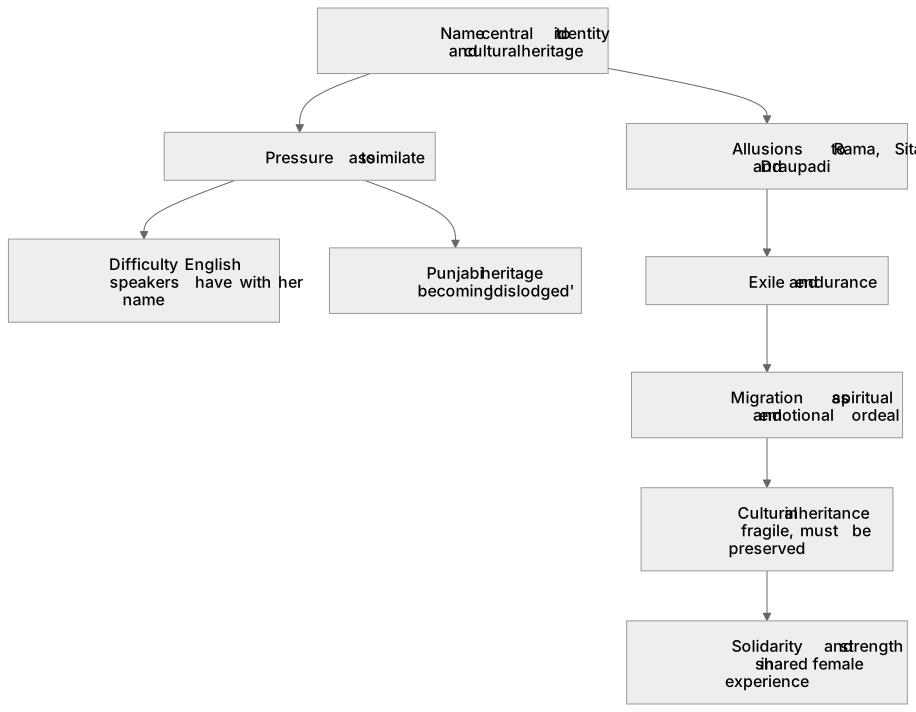
Watch it explained
What is the one idea the video explains? Say it in a sentence.
Read the described scene instead
Raman Mundair's 'Name Journeys' explores identity, language and migration. The speaker feels pressure to assimilate, and her Punjabi heritage seems dislodged. Her name becomes a symbol of that struggle. A name is central to identity and cultural heritage. English speakers struggle with her name, and she feels pressure to anglicise it. The poem connects this personal pressure to the wider South Asian diaspora experience of assimilation. Mundair alludes to Hindu epics, Itihasa, including the Ramayana and Mahabharata. The phrase felt the wilderness echoes Rama and Sita's exile. The phrase trial by fire recalls Sita's ordeal, framing migration as a painful test of identity and integrity. Pause here: how does form meet theme? The metaphor 'infertile English soil' depicts England as unable to nourish her cultural roots. The adjective 'void' and abstract nouns 'history' and 'memory' convey disconnection and loss. The poem varies the ghazal: it keeps couplets but uses free verse and enjambment, linking cultural inheritance with formal adaptation. The poem is not a direct retelling of Sita and Draupadi; it uses them as parallels to the speaker's own name journey. Nor does the speaker reject her heritage: she struggles to preserve it against erosion. And it is not a strict traditional ghazal, because it uses free verse and enjambment. So 'Name Journeys' presents migration as physical and spiritual. The speaker's name and language expose pressure to assimilate, while mythic exile and trial give her experience epic scale. Female solidarity appears in 'spiritual sari-sisters entwined', a phrase whose sibilance and metaphor suggest deep connection.
Key words
Say what each word means before you turn the card.
Identity and names
Try answering aloud or in your head before turning the card.
Migration and displacement
Try answering aloud or in your head before turning the card.
Cultural heritage and language
Try answering aloud or in your head before turning the card.
Female experience and solidarity
Try answering aloud or in your head before turning the card.
See every definition
- Identity and names
- The poem explores how a name is central to identity and cultural heritage, and the pressure to assimilate is symbolised by the difficulty English speakers have with her name.
- Migration and displacement
- The speaker's personal experience of cultural displacement is framed as not just a physical move but a spiritual and emotional ordeal, linking her journey to epic stories of exile.
- Cultural heritage and language
- Cultural inheritance is fragile and must be actively preserved against forces that seek to erase it, with the speaker feeling her Punjabi heritage becoming 'dislodged'.
- Female experience and solidarity
- The poem finds solidarity and strength in shared female experience, suggesting a deep, spiritual bond between women who share similar struggles across time and myth.
Label the diagram
Some boxes have lost their names. Pick the right name for each number.
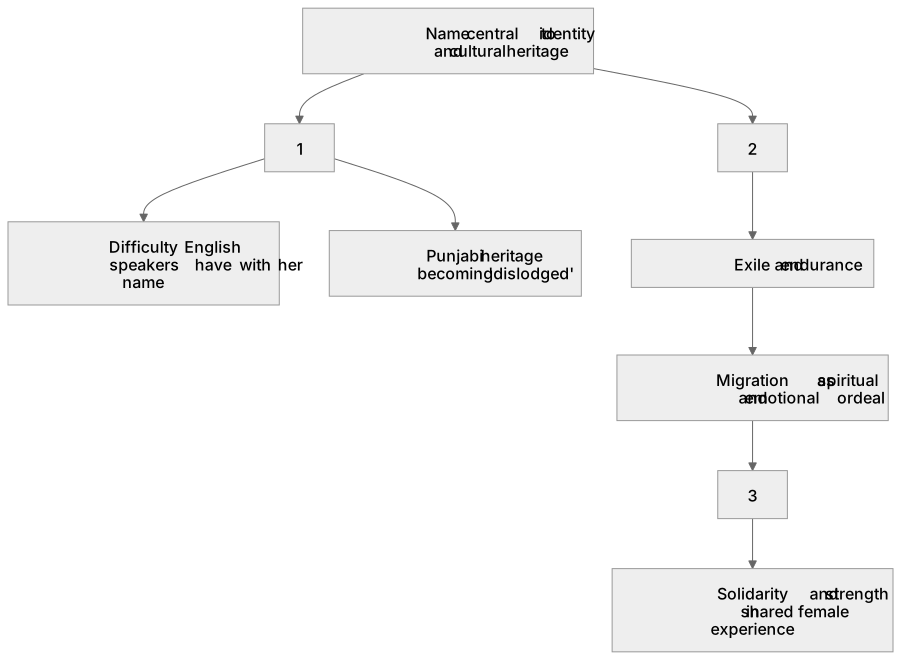
1Box 1
2Box 2
3Box 3
There is more to this lesson
The full lesson goes on to check your understanding and help you earn the marks. Create a free account to carry on, with your progress saved.
A week of Premium from your first lesson · Then the free plan continues · No card, no charge
Test your understanding of Poetry anthology: Worlds and Lives: Name Journeys
Active recall beats re-reading. Take an instant quiz now to test what you’ve learned and lock it into long-term memory.
A week of Premium from your first lesson · Then the free plan continues · No card, no charge