AQA · GCSE · English Literature
Shakespeare and the 19th-century novel
Master the complexities of Shakespeare and the 19th-century novel with this comprehensive guide. We decode the examiner's mindset, break down key themes and characters, and provide the precise analytical tools you need to secure top marks in Paper 3.1.
- 6 min read
- 2 worked examples
- 4 practice questions
- 8 key terms
Study Notes
Overview
Welcome to your complete revision guide for Paper 3.1: Shakespeare and the 19th-century novel. This paper is a rigorous test of your ability to engage critically with two of the most significant pillars of English Literature. Examiners are not looking for simple plot summaries; they are looking for perceptive, conceptualised responses that seamlessly integrate textual analysis (AO2) with contextual understanding (AO3). Whether you are exploring the bloody ambition of Macbeth or the social conscience of A Christmas Carol, your goal is to construct a compelling argument that demonstrates a deep appreciation of the writer's craft and the world in which they were writing.
Listen to our comprehensive revision podcast to reinforce your learning:
Shakespeare: Plot & Content Overview
While the specific play varies, the structural trajectory of Shakespeare's tragedies and problem plays often follows a distinct pattern. The exposition establishes the status quo and introduces the inciting incident (e.g., the witches' prophecy in Macbeth). The rising action builds tension through conflict and complication, leading to a pivotal climax (often in Act 3) where the protagonist's fate is sealed. The falling action unravels the consequences of the climax, culminating in a tragic resolution or denouement that restores order, often at a terrible cost.
19th-Century Novel: Plot & Content Overview
The 19th-century novel typically traces a protagonist's journey through a society fraught with moral, social, or scientific challenges. Novels like A Christmas Carol or Great Expectations follow a structure of moral awakening or bildungsroman (coming-of-age), moving from ignorance or flaw, through a series of trials or supernatural interventions, to a state of redemption, self-awareness, or tragic consequence.
Themes
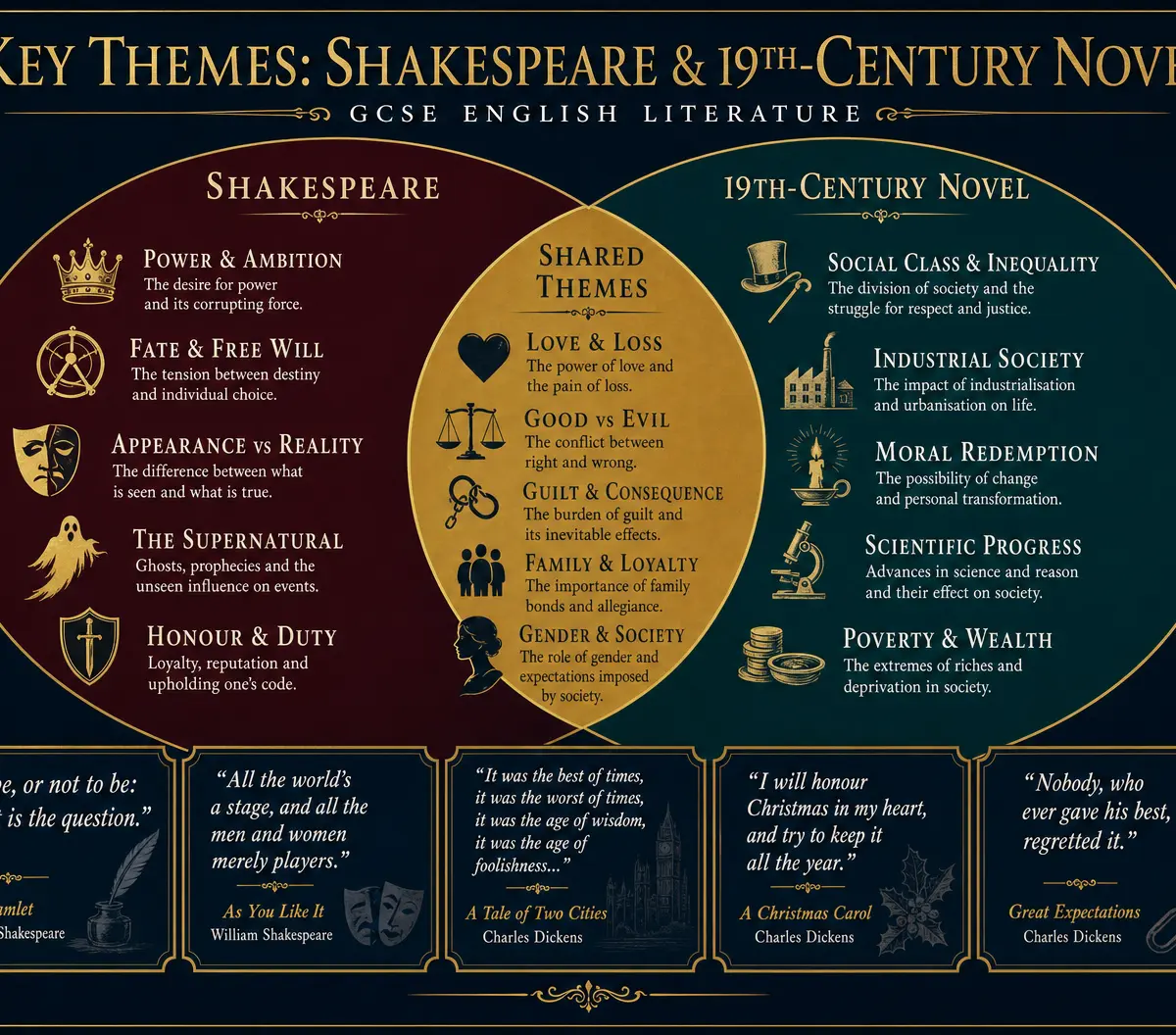
Theme 1: Power and Ambition
In Shakespearean tragedy, ambition is frequently presented as a corrupting force that disrupts the natural order (the Great Chain of Being). The desire for power leads to moral decay and inevitable downfall. In the 19th-century novel, power is often explored through the lens of social class and wealth, highlighting the exploitation of the vulnerable by the powerful.
Key Quotes:
- "I have no spur / To prick the sides of my intent, but only / Vaulting ambition, which o'erleaps itself / And falls on the' other." (Macbeth, Act 1 Scene 7) - Shakespeare uses the metaphor of horse-riding to illustrate how unchecked ambition leads to disaster.
- "Are there no prisons?" (A Christmas Carol, Stave 1) - Dickens uses Scrooge's rhetorical question to expose the callous indifference of the wealthy towards the destitute.
Theme 2: Appearance vs. Reality
The tension between what seems to be and what is forms the core of much literary conflict. Characters wear 'masks' to conceal their true intentions, creating dramatic irony and suspense.
Key Quotes:
- "Look like the innocent flower, / But be the serpent under't." (Macbeth, Act 1 Scene 5) - Lady Macbeth's imperative employs juxtaposed natural imagery to advocate for dangerous deception.
- "There is no playing fast and loose with the truth..." (Great Expectations) - The 19th-century novel often punishes those who attempt to deceive society or themselves.
Character Analysis
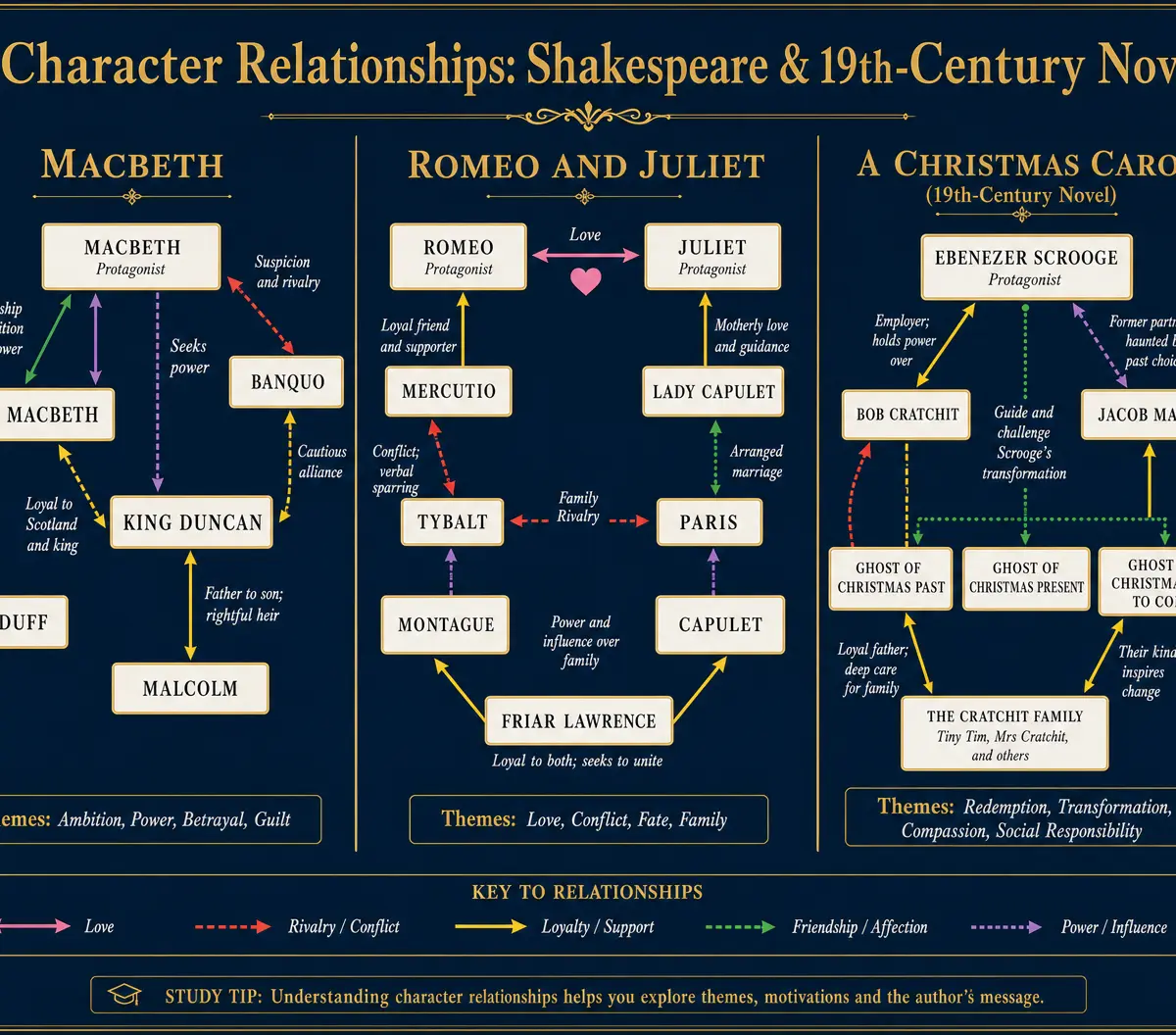
The Tragic Hero / Flawed Protagonist
Role: The central figure whose journey drives the narrative, often possessing a fatal flaw (hamartia) that leads to their downfall or necessitates redemption.
Key Traits: Ambitious, conflicted, initially respected, ultimately isolated or transformed.
Character Arc: Moves from a position of security, through a period of intense internal and external conflict, arriving at either tragic ruin (Macbeth) or moral salvation (Scrooge).
Essential Quotes:
- "O, full of scorpions is my mind, dear wife!" (Macbeth) - The metaphor of 'scorpions' vividly captures the psychological torment of guilt.
- "I am as light as a feather, I am as happy as an angel..." (A Christmas Carol) - Dickens uses a series of joyous similes to emphasise the totality of Scrooge's rebirth.
Writer's Methods
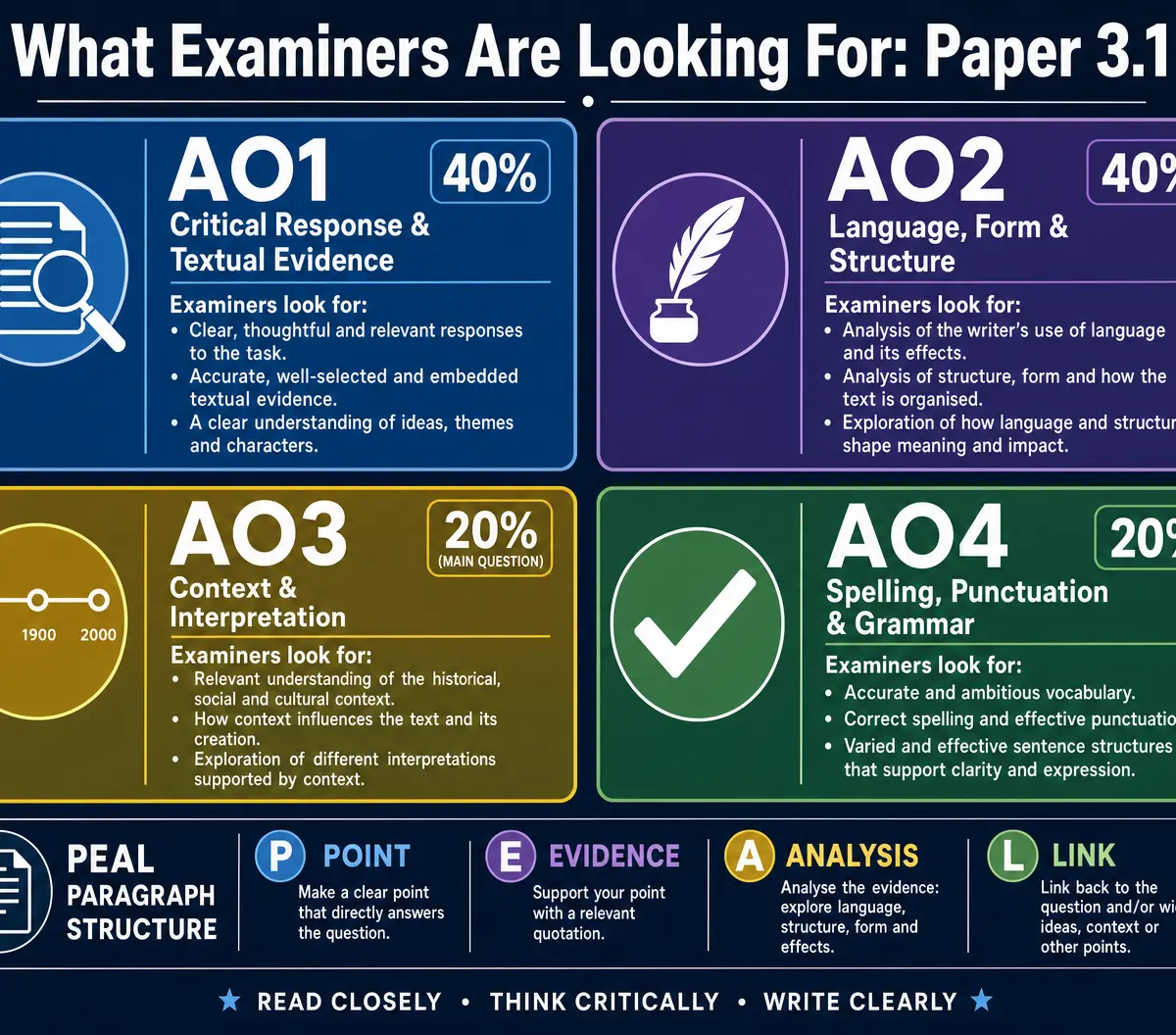
Examiners heavily reward the analysis of methods (AO2). For Shakespeare, focus on the dramatic form: soliloquies that reveal inner turmoil, the shift between verse (iambic pentameter) and prose to indicate status or sanity, and the use of dramatic irony to build tension. For the 19th-century novel, focus on narrative voice (first-person intimacy vs. third-person omniscience), structural devices like cyclical narratives or cliffhangers, and the use of setting as a reflection of character (pathetic fallacy).
Context
Context (AO3) must be integrated, not bolted on. For Shakespeare, connect your analysis to Elizabethan/Jacobean anxieties: the divine right of kings, patriarchal structures, and the genuine fear of the supernatural. For the 19th-century novel, link your points to Victorian concerns: the impact of the Industrial Revolution, the harsh realities of the Poor Law, the rigid class system, and the tension between scientific advancement and religious faith.
Visual Resources
3 diagrams and illustrations
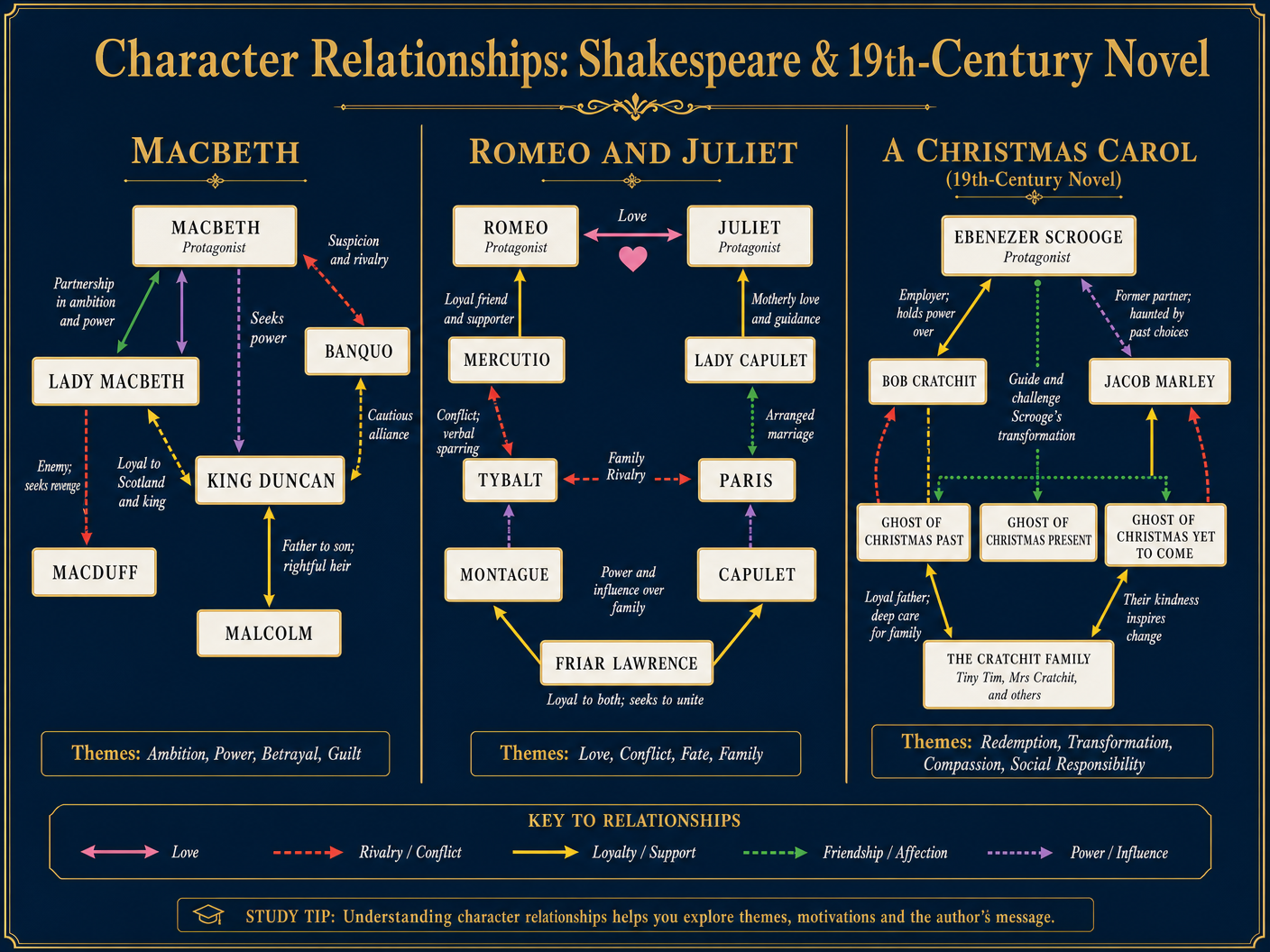
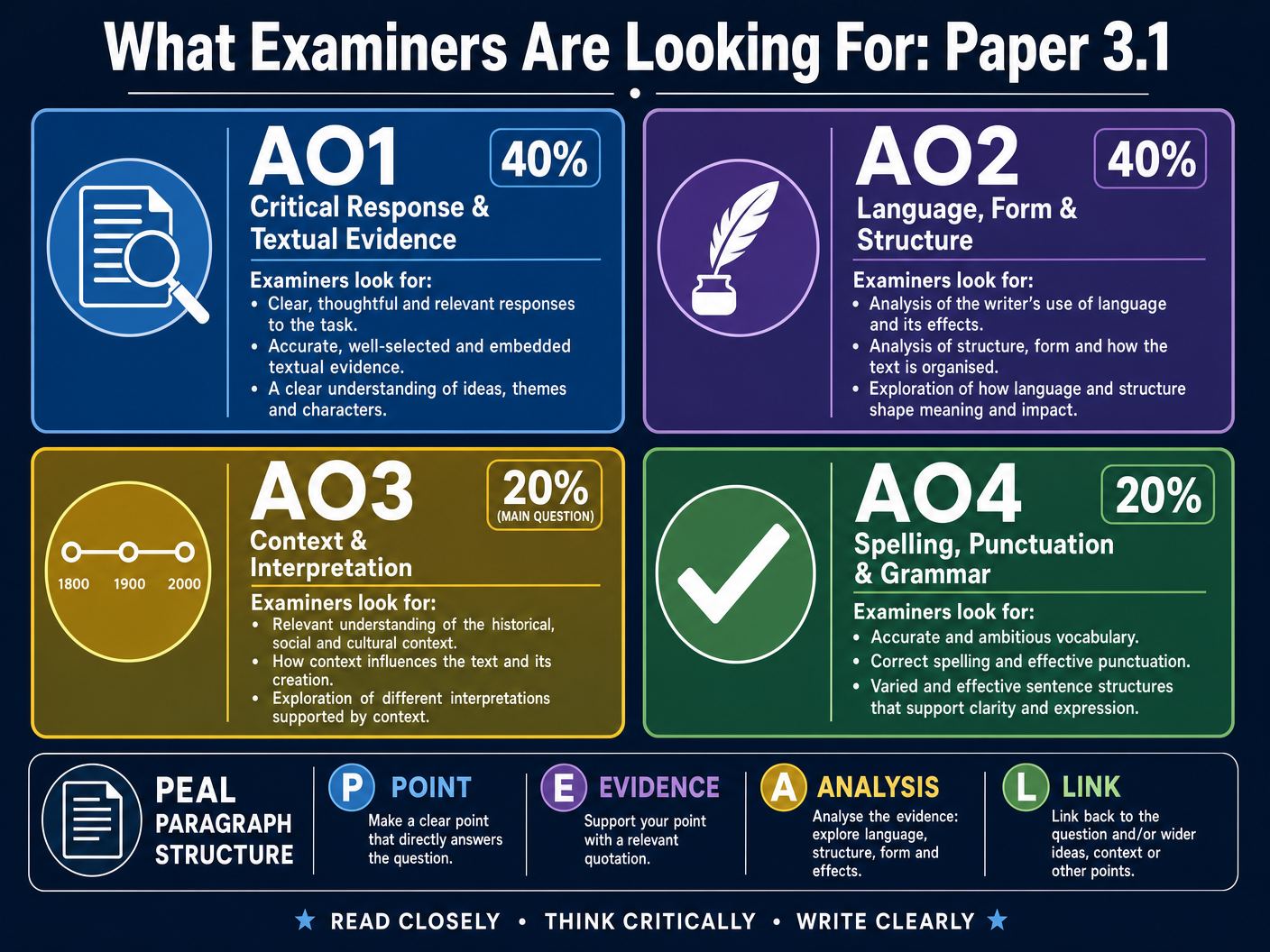
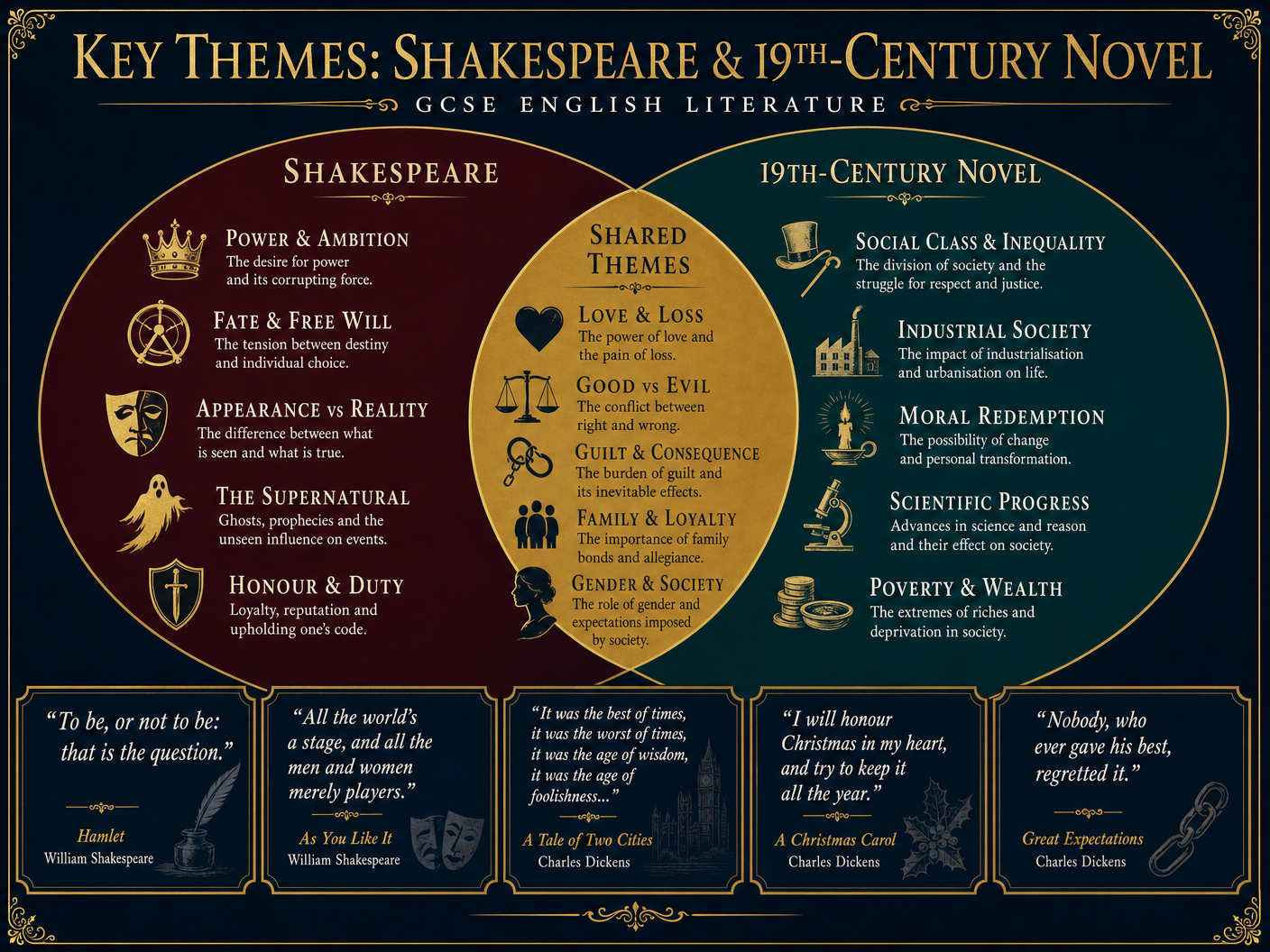
Interactive Diagrams
1 interactive diagram to visualise key concepts
Conceptual Flow Outline
The Typical Structure of a Shakespearean Tragedy
Worked Examples
2 worked examples — open one to explore the question and available guidance.
Practice Questions
Test your understanding — click to reveal model answers
Starting with this extract, explore how the writer presents the corrupting influence of power. Write about how power is presented in the extract, and how it is presented in the text as a whole.
Hint: Consider how the desire for power changes the character's language, relationships, and moral boundaries.
Starting with this extract, explore how the writer presents the theme of isolation. Write about how isolation is presented in the extract, and how it is presented in the text as a whole.
Hint: Look at whether the isolation is self-imposed or forced by society, and how the writer uses setting to reflect this.
Starting with this extract, explore how the writer presents the conflict between good and evil. Write about how this conflict is presented in the extract, and how it is presented in the text as a whole.
Hint: Consider how the writer uses light and dark imagery, or contrasting characters (foils), to represent this conflict.
Starting with this extract, explore how the writer presents the role of women/gender expectations. Write about how gender is presented in the extract, and how it is presented in the text as a whole.
Hint: Look for moments where characters either conform to or subvert the patriarchal expectations of their time.
Test your understanding of Shakespeare and the 19th-century novel
Active recall beats re-reading. Take an instant quiz now to test what you’ve learned and lock it into long-term memory.
7 days Premium · Then free forever · No card, no charge