AQA · GCSE · English Literature
Skills
Master the essential skills of reading comprehension and critical analysis for GCSE English Literature. This guide equips you with the tools to move beyond surface-level reading, teaching you how to infer meaning, analyse writer's methods, and evaluate texts critically to secure top marks.
- 5 min read
- 2 worked examples
- 4 practice questions
- 8 key terms
Study Notes
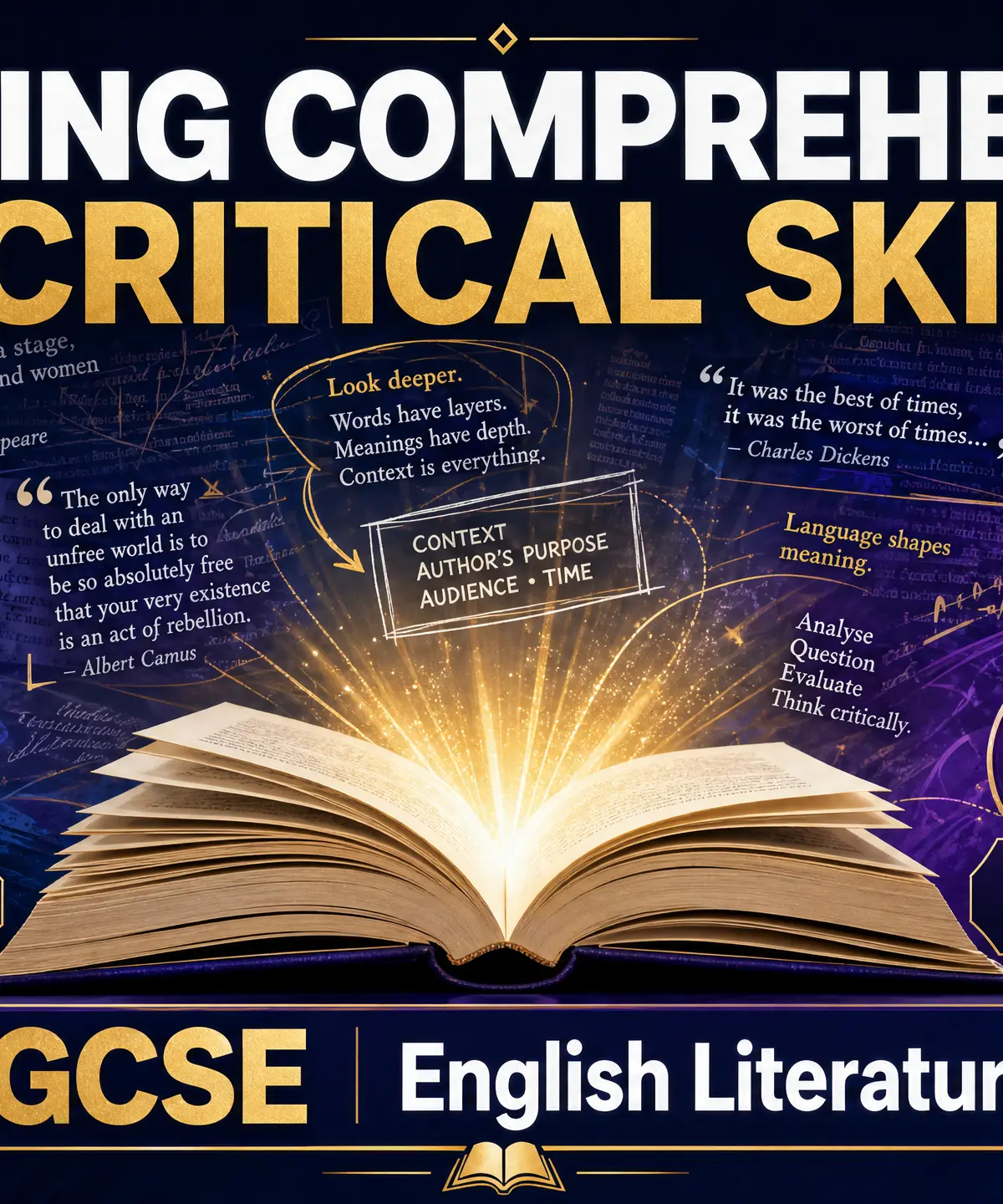
Overview
Reading comprehension and critical reading are the foundational skills of GCSE English Literature. Examiners are not looking for a simple retelling of the plot; they want to see that you can read between the lines, understand how writers construct meaning, and evaluate the impact of their choices. Whether you are analysing a Shakespearean tragedy, a 19th-century novel, or an unseen poem, the ability to decode language, form, and structure is what separates an average response from an exceptional one. This guide will teach you how to transition from literal comprehension to perceptive, critical analysis.
Listen to our comprehensive audio guide here:
The Reading Skills Pyramid
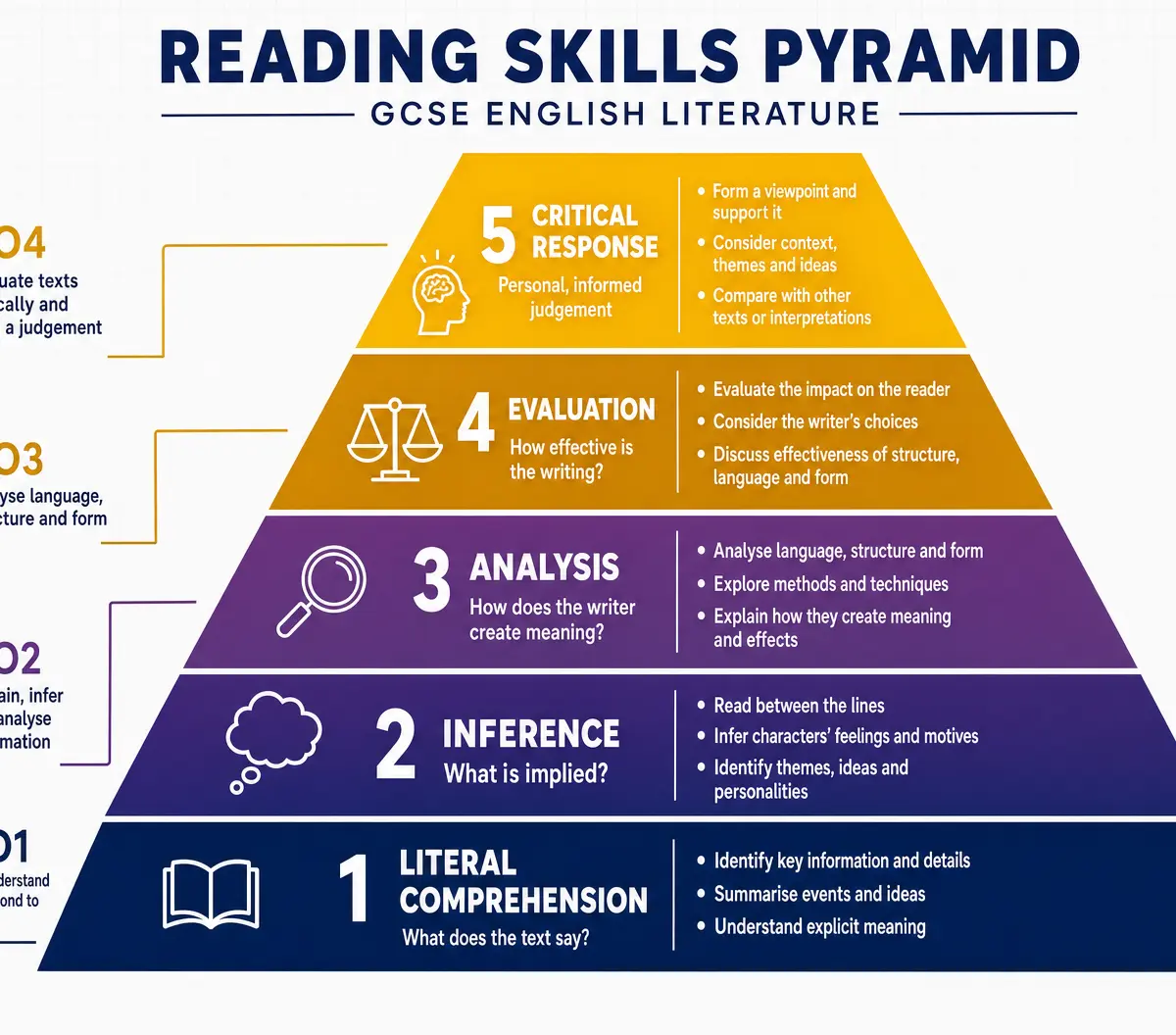
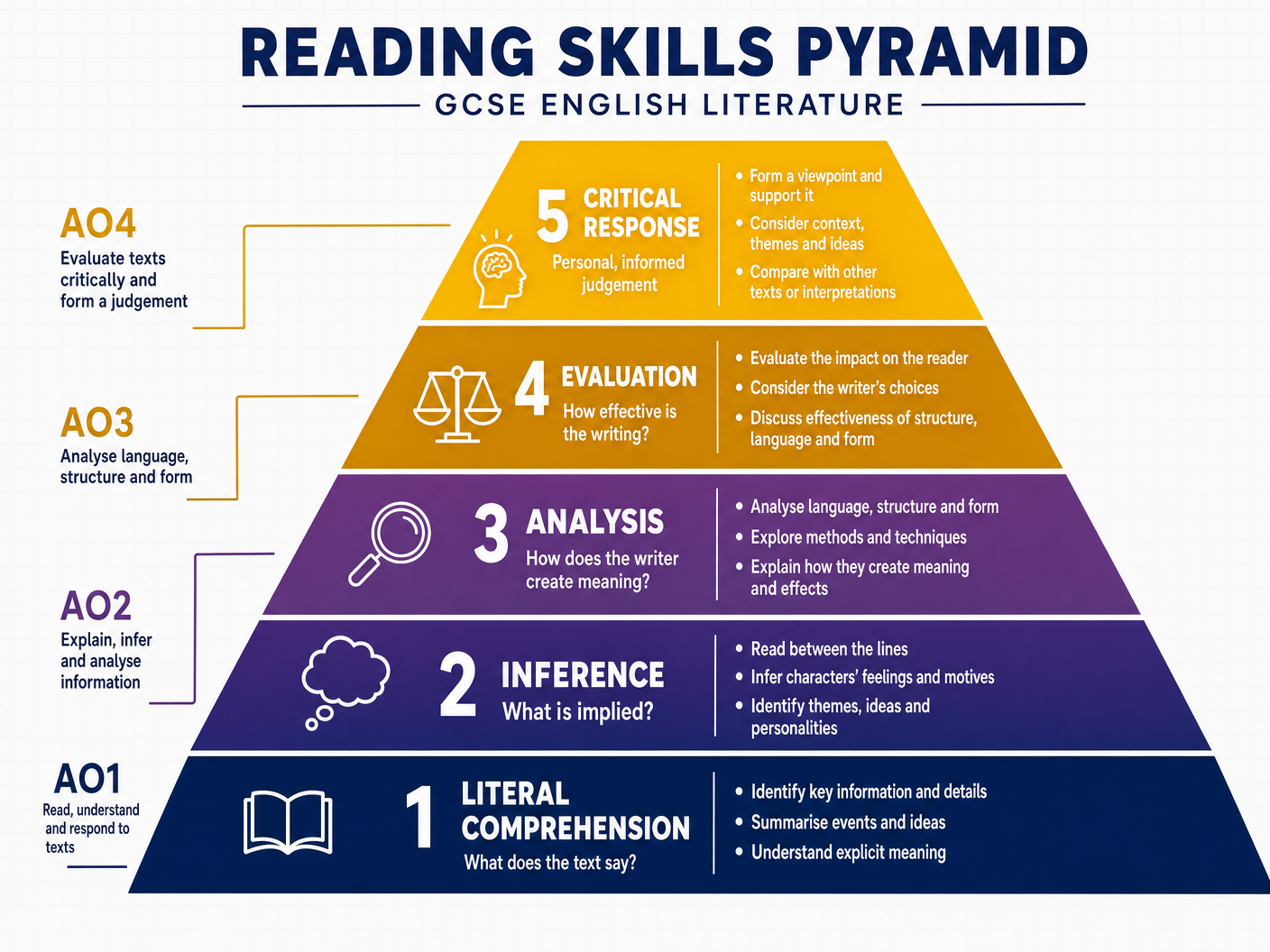
To succeed in English Literature, you must move up the reading skills pyramid.
- Literal Comprehension: This is the base. What does the text explicitly say? Who is doing what, and where? While necessary, this alone will not earn high marks.
- Inference: Reading between the lines. What is implied but not directly stated? If a character is described as having 'clenched fists', the inference is that they are angry or tense.
- Analysis: How does the writer create meaning? This involves identifying specific language, structural, or formal choices and explaining their effect on the reader.
- Evaluation: Judging the effectiveness of the writing. How well does the writer convey their message or theme?
- Critical Response: The apex of the pyramid. This is your personal, informed judgement, supported by judicious textual evidence and contextual understanding.
Assessment Objectives Breakdown
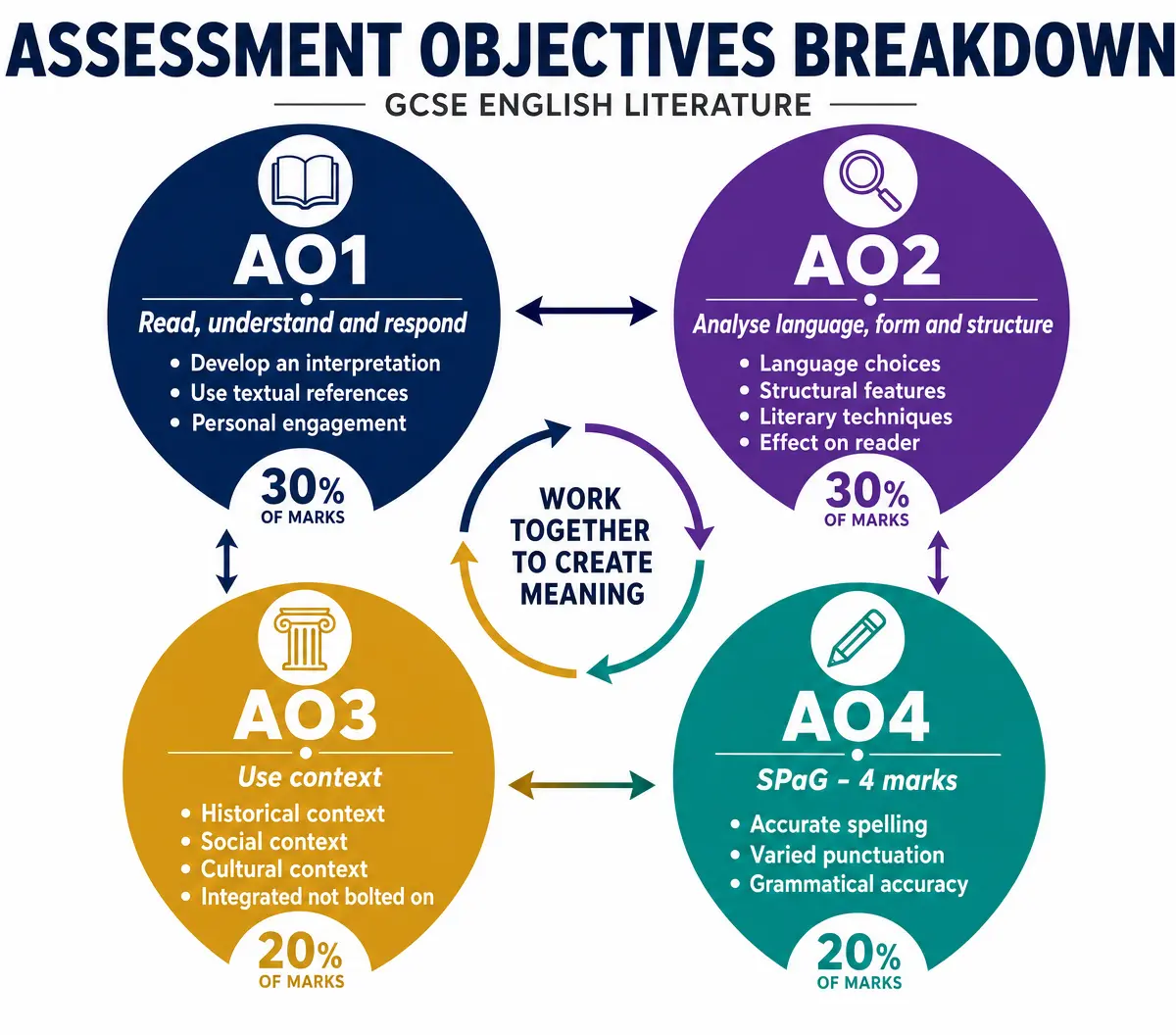
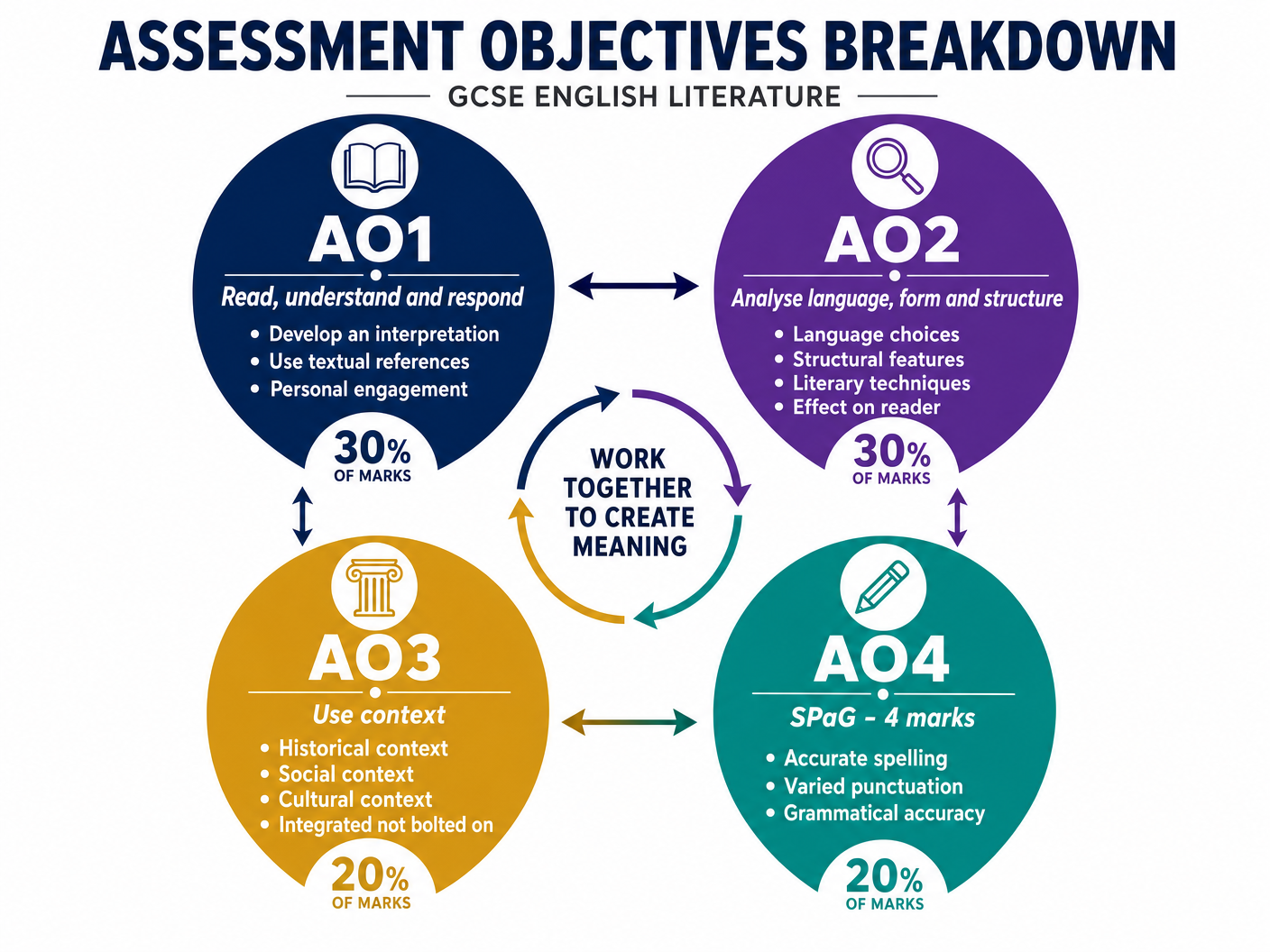
Every question you answer is marked against four Assessment Objectives (AOs). Understanding these is crucial for exam success:
AO1: Read, Understand and Respond (30%)
Examiners want to see a clear, conceptualised interpretation of the text. You must maintain a focused argument throughout your essay, supported by well-chosen, embedded quotations. It is not enough to simply drop a quote into a paragraph; it must be woven into your sentence seamlessly.
AO2: Analyse Language, Form and Structure (30%)
This is where you explore the writer's craft. You must identify specific techniques (e.g., metaphor, enjambment, foreshadowing) and, crucially, explain their effect. Why did the writer choose that specific word? How does the structure mirror the character's emotional state?
AO3: Context (20%)
Context is the social, historical, and cultural environment in which the text was written and set. The golden rule for AO3 is integration. Context must not be bolted on as a separate paragraph; it should inform and enhance your analysis of the text.
AO4: Spelling, Punctuation and Grammar (SPaG - up to 4 marks)
On specific questions, you are awarded marks for accurate spelling, varied punctuation, and grammatical correctness. Use sophisticated vocabulary and ensure your sentences are well-constructed.
Writer's Methods: A Toolkit
When analysing a text, consider the following methods:
Language:
- Semantic Fields: Groups of words related to a specific theme (e.g., a semantic field of violence).
- Imagery: Similes, metaphors, and personification used to create vivid pictures in the reader's mind.
- Connotations: The associations and feelings a word evokes beyond its literal meaning.
Structure:
- Foreshadowing: Hints or clues about what will happen later in the text.
- Juxtaposition: Placing two contrasting ideas, characters, or settings side-by-side to highlight their differences.
- Pacing: How quickly or slowly the narrative moves, often reflecting the tension or mood of the scene.
Form:
- Narrative Perspective: First-person (I), third-person limited (he/she), or third-person omniscient. How does the perspective influence our understanding?
- Dramatic Irony: When the audience knows something the characters do not, creating tension or humour.
Structuring Your Response
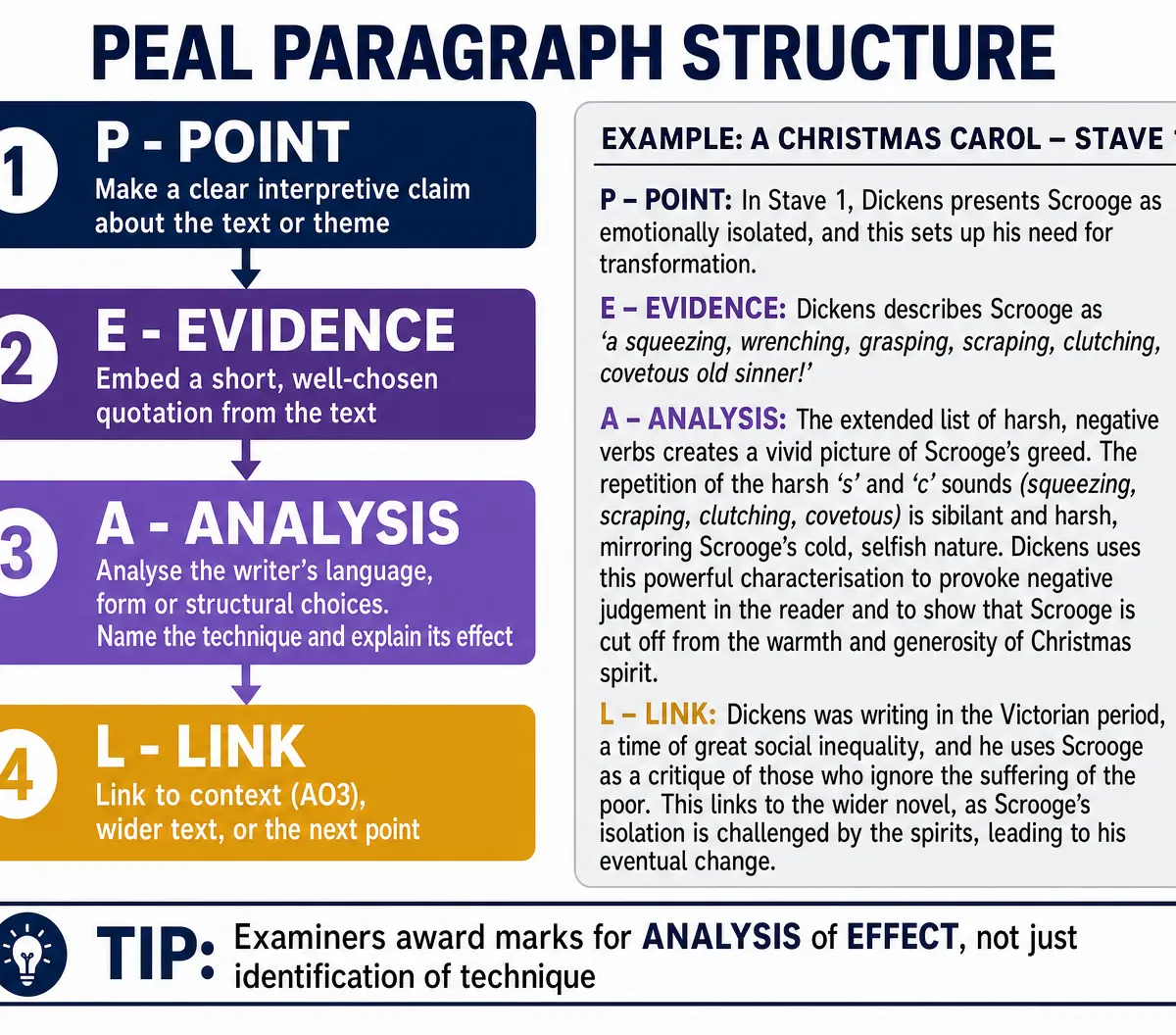
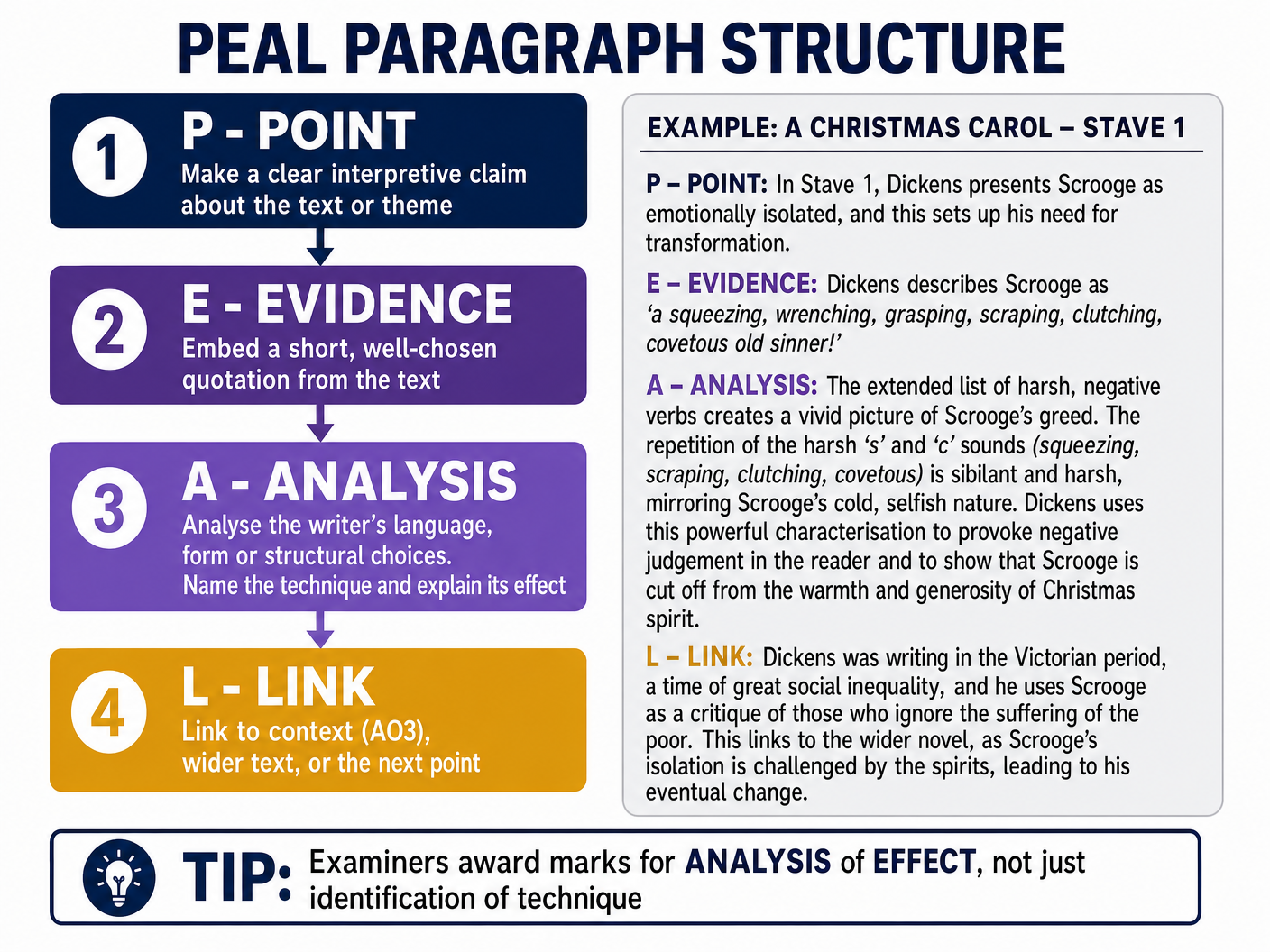
To ensure you hit all the AOs, use the PEAL paragraph structure:
- Point: Make a clear interpretive claim (AO1).
- Evidence: Embed a short, well-chosen quotation (AO1).
- Analysis: Analyse the writer's methods and explain the effect (AO2).
- Link: Link back to the question, to context (AO3), or to the wider text.
Key Quotes for Analysis:
- "The writer uses [technique] to suggest..."
- "This phrase carries connotations of..."
- "The structure of this stanza mirrors..."
- "In the context of [historical period], this implies..."
Approaching Unseen Texts
When faced with an unseen poem or extract, don't panic. Follow this process:
- Read literal first: Get a basic grasp of what is happening.
- Read for inference: What is the mood? What are the underlying themes?
- Annotate for methods: Highlight interesting words, structural shifts, or imagery.
- Form a thesis: What is your overall interpretation of the text?
Visual Resources
3 diagrams and illustrations
Interactive Diagrams
1 interactive diagram to visualise key concepts
Conceptual Flow Outline
The progression of reading skills from basic understanding to critical evaluation.
Worked Examples
2 worked examples — open one to explore the question and available guidance.
Practice Questions
Test your understanding — click to reveal model answers
Read the provided extract. How does the writer use language to describe the setting? (8 marks)
Hint: Focus entirely on AO2. Look for semantic fields, imagery, and specific word choices. You do not need context for this question.
Explore how the writer presents the relationship between the two main characters in the text as a whole. (30 marks)
Hint: This is a whole-text question. You need to track how the relationship changes from the beginning, through the middle, to the end. Integrate context to explain why they interact the way they do.
Compare how poets present the power of nature in Poem X and one other poem. (30 marks)
Hint: Choose a second poem that offers either a strong similarity or a clear contrast. Ensure you are writing about BOTH poems in every paragraph.
Starting with this extract, evaluate how successfully the writer builds tension. (30 marks)
Hint: The word 'evaluate' means you must make a judgement. Use phrases like 'The writer is highly successful in...' or 'This is particularly effective because...'
Test your understanding of Skills
Active recall beats re-reading. Take an instant quiz now to test what you’ve learned and lock it into long-term memory.
7 days Premium · Then free forever · No card, no charge