Pearson Edexcel · A-Level · English Literature
Course version: 9ET0 · Version from Sept 2015
Poetry – Section A: Post-2000 Poetry – Poems of the Decade: An Anthology…
Full specification wording
Component 3: Poetry – Section A: Post-2000 Poetry – Poems of the Decade: An Anthology of the Forward Books of Poetry 2002–2011: Chainsaw Versus the Pampas Grass Simon Armitage
Simon Armitage’s 'Chainsaw Versus the Pampas Grass' explores the conflict between artificial, aggressive masculinity and the resilient, enduring power of nature.
Checked against the Pearson Edexcel 9ET0 specification (opens in a new tab) on .
- Point 2 of 20
- 4 key terms
Study notes
From the checked teaching notes for this specification point.
The idea
Simon Armitage’s 'Chainsaw Versus the Pampas Grass' explores the conflict between artificial, aggressive masculinity and the resilient, enduring power of nature. The poem uses the personified chainsaw, described with violent, mechanical imagery like 'grinding its teeth', to represent destructive human impulses. In contrast, the pampas grass is depicted as regal and passive yet ultimately unconquerable, symbolising the quiet persistence of the natural world. Armitage employs a conversational, colloquial tone mixed with rich, sensory language to heighten the dramatic battle.
What earns the marks
- Analyse the personification of the chainsaw as a symbol of toxic masculinity and destructive human power.
- Evaluate the representation of the pampas grass as a symbol of nature's resilience and quiet defiance.
- Examine Armitage's use of colloquial language contrasted with violent, sensory imagery to create a vivid narrative voice.
- Discuss the structural progression of the poem, from the chainsaw's aggressive preparation to its ultimate defeat by the regrowing grass.
Common mistakes and how to put them right
Treating the poem solely as a literal account of gardening.
Put it right: Analyse the allegorical conflict between humanity and nature or masculinity and femininity.
Ignoring the structural elements.
Put it right: Explicitly link the stanza lengths and enjambment to the chaotic, uncontrolled energy of the chainsaw.
Misinterpreting the ending as a victory for the chainsaw.
Put it right: Recognise that the regrowth of the pampas grass signifies nature's ultimate triumph.
Exam tips
- Compare the aggressive, plosive sounds used for the chainsaw with the softer sibilance associated with the pampas grass.
- Link the poem's themes of human destruction and natural resilience to other poems in the anthology, such as 'The Deliverer' or 'History'.
- Use short, embedded quotations like 'grinding its teeth' to demonstrate Armitage's use of zoomorphism and personification.
Try the lesson
The start of the Component 3: Poetry – Section A: Post-2000 Poetry – Poems of the Decade: An Anthology of the Forward Books of Poetry 2002–2011: Chainsaw Versus the Pampas Grass Simon Armitage lesson, made from checked teaching notes for this specification point.
Have a go first
In Simon Armitage's 'Chainsaw Versus the Pampas Grass', how is the chainsaw primarily personified throughout the poem?
Listen
Simon Armitage’s 'Chainsaw Versus the Pampas Grass' explores the conflict between artificial, aggressive masculinity and the resilient, enduring power of nature. The poem uses the personified chainsaw, described with violent, mechanical imagery like 'grinding its teeth', to represent destructive human impulses. In contrast, the pampas grass is depicted as regal and passive yet ultimately unconquerable, symbolising the quiet persistence of the natural world. Armitage employs a conversational, colloquial tone mixed with rich, sensory language to heighten the dramatic battle. A strong answer earns marks for these points. Analyse the personification of the chainsaw as a symbol of toxic masculinity and destructive human power. Evaluate the representation of the pampas grass as a symbol of nature's resilience and quiet defiance. Examine Armitage's use of colloquial language contrasted with violent, sensory imagery to create a vivid narrative voice. Discuss the structural progression of the poem, from the chainsaw's aggressive preparation to its ultimate defeat by the regrowing grass. A common slip: Treating the poem solely as a literal account of gardening. Instead, analyse the allegorical conflict between humanity and nature or masculinity and femininity. Exam tip: Compare the aggressive, plosive sounds used for the chainsaw with the softer sibilance associated with the pampas grass.
See it
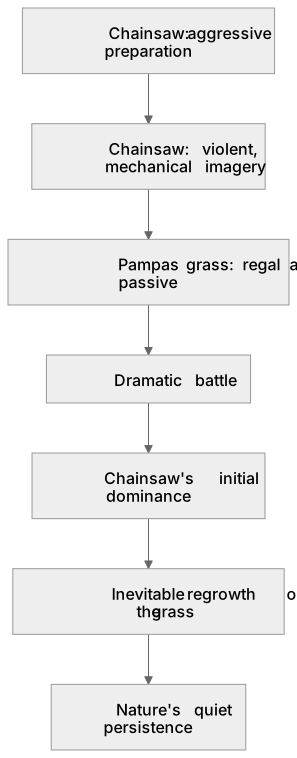
Put it in order
Put these steps in the order they happen.
- 1. Nature's quiet persistence
- 2. Inevitable regrowth of the grass
- 3. Pampas grass: regal and passive
- 4. Chainsaw's initial dominance
- 5. Chainsaw: aggressive preparation
- 6. Chainsaw: violent, mechanical imagery
- 7. Dramatic battle
Key words
Say what each word means before you turn the card.
Man versus Nature
Try answering aloud or in your head before turning the card.
Masculinity and Aggression
Try answering aloud or in your head before turning the card.
Resilience and Endurance
Try answering aloud or in your head before turning the card.
Power and Control
Try answering aloud or in your head before turning the card.
See every definition
- Man versus Nature
- The conflict between artificial, aggressive masculinity and the resilient, enduring power of nature, reflecting the futility of humanity's attempts to control nature.
- Masculinity and Aggression
- The personified chainsaw, described with violent, mechanical imagery, represents destructive human impulses and toxic masculinity.
- Resilience and Endurance
- The pampas grass is depicted as regal and passive yet ultimately unconquerable, symbolising the quiet persistence of the natural world.
- Power and Control
- The initial dominance of the chainsaw gives way to the inevitable regrowth of the grass, reflecting the futility of humanity's attempts to control nature.
Label the diagram
Some boxes have lost their names. Pick the right name for each number.
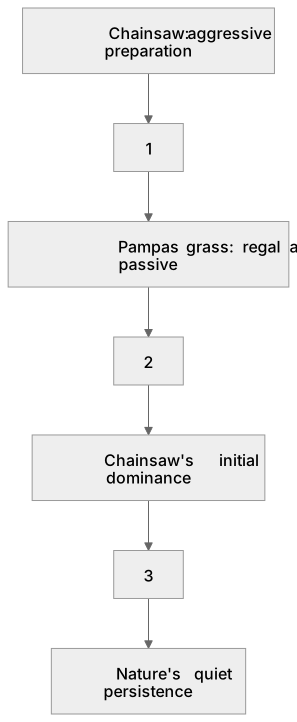
1Box 1
2Box 2
3Box 3
There is more to this lesson
The full lesson goes on to check your understanding and help you earn the marks. Create a free account to carry on, with your progress saved.
A week of Premium from your first lesson · Then the free plan continues · No card, no charge
Test your understanding of Component 3: Poetry – Section A: Post-2000 Poetry – Poems of the Decade: An Anthology of the Forward Books of Poetry 2002–2011: Chainsaw Versus the Pampas Grass Simon Armitage
Active recall beats re-reading. Take an instant quiz now to test what you’ve learned and lock it into long-term memory.
A week of Premium from your first lesson · Then the free plan continues · No card, no charge