Pearson Edexcel · A-Level · English Literature
Course version: 9ET0 · Version from Sept 2015
Poetry – Section A: Post-2000 Poetry – Poems of the Decade: An Anthology…
Full specification wording
Component 3: Poetry – Section A: Post-2000 Poetry – Poems of the Decade: An Anthology of the Forward Books of Poetry 2002–2011: Eat Me Patience Agbabi
Patience Agbabi's 'Eat Me' is a dramatic monologue about a woman trapped in an abusive feeder-feedee relationship.
Checked against the Pearson Edexcel 9ET0 specification (opens in a new tab) on .
- Point 1 of 20
- 4 key terms
Study notes
From the checked teaching notes for this specification point.
The idea
Patience Agbabi's 'Eat Me' is a dramatic monologue about a woman trapped in an abusive feeder-feedee relationship. Her partner controls and objectifies her by forcing her to gain weight for his gratification, until the body he has enlarged becomes the means of his death: she rolls onto him and suffocates him. Ten tercets and chains of assonant triple rhyme give the account a controlled, claustrophobic pattern, while sensory food and body imagery exposes coercion, dependency and dehumanisation. The ending reverses physical power but remains disturbing rather than offering a simple triumph, because the speaker has endured lasting bodily and psychological violence.
What earns the marks
- Analyse how the dramatic-monologue voice reveals coercion, dependency and the speaker's diminished sense of self.
- Evaluate how ten tercets and each stanza's assonant triple rhyme create controlled patterning that echoes the partner's coercive shaping of her body.
- Explore food, appetite and body imagery as a means of exposing sexist objectification and domestic abuse.
- Assess the ending's reversal of physical power, while considering why killing the abuser does not make the damage or emotional emptiness disappear.
Common mistakes and how to put them right
Reading the poem only as a story about weight gain.
Put it right: Connect feeding, confinement and dependence to coercive control and objectification.
Saying the speaker eats her partner.
Put it right: She rolls over and suffocates him with the body he forced her to enlarge.
Calling the ending uncomplicated liberation.
Put it right: Weigh the reversal of power against the final emptiness and the lasting violence already done to the speaker.
Exam tips
- Compare 'Eat Me' with poems about coercive relationships, bodily autonomy or reversals of power, while keeping Agbabi's specific methods central.
- Track pronouns and bodily possession to show how the speaker moves from being shaped as his object to acting with lethal agency.
- Analyse a stanza's linked vowel sounds rather than calling the pattern full rhyme: the controlled but imperfect music reinforces unease.
Try the lesson
The start of the Component 3: Poetry – Section A: Post-2000 Poetry – Poems of the Decade: An Anthology of the Forward Books of Poetry 2002–2011: Eat Me Patience Agbabi lesson, made from checked teaching notes for this specification point.
Have a go first
What is the central dynamic explored between the speaker and her partner in Patience Agbabi's poem 'Eat Me'?
Listen
Patience Agbabi's 'Eat Me' is a dramatic monologue about a woman trapped in an abusive feeder-feedee relationship. Her partner controls and objectifies her by forcing her to gain weight for his gratification, until the body he has enlarged becomes the means of his death: she rolls onto him and suffocates him. Ten tercets and chains of assonant triple rhyme give the account a controlled, claustrophobic pattern, while sensory food and body imagery exposes coercion, dependency and dehumanisation. The ending reverses physical power but remains disturbing rather than offering a simple triumph, because the speaker has endured lasting bodily and psychological violence. A strong answer earns marks for these points. Analyse how the dramatic-monologue voice reveals coercion, dependency and the speaker's diminished sense of self. Evaluate how ten tercets and each stanza's assonant triple rhyme create controlled patterning that echoes the partner's coercive shaping of her body. Explore food, appetite and body imagery as a means of exposing sexist objectification and domestic abuse. Assess the ending's reversal of physical power, while considering why killing the abuser does not make the damage or emotional emptiness disappear. A common slip: Reading the poem only as a story about weight gain. Instead, connect feeding, confinement and dependence to coercive control and objectification. Exam tip: Compare 'Eat Me' with poems about coercive relationships, bodily autonomy or reversals of power, while keeping Agbabi's specific methods central.
See it
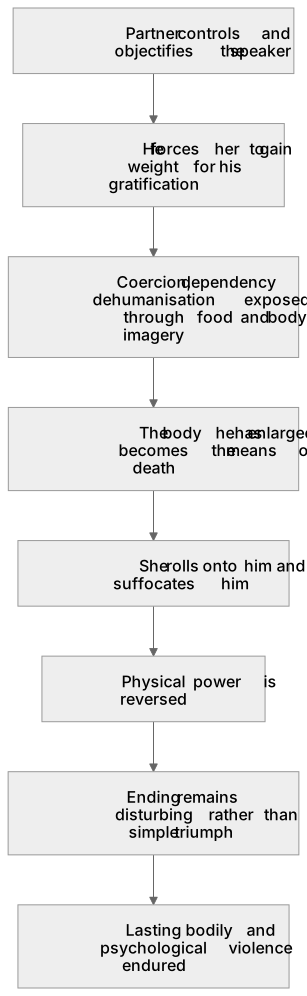
Put it in order
Put these steps in the order they happen.
- 1. She rolls onto him and suffocates him
- 2. Lasting bodily and psychological violence endured
- 3. Physical power is reversed
- 4. Partner controls and objectifies the speaker
- 5. He forces her to gain weight for his gratification
- 6. Ending remains disturbing rather than a simple triumph
- 7. Coercion, dependency and dehumanisation exposed through food and body imagery
- 8. The body he has enlarged becomes the means of his death
Key words
Say what each word means before you turn the card.
Power and Control
Try answering aloud or in your head before turning the card.
Gender and Patriarchy
Try answering aloud or in your head before turning the card.
Transgression and Taboo
Try answering aloud or in your head before turning the card.
Bodily Autonomy
Try answering aloud or in your head before turning the card.
See every definition
- Power and Control
- The partner controls and objectifies the speaker by forcing her to gain weight for his gratification, until the ending reverses physical power.
- Gender and Patriarchy
- Food, appetite and body imagery expose sexist objectification and domestic abuse within the relationship.
- Transgression and Taboo
- The speaker rolls onto her partner and suffocates him with the body he forced her to enlarge.
- Bodily Autonomy
- The speaker moves from being shaped as his object to acting with lethal agency, though lasting bodily and psychological violence remains.
Label the diagram
Some boxes have lost their names. Pick the right name for each number.
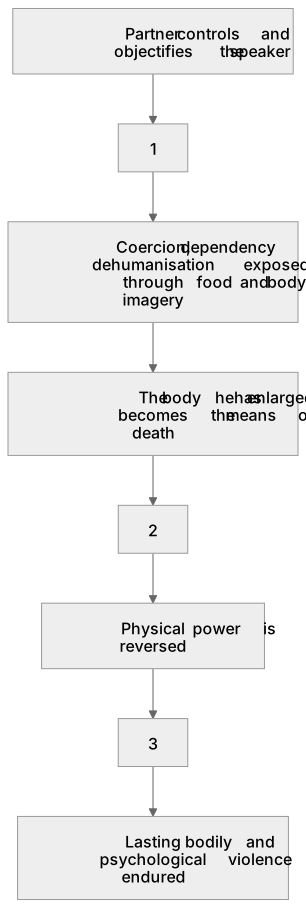
1Box 1
2Box 2
3Box 3
There is more to this lesson
The full lesson goes on to check your understanding and help you earn the marks. Create a free account to carry on, with your progress saved.
A week of Premium from your first lesson · Then the free plan continues · No card, no charge
Test your understanding of Component 3: Poetry – Section A: Post-2000 Poetry – Poems of the Decade: An Anthology of the Forward Books of Poetry 2002–2011: Eat Me Patience Agbabi
Active recall beats re-reading. Take an instant quiz now to test what you’ve learned and lock it into long-term memory.
A week of Premium from your first lesson · Then the free plan continues · No card, no charge