Pearson Edexcel · A-Level · English Literature
Course version: 9ET0 · Version from Sept 2015
Poetry – Section B: Specified Poetry Pre- or Post-1900 – Post-1900 – The…
Full specification wording
Component 3: Poetry – Section B: Specified Poetry Pre- or Post-1900 – Post-1900 – The Modernist Period – The Great Modern Poets, editor Michael Schmidt (Quercus, 2014): in Just e e cummings
E. E. Cummings’s ‘in Just-’ is a quintessential Modernist poem that captures the vibrant, chaotic energy of spring through radical typographical experimentation.
Checked against the Pearson Edexcel 9ET0 specification (opens in a new tab) on .
- Point 16 of 21
- 3 key terms
Study notes
From the checked teaching notes for this specification point.
The idea
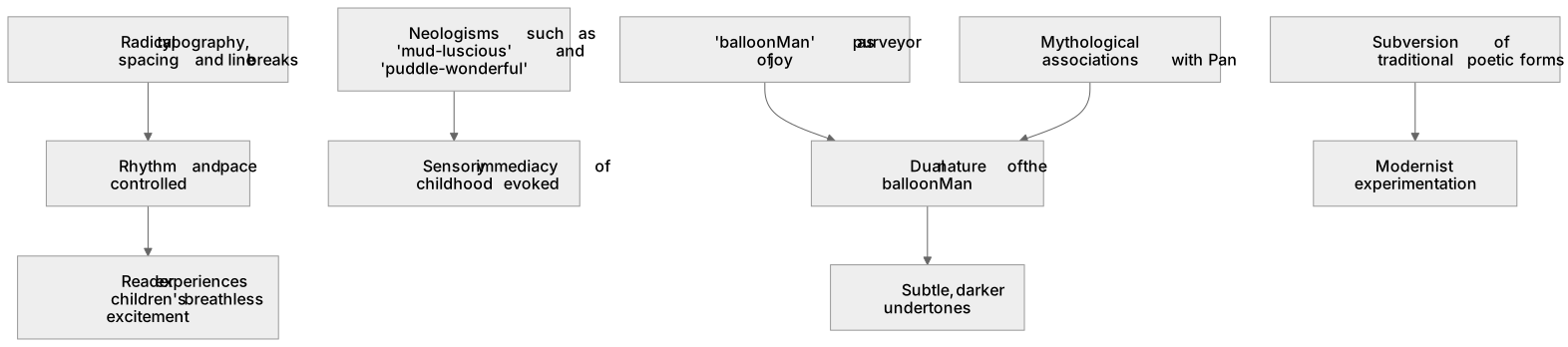
E. E. Cummings’s ‘in Just-’ is a quintessential Modernist poem that captures the vibrant, chaotic energy of spring through radical typographical experimentation. The poem describes children running to the whistle of a ‘balloonMan’, blending innocent joy with subtle, darker undertones referencing the mythological Pan. Cummings abandons traditional syntax, punctuation, and spacing to dictate the rhythm and visual impact of the verse, forcing the reader to experience the breathless excitement of the children.
What earns the marks
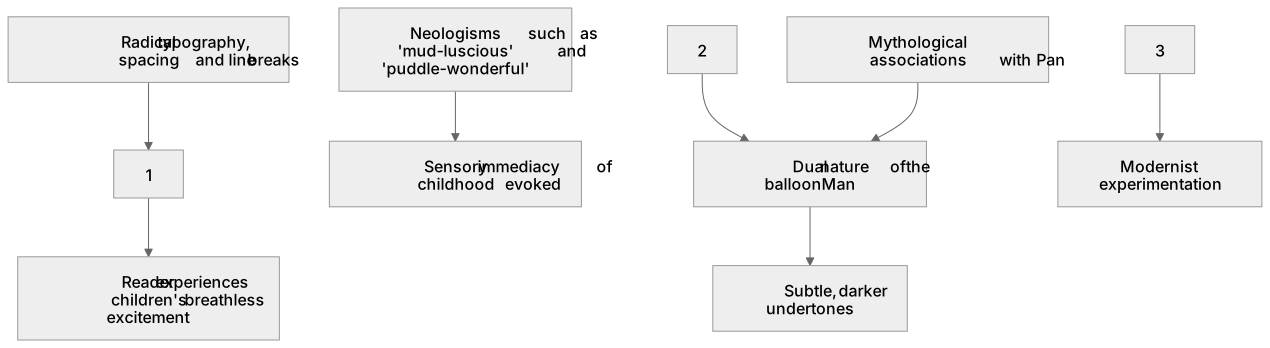
- Analyse Cummings's idiosyncratic use of typography, spacing, and line breaks to control rhythm and pace.
- Evaluate the creation of neologisms (e.g., 'mud-luscious') to capture the sensory immediacy of childhood.
- Discuss the dual nature of the 'balloonMan', contrasting his role as a purveyor of joy with his mythological associations with Pan.
- Examine the poem's subversion of traditional poetic forms as a hallmark of Modernist experimentation.
Common mistakes and how to put them right
Dismissing the unusual spacing and lack of punctuation as random errors.
Put it right: Analyse these typographical choices as deliberate techniques to control the reader's pace and mimic the children's breathless energy.
Reading the poem solely as a cheerful celebration of spring.
Put it right: Acknowledge the subtle, unsettling undertones introduced by the 'goat-footed' balloon man and his connection to Pan.
Misquoting the poem by adding standard capitalisation or punctuation.
Put it right: Reproduce Cummings's exact typography, including lowercase letters and specific hyphenation, when quoting.
Exam tips
- Focus on how the visual layout of the poem on the page contributes directly to its meaning and auditory rhythm.
- Compare Cummings's experimental form with more traditional Modernist structures to highlight the diversity of the movement.
- Discuss the effect of running words together (e.g., 'eddieandbill') to convey the inseparable nature and speed of the children.
Try the lesson
The start of the Component 3: Poetry – Section B: Specified Poetry Pre- or Post-1900 – Post-1900 – The Modernist Period – The Great Modern Poets, editor Michael Schmidt (Quercus, 2014): in Just e e cummings lesson, made from checked teaching notes for this specification point.
Have a go first
What is the primary setting and season depicted in e. e. cummings' poem "in Just-"?
Listen
E. E. Cummings’s ‘in Just-’ is a quintessential Modernist poem that captures the vibrant, chaotic energy of spring through radical typographical experimentation. The poem describes children running to the whistle of a ‘balloonMan’, blending innocent joy with subtle, darker undertones referencing the mythological Pan. Cummings abandons traditional syntax, punctuation, and spacing to dictate the rhythm and visual impact of the verse, forcing the reader to experience the breathless excitement of the children. A strong answer earns marks for these points. Analyse Cummings's idiosyncratic use of typography, spacing, and line breaks to control rhythm and pace. Evaluate the creation of neologisms (e.g., 'mud-luscious') to capture the sensory immediacy of childhood. Discuss the dual nature of the 'balloonMan', contrasting his role as a purveyor of joy with his mythological associations with Pan. Examine the poem's subversion of traditional poetic forms as a hallmark of Modernist experimentation. A common slip: Dismissing the unusual spacing and lack of punctuation as random errors. Instead, Analyse these typographical choices as deliberate techniques to control the reader's pace and mimic the children's breathless energy. Exam tip: Focus on how the visual layout of the poem on the page contributes directly to its meaning and auditory rhythm.
See it
Key words
Say what each word means before you turn the card.
Childhood Innocence
Try answering aloud or in your head before turning the card.
Mythological Allusion
Try answering aloud or in your head before turning the card.
Modernist Experimentation
Try answering aloud or in your head before turning the card.
See every definition
- Childhood Innocence
- Innocent joy blended with subtle, darker undertones, evoked through compound words that capture sensory childhood experiences.
- Mythological Allusion
- A reference to the mythological Pan, connected to the 'goat-footed' balloon man and introducing subtle, unsettling undertones.
- Modernist Experimentation
- The subversion of traditional poetic forms through idiosyncratic typography, spacing and line breaks that control rhythm and pace.
Label the diagram
Some boxes have lost their names. Pick the right name for each number.
1Box 1
2Box 2
3Box 3
There is more to this lesson
The full lesson goes on to check your understanding and help you earn the marks. Create a free account to carry on, with your progress saved.
A week of Premium from your first lesson · Then the free plan continues · No card, no charge
Test your understanding of Component 3: Poetry – Section B: Specified Poetry Pre- or Post-1900 – Post-1900 – The Modernist Period – The Great Modern Poets, editor Michael Schmidt (Quercus, 2014): in Just e e cummings
Active recall beats re-reading. Take an instant quiz now to test what you’ve learned and lock it into long-term memory.
A week of Premium from your first lesson · Then the free plan continues · No card, no charge