Pearson Edexcel · A-Level · English Literature
Course version: 9ET0 · Version from Sept 2015
Poetry – Section B: Specified Poetry Pre- or Post-1900 – Post-1900 – The…
Full specification wording
Component 3: Poetry – Section B: Specified Poetry Pre- or Post-1900 – Post-1900 – The Modernist Period – The Great Modern Poets, editor Michael Schmidt (Quercus, 2014): pity this busy monster, manunkind
In "pity this busy monster, manunkind", E.E. Cummings delivers a scathing critique of modern technological progress and humanity's alienation from the natural world.
Checked against the Pearson Edexcel 9ET0 specification (opens in a new tab) on .
- Point 17 of 21
- 4 key terms
Study notes
From the checked teaching notes for this specification point.
The idea
In "pity this busy monster, manunkind", E.E. Cummings delivers a scathing critique of modern technological progress and humanity's alienation from the natural world. The poem satirises the scientific pursuit of mastery over nature, portraying human society as a grotesque, unnatural "monster". Cummings employs typographical disruption, neologisms such as "manunkind", and medical imagery to diagnose the sickness of a culture that treats Progress as a "comfortable disease". The antithesis "A world of made / is not a world of born" opposes manufactured systems to living creation, before the final invitation to a "good universe next door" turns diagnosis into an irreverent proposal for escape.
What earns the marks
- Analyse the use of neologisms, such as "manunkind", to highlight the unnatural and dehumanising effects of modern progress.
- Evaluate the contrast between the artificial world of "made" and the living world of "born".
- Explore the use of medical and scientific imagery to portray modern society as a diseased or monstrous entity.
- Contextualise the poem's anti-technological stance within the Modernist reaction against industrialisation and scientific rationalism.
Common mistakes and how to put them right
Misinterpreting the word "pity" as genuine sympathy, rather than recognising the speaker's deeply sarcastic and condescending tone.
Ignoring the significance of the final line ("listen.
Put it right: There's a hell of a good universe next door; let's go"), which shifts the poem from critique to a call for transcendence.
Failing to analyse the specific impact of Cummings' compound words and disrupted syntax on the poem's satirical meaning.
Exam tips
- Focus on the dichotomy between "made" and "born" as a central framework for analysing the poem's imagery and themes.
- Link Cummings' critique of scientific rationalism to the broader anxieties of the Modernist period regarding technological advancement.
- Pay close attention to the tone of the speaker, ensuring you capture the blend of satirical detachment and urgent warning.
Try the lesson
The start of the Component 3: Poetry – Section B: Specified Poetry Pre- or Post-1900 – Post-1900 – The Modernist Period – The Great Modern Poets, editor Michael Schmidt (Quercus, 2014): pity this busy monster, manunkind lesson, made from checked teaching notes for this specification point.
Have a go first
What is the central critique presented in E.E. Cummings' poem 'pity this busy monster, manunkind'?
Listen
In "pity this busy monster, manunkind", E.E. Cummings delivers a scathing critique of modern technological progress and humanity's alienation from the natural world. The poem satirises the scientific pursuit of mastery over nature, portraying human society as a grotesque, unnatural "monster". Cummings employs typographical disruption, neologisms such as "manunkind", and medical imagery to diagnose the sickness of a culture that treats Progress as a "comfortable disease". The antithesis "A world of made / is not a world of born" opposes manufactured systems to living creation, before the final invitation to a "good universe next door" turns diagnosis into an irreverent proposal for escape. A strong answer earns marks for these points. Analyse the use of neologisms, such as "manunkind", to highlight the unnatural and dehumanising effects of modern progress. Evaluate the contrast between the artificial world of "made" and the living world of "born". Explore the use of medical and scientific imagery to portray modern society as a diseased or monstrous entity. Contextualise the poem's anti-technological stance within the Modernist reaction against industrialisation and scientific rationalism. Exam tip: Focus on the dichotomy between "made" and "born" as a central framework for analysing the poem's imagery and themes.
See it
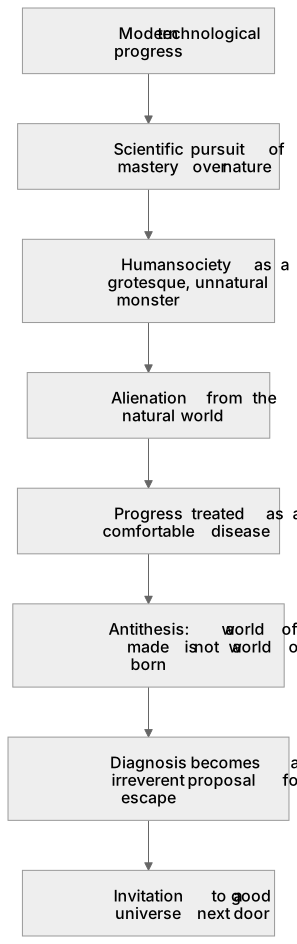
Put it in order
Put these steps in the order they happen.
- 1. Progress treated as a comfortable disease
- 2. Invitation to a good universe next door
- 3. Antithesis: a world of made is not a world of born
- 4. Modern technological progress
- 5. Scientific pursuit of mastery over nature
- 6. Diagnosis becomes an irreverent proposal for escape
- 7. Human society as a grotesque, unnatural monster
- 8. Alienation from the natural world
Key words
Say what each word means before you turn the card.
Technological Progress vs. Nature
Try answering aloud or in your head before turning the card.
Dehumanisation
Try answering aloud or in your head before turning the card.
Scientific Rationalism
Try answering aloud or in your head before turning the card.
Transcendence
Try answering aloud or in your head before turning the card.
See every definition
- Technological Progress vs. Nature
- The poem's critique of modern technological progress and humanity's alienation from the natural world, satirising the scientific pursuit of mastery over nature.
- Dehumanisation
- The unnatural and dehumanising effects of modern progress, highlighted through neologisms such as "manunkind".
- Scientific Rationalism
- The scientific pursuit of mastery over nature, which the poem satirises and which the Modernist period reacted against.
- Transcendence
- The shift in the final line from critique to a call for escape, an irreverent proposal for a "good universe next door".
Label the diagram
Some boxes have lost their names. Pick the right name for each number.
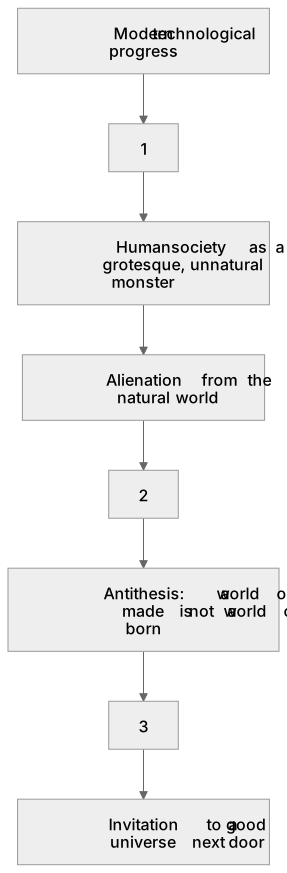
1Box 1
2Box 2
3Box 3
There is more to this lesson
The full lesson goes on to check your understanding and help you earn the marks. Create a free account to carry on, with your progress saved.
A week of Premium from your first lesson · Then the free plan continues · No card, no charge
Test your understanding of Component 3: Poetry – Section B: Specified Poetry Pre- or Post-1900 – Post-1900 – The Modernist Period – The Great Modern Poets, editor Michael Schmidt (Quercus, 2014): pity this busy monster, manunkind
Active recall beats re-reading. Take an instant quiz now to test what you’ve learned and lock it into long-term memory.
A week of Premium from your first lesson · Then the free plan continues · No card, no charge