Pearson Edexcel · A-Level · English Literature
Course version: 9ET0 · Version from Sept 2015
Poetry – Section B: Specified Poetry Pre- or Post-1900 – Post-1900 – The…
Full specification wording
Component 3: Poetry – Section B: Specified Poetry Pre- or Post-1900 – Post-1900 – The Modernist Period – The Great Modern Poets, editor Michael Schmidt (Quercus, 2014): Mowing
"Mowing" by Robert Frost explores the relationship between human labour, nature, and artistic creation.
Checked against the Pearson Edexcel 9ET0 specification (opens in a new tab) on .
- Point 4 of 21
- 4 key terms
Study notes
From the checked teaching notes for this specification point.
The idea
"Mowing" by Robert Frost explores the relationship between human labour, nature, and artistic creation. The speaker reflects on the sound of a scythe cutting hay, rejecting romanticised or supernatural interpretations of the work (such as 'fay or elf') in favour of the tangible reality of physical labour. The poem functions as a sonnet, though its irregular rhyme scheme and conversational rhythm reflect Frost's modernist approach to traditional forms. The central assertion, 'The fact is the sweetest dream that labor knows', encapsulates the poem's philosophy: truth and beauty are found in the practical, physical engagement with the world rather than in abstract escapism.
What earns the marks
- Analyse Frost's adaptation of the sonnet form, noting how the irregular rhyme scheme mirrors the rhythmic but unromanticised motion of the scythe.
- Evaluate the use of personification, specifically how the scythe's 'whispering' creates a dialogue between the labourer and the tool.
- Explore the poem's rejection of romanticism and fantasy, focusing on the dismissal of 'fay or elf' in favour of pragmatic reality.
- Examine the significance of the concluding aphorism, 'The fact is the sweetest dream that labor knows', as a statement on the intrinsic value of hard work.
Common mistakes and how to put them right
Classifying the poem as a traditional Petrarchan or Shakespearean sonnet.
Put it right: Identify it as an irregular sonnet that subverts traditional structural expectations to suit its modernist themes.
Assuming the poem is purely a literal description of farming.
Put it right: Interpret the act of mowing as a metaphor for the poetic process and the search for truth.
Claiming the speaker finds the work tedious or punishing.
Put it right: Recognise that the speaker finds profound satisfaction and 'sweetness' in the physical reality of the labour.
Exam tips
- Compare the representation of rural labour in 'Mowing' with other Frost poems or modernist works in the anthology to highlight his unique philosophical stance.
- Focus closely on the repeated 'sound' and 'whispering' of the scythe to show how auditory imagery turns physical labour into the poem's central question.
- Use the phrase 'The fact is the sweetest dream' as a critical anchor when discussing Frost's approach to realism versus romanticism.
Try the lesson
The start of the Component 3: Poetry – Section B: Specified Poetry Pre- or Post-1900 – Post-1900 – The Modernist Period – The Great Modern Poets, editor Michael Schmidt (Quercus, 2014): Mowing lesson, made from checked teaching notes for this specification point.
Have a go first
In Robert Frost's poem 'Mowing', what does the speaker conclude is the 'sweetest dream that labor knows'?
Listen
Mowing" by Robert Frost explores the relationship between human labour, nature, and artistic creation. The speaker reflects on the sound of a scythe cutting hay, rejecting romanticised or supernatural interpretations of the work (such as 'fay or elf') in favour of the tangible reality of physical labour. The poem functions as a sonnet, though its irregular rhyme scheme and conversational rhythm reflect Frost's modernist approach to traditional forms. The central assertion, 'The fact is the sweetest dream that labor knows', encapsulates the poem's philosophy: truth and beauty are found in the practical, physical engagement with the world rather than in abstract escapism. A strong answer earns marks for these points. Analyse Frost's adaptation of the sonnet form, noting how the irregular rhyme scheme mirrors the rhythmic but unromanticised motion of the scythe. Evaluate the use of personification, specifically how the scythe's 'whispering' creates a dialogue between the labourer and the tool. Explore the poem's rejection of romanticism and fantasy, focusing on the dismissal of 'fay or elf' in favour of pragmatic reality. Examine the significance of the concluding aphorism, 'The fact is the sweetest dream that labor knows', as a statement on the intrinsic value of hard work. A common slip: Classifying the poem as a traditional Petrarchan or Shakespearean sonnet. Instead, Identify it as an irregular sonnet that subverts traditional structural expectations to suit its modernist themes. Exam tip: Compare the representation of rural labour in 'Mowing' with other Frost poems or modernist works in the anthology to highlight his unique philosophical stance.
See it
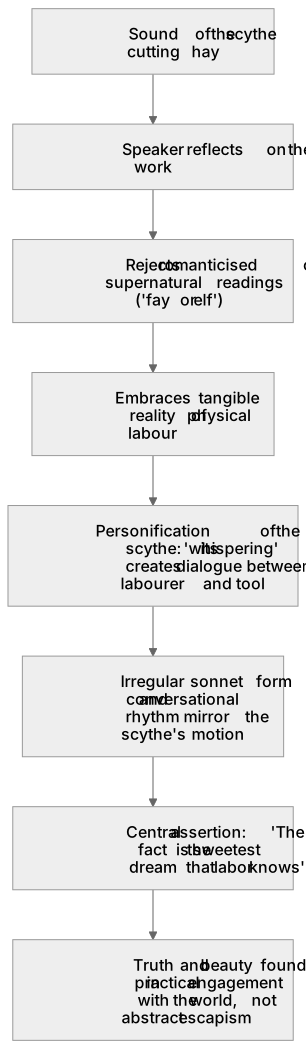
Put it in order
Put these steps in the order they happen.
- 1. Personification of the scythe: its 'whispering' creates dialogue between labourer and tool
- 2. Truth and beauty found in practical engagement with the world, not abstract escapism
- 3. Irregular sonnet form and conversational rhythm mirror the scythe's motion
- 4. Sound of the scythe cutting hay
- 5. Speaker reflects on the work
- 6. Central assertion: 'The fact is the sweetest dream that labor knows'
- 7. Rejects romanticised or supernatural readings ('fay or elf')
- 8. Embraces tangible reality of physical labour
Key words
Say what each word means before you turn the card.
The dignity of physical labour
Try answering aloud or in your head before turning the card.
Realism versus Romanticism
Try answering aloud or in your head before turning the card.
The relationship between humanity and nature
Try answering aloud or in your head before turning the card.
The poetic process and artistic creation
Try answering aloud or in your head before turning the card.
See every definition
- The dignity of physical labour
- The idea that truth and beauty are found in practical, physical engagement with the world rather than in abstract escapism, with the speaker finding profound satisfaction and sweetness in the labour.
- Realism versus Romanticism
- The poem's rejection of romanticised or supernatural interpretations such as 'fay or elf' in favour of the tangible reality of physical labour and pragmatic reality.
- The relationship between humanity and nature
- The connection explored through the personification of the scythe, whose 'whispering' creates a dialogue between the labourer and the tool.
- The poetic process and artistic creation
- The act of mowing understood as a metaphor for the poetic process and the search for truth, rather than a purely literal description of farming.
Label the diagram
Some boxes have lost their names. Pick the right name for each number.
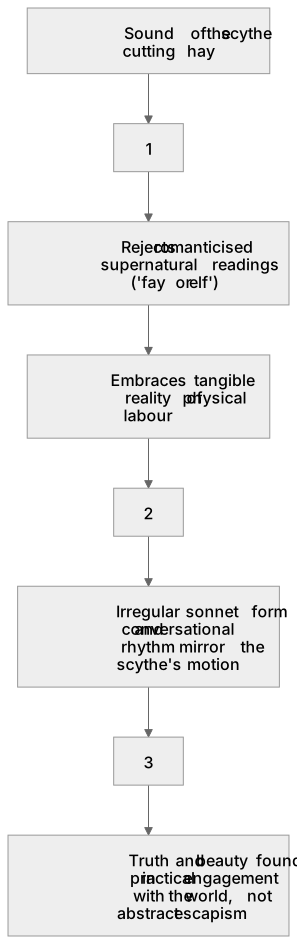
1Box 1
2Box 2
3Box 3
There is more to this lesson
The full lesson goes on to check your understanding and help you earn the marks. Create a free account to carry on, with your progress saved.
A week of Premium from your first lesson · Then the free plan continues · No card, no charge
Test your understanding of Component 3: Poetry – Section B: Specified Poetry Pre- or Post-1900 – Post-1900 – The Modernist Period – The Great Modern Poets, editor Michael Schmidt (Quercus, 2014): Mowing
Active recall beats re-reading. Take an instant quiz now to test what you’ve learned and lock it into long-term memory.
A week of Premium from your first lesson · Then the free plan continues · No card, no charge