Pearson Edexcel · A-Level · English Literature
Course version: 9ET0 · Version from Sept 2015
Poetry – Section B: Specified Poetry Pre- or Post-1900 – Post-1900 – The…
Full specification wording
Component 3: Poetry – Section B: Specified Poetry Pre- or Post-1900 – Post-1900 – The Modernist Period – The Great Modern Poets, editor Michael Schmidt (Quercus, 2014): Stopping by Woods on a Snowy Evening
Frost’s ‘Stopping by Woods on a Snowy Evening’ captures a moment of profound hesitation between societal obligation and the seductive pull of isolation.
Checked against the Pearson Edexcel 9ET0 specification (opens in a new tab) on .
- Point 3 of 21
- 4 key terms
Study notes
From the checked teaching notes for this specification point.
The idea
Frost’s ‘Stopping by Woods on a Snowy Evening’ captures a moment of profound hesitation between societal obligation and the seductive pull of isolation. The speaker pauses in a frozen landscape, drawn to the ‘lovely, dark and deep’ woods, which symbolise both aesthetic beauty and the temptation of oblivion or death. The poem’s rigid structure—written in iambic tetrameter with an interlocking AABA rhyme scheme—creates a hypnotic, lullaby-like rhythm that mirrors the falling snow. The famous repetition of the final line, ‘And miles to go before I sleep’, shifts the tone from literal weariness to a metaphorical acknowledgement of life’s enduring burdens, reflecting Modernist anxieties about duty, existential isolation, and survival.
What earns the marks
- Analyse the interlocking Rubaiyat stanza (AABA) and how it propels the narrative forward while creating a hypnotic rhythm.
- Evaluate the symbolic contrast between the dark, alluring woods and the demands of the human world represented by the village and promises.
- Discuss the significance of the horse as a symbol of practical, instinctual reality contrasting with the speaker's philosophical reverie.
- Explore the ambiguity of the repeated final lines as representing either a recommitment to life or a weary resignation to duty.
Common mistakes and how to put them right
Reading the poem solely as a simple nature lyric.
Put it right: Explore the darker psychological undertones and the temptation of oblivion or death.
Ignoring the structural mechanics of the poem.
Put it right: Explicitly link the interlocking rhyme scheme to the speaker's internal conflict and the hypnotic setting.
Assuming 'sleep' only refers to literal rest.
Put it right: Analyse 'sleep' as a metaphor for death or the ultimate release from societal obligations.
Exam tips
- Examine how the sibilance and soft consonant sounds mimic the auditory experience of falling snow and silence.
- Contrast the owner of the woods, who is safely in the village, with the isolated speaker to highlight themes of alienation.
- Use the poem to discuss Modernist themes of existential doubt and the individual's struggle against the demands of modern life.
Try the lesson
The start of the Component 3: Poetry – Section B: Specified Poetry Pre- or Post-1900 – Post-1900 – The Modernist Period – The Great Modern Poets, editor Michael Schmidt (Quercus, 2014): Stopping by Woods on a Snowy Evening lesson, made from checked teaching notes for this specification point.
Have a go first
How does the interlocking rhyme scheme (AABA BBCB CCDC DDDD) of 'Stopping by Woods on a Snowy Evening' structurally reflect the speaker's experience?
Listen
Frost’s ‘Stopping by Woods on a Snowy Evening’ captures a moment of profound hesitation between societal obligation and the seductive pull of isolation. The speaker pauses in a frozen landscape, drawn to the ‘lovely, dark and deep’ woods, which symbolise both aesthetic beauty and the temptation of oblivion or death. The poem’s rigid structure—written in iambic tetrameter with an interlocking AABA rhyme scheme—creates a hypnotic, lullaby-like rhythm that mirrors the falling snow. The famous repetition of the final line, ‘And miles to go before I sleep’, shifts the tone from literal weariness to a metaphorical acknowledgement of life’s enduring burdens, reflecting Modernist anxieties about duty, existential isolation, and survival. A strong answer earns marks for these points. Analyse the interlocking Rubaiyat stanza (AABA) and how it propels the narrative forward while creating a hypnotic rhythm. Evaluate the symbolic contrast between the dark, alluring woods and the demands of the human world represented by the village and promises. Discuss the significance of the horse as a symbol of practical, instinctual reality contrasting with the speaker's philosophical reverie. Explore the ambiguity of the repeated final lines as representing either a recommitment to life or a weary resignation to duty. A common slip: Reading the poem solely as a simple nature lyric. Instead, explore the darker psychological undertones and the temptation of oblivion or death. Exam tip: Examine how the sibilance and soft consonant sounds mimic the auditory experience of falling snow and silence.
See it
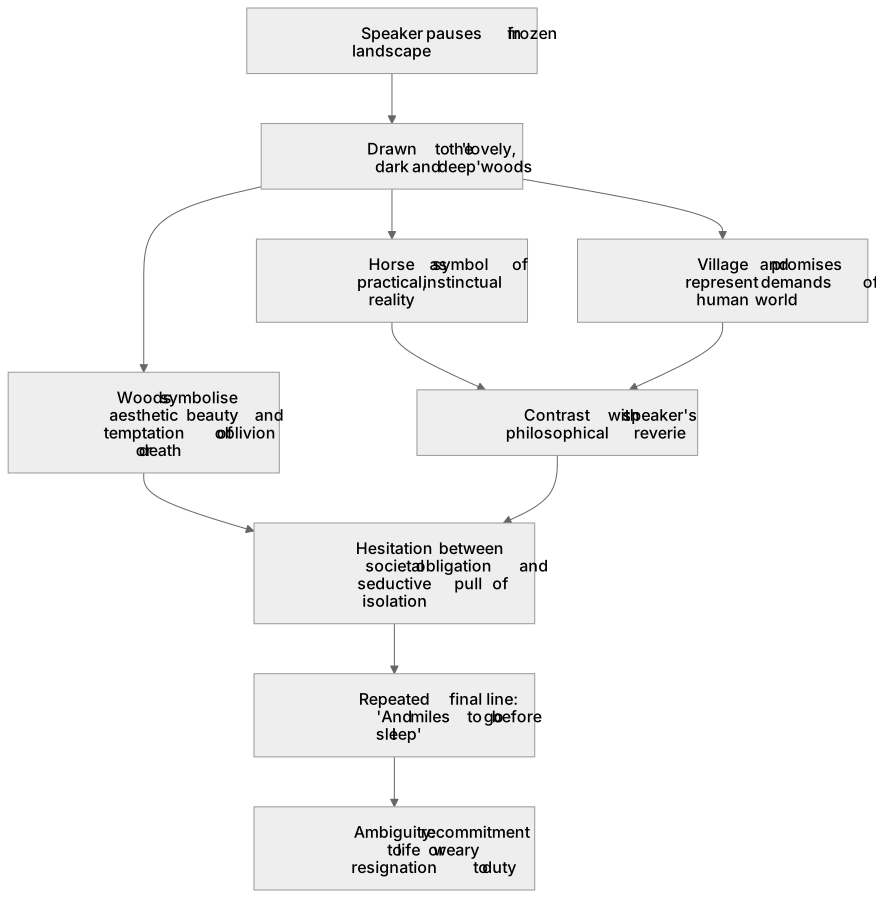
Key words
Say what each word means before you turn the card.
Duty versus Desire
Try answering aloud or in your head before turning the card.
Isolation and Alienation
Try answering aloud or in your head before turning the card.
The Allure of Nature
Try answering aloud or in your head before turning the card.
Mortality and Oblivion
Try answering aloud or in your head before turning the card.
See every definition
- Duty versus Desire
- The tension between societal obligation and the seductive pull of isolation that the speaker hesitates between in the frozen landscape.
- Isolation and Alienation
- The state of the isolated speaker, contrasted with the owner of the woods who is safely in the village.
- The Allure of Nature
- The attraction of the woods, described as 'lovely, dark and deep', which symbolise both aesthetic beauty and the temptation of oblivion or death.
- Mortality and Oblivion
- The temptation of oblivion or death suggested by the woods, with 'sleep' analysed as a metaphor for death or release from societal obligations.
Label the diagram
Some boxes have lost their names. Pick the right name for each number.
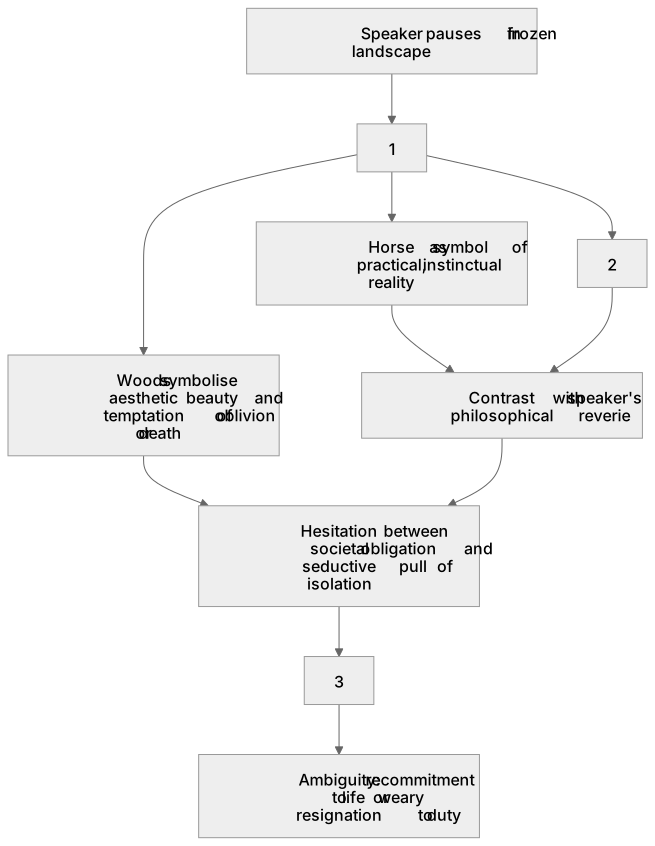
1Box 1
2Box 2
3Box 3
There is more to this lesson
The full lesson goes on to check your understanding and help you earn the marks. Create a free account to carry on, with your progress saved.
A week of Premium from your first lesson · Then the free plan continues · No card, no charge
Test your understanding of Component 3: Poetry – Section B: Specified Poetry Pre- or Post-1900 – Post-1900 – The Modernist Period – The Great Modern Poets, editor Michael Schmidt (Quercus, 2014): Stopping by Woods on a Snowy Evening
Active recall beats re-reading. Take an instant quiz now to test what you’ve learned and lock it into long-term memory.
A week of Premium from your first lesson · Then the free plan continues · No card, no charge