Pearson Edexcel · A-Level · English Literature
Course version: 9ET0 · Version from Sept 2015
Poetry – Section B: Specified Poetry Pre- or Post-1900 – Post-1900 – The…
Full specification wording
Component 3: Poetry – Section B: Specified Poetry Pre- or Post-1900 – Post-1900 – The Modernist Period – The Great Modern Poets, editor Michael Schmidt (Quercus, 2014): Recuerdo
"Recuerdo", meaning 'memory' in Spanish, captures the intoxicating, carefree joy of a youthful romantic escapade.
Checked against the Pearson Edexcel 9ET0 specification (opens in a new tab) on .
- Point 14 of 21
- 4 key terms
Study notes
From the checked teaching notes for this specification point.
The idea
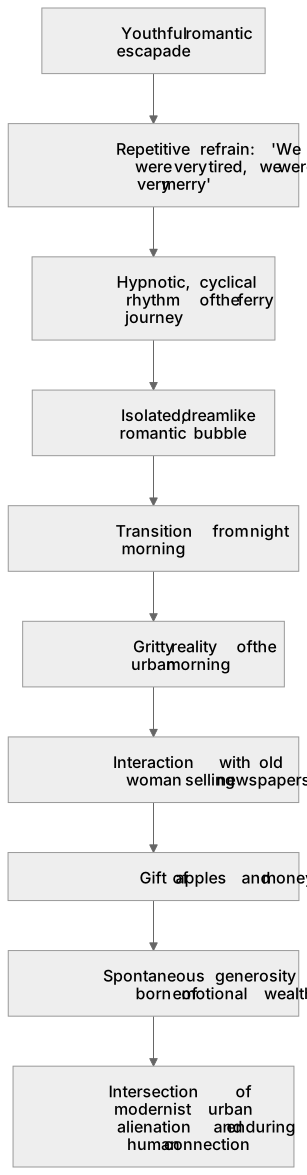
"Recuerdo", meaning 'memory' in Spanish, captures the intoxicating, carefree joy of a youthful romantic escapade. Edna St. Vincent Millay uses a highly rhythmic, repetitive structure, notably the refrain "We were very tired, we were very merry", to mimic the hypnotic motion of the Staten Island ferry and the lovers' joyful exhaustion. The poem contrasts the couple's isolated, almost dreamlike romantic bubble with the gritty reality of the urban morning, culminating in their interaction with an old woman selling newspapers. By giving her their apples and money, the lovers demonstrate a spontaneous generosity born of their own emotional wealth, highlighting the intersection of modernist urban alienation and enduring human connection.
What earns the marks
- Analyse the use of repetition and refrain to establish the hypnotic, cyclical rhythm of the ferry journey.
- Evaluate the contrast between the lovers' emotional wealth and the physical poverty of the old woman.
- Explore the significance of the urban setting and how the couple isolates themselves within the bustling city.
- Discuss the sensory imagery used to convey the transition from night to morning and its effect on the poem's mood.
Common mistakes and how to put them right
Assuming the poem is purely a naive love song.
Put it right: Recognise the subtle modernist awareness of class and urban poverty introduced in the final stanza.
Ignoring the significance of the title.
Put it right: Explicitly connect the title 'Recuerdo' (memory) to the nostalgic, retrospective tone of the narrative.
Overlooking the strict rhyme scheme.
Put it right: Analyse how the AABBCC structure reinforces the rhythmic, repetitive motion of the ferry and the couple's unified state.
Exam tips
- Compare the depiction of urban romance in 'Recuerdo' with more cynical modernist portrayals of city life.
- Quote the refrain accurately to demonstrate how Millay balances physical exhaustion with emotional elation.
- Examine the symbolic exchange of the apples and money as a gesture of shared humanity bridging class divides.
Try the lesson
The start of the Component 3: Poetry – Section B: Specified Poetry Pre- or Post-1900 – Post-1900 – The Modernist Period – The Great Modern Poets, editor Michael Schmidt (Quercus, 2014): Recuerdo lesson, made from checked teaching notes for this specification point.
Have a go first
In Edna St. Vincent Millay's poem "Recuerdo", which lines function as a refrain at the beginning of each stanza to establish the speakers' physical and emotional state?
Listen
Recuerdo", meaning 'memory' in Spanish, captures the intoxicating, carefree joy of a youthful romantic escapade. Edna St. Vincent Millay uses a highly rhythmic, repetitive structure, notably the refrain "We were very tired, we were very merry", to mimic the hypnotic motion of the Staten Island ferry and the lovers' joyful exhaustion. The poem contrasts the couple's isolated, almost dreamlike romantic bubble with the gritty reality of the urban morning, culminating in their interaction with an old woman selling newspapers. By giving her their apples and money, the lovers demonstrate a spontaneous generosity born of their own emotional wealth, highlighting the intersection of modernist urban alienation and enduring human connection. A strong answer earns marks for these points. Analyse the use of repetition and refrain to establish the hypnotic, cyclical rhythm of the ferry journey. Evaluate the contrast between the lovers' emotional wealth and the physical poverty of the old woman. Explore the significance of the urban setting and how the couple isolates themselves within the bustling city. Discuss the sensory imagery used to convey the transition from night to morning and its effect on the poem's mood. A common slip: Assuming the poem is purely a naive love song. Instead, recognise the subtle modernist awareness of class and urban poverty introduced in the final stanza. Exam tip: Compare the depiction of urban romance in 'Recuerdo' with more cynical modernist portrayals of city life.
See it
Key words
Say what each word means before you turn the card.
Youthful romance
Try answering aloud or in your head before turning the card.
Urban isolation versus connection
Try answering aloud or in your head before turning the card.
Memory and nostalgia
Try answering aloud or in your head before turning the card.
Class and poverty
Try answering aloud or in your head before turning the card.
See every definition
- Youthful romance
- The intoxicating, carefree joy of a romantic escapade between young lovers, presented as an isolated, almost dreamlike bubble.
- Urban isolation versus connection
- The contrast between the couple's isolated, dreamlike romantic bubble and the gritty reality of the urban morning, where generosity bridges class divides.
- Memory and nostalgia
- The retrospective, nostalgic tone of the narrative, signalled by the title 'Recuerdo', meaning 'memory' in Spanish.
- Class and poverty
- The subtle modernist awareness of class and urban poverty introduced in the final stanza, where the lovers give apples and money to an old woman selling newspapers.
Label the diagram
Some boxes have lost their names. Pick the right name for each number.
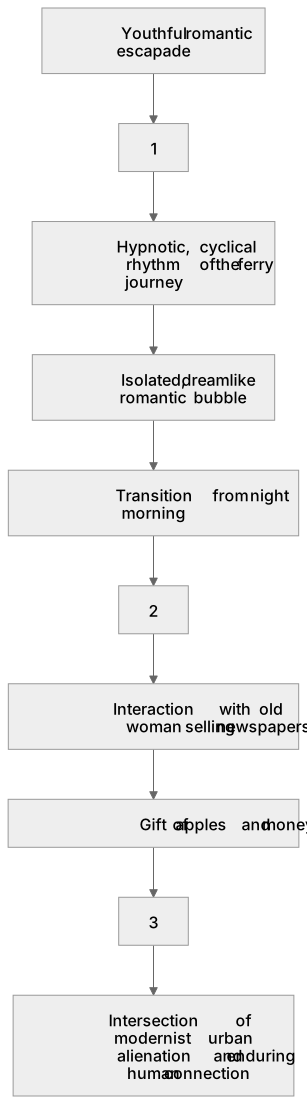
1Box 1
2Box 2
3Box 3
There is more to this lesson
The full lesson goes on to check your understanding and help you earn the marks. Create a free account to carry on, with your progress saved.
A week of Premium from your first lesson · Then the free plan continues · No card, no charge
Test your understanding of Component 3: Poetry – Section B: Specified Poetry Pre- or Post-1900 – Post-1900 – The Modernist Period – The Great Modern Poets, editor Michael Schmidt (Quercus, 2014): Recuerdo
Active recall beats re-reading. Take an instant quiz now to test what you’ve learned and lock it into long-term memory.
A week of Premium from your first lesson · Then the free plan continues · No card, no charge