Pearson Edexcel · A-Level · English Literature
Course version: 9ET0 · Version from Sept 2015
Poetry – Section B: Specified Poetry Pre- or Post-1900 – Post-1900 – The…
Full specification wording
Component 3: Poetry – Section B: Specified Poetry Pre- or Post-1900 – Post-1900 – The Modernist Period – The Great Modern Poets, editor Michael Schmidt (Quercus, 2014): The Love Song of J. Alfred Prufrock
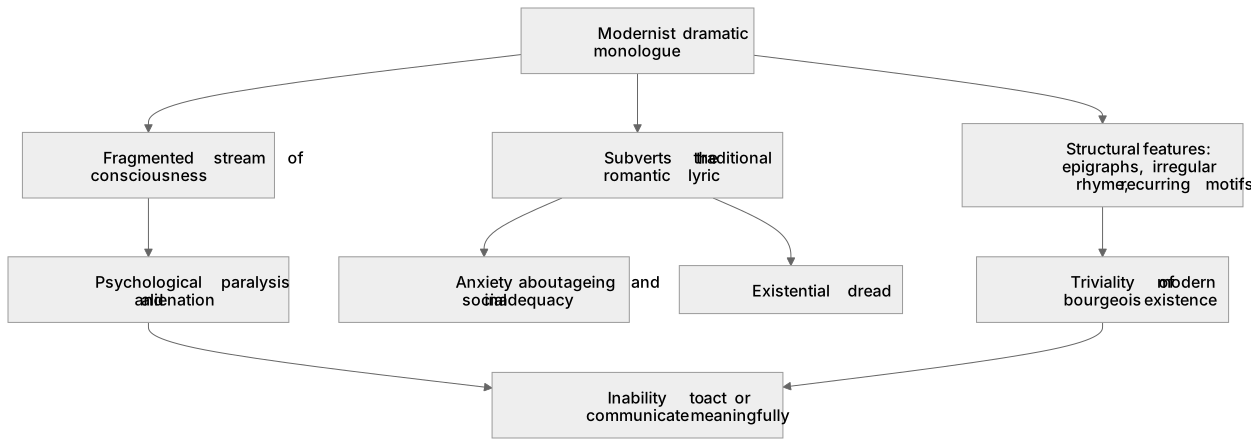
T.S. Eliot’s seminal Modernist dramatic monologue captures the psychological paralysis and profound alienation of the early twentieth-century urban psyche.
Checked against the Pearson Edexcel 9ET0 specification (opens in a new tab) on .
- Point 13 of 21
- 4 key terms
Study notes
From the checked teaching notes for this specification point.
The idea
T.S. Eliot’s seminal Modernist dramatic monologue captures the psychological paralysis and profound alienation of the early twentieth-century urban psyche. Through a fragmented stream-of-consciousness narrative, the speaker navigates a decaying cityscape, symbolised by the cat-like 'yellow fog'. Key structural features include the use of epigraphs, irregular rhyme schemes, and recurring motifs, such as measuring out life in 'coffee spoons', which highlight the triviality of modern bourgeois existence and the speaker's inability to act or communicate meaningfully.
What earns the marks
- Analyse the use of dramatic monologue and stream of consciousness to reveal psychological fragmentation.
- Evaluate the significance of urban imagery, such as the 'yellow fog' and 'half-deserted streets', in establishing a mood of decay.
- Explore the subversion of the 'love song' form through the speaker's overwhelming social anxiety and fear of rejection.
- Assess the impact of intertextual references, including the epigraph from Dante and allusions to Hamlet or Marvell.
Common mistakes and how to put them right
Treating the poem as a traditional romantic address to a literal lover.
Put it right: Recognise the 'you and I' as a divided self or an invitation to the reader into the speaker's internal psychological landscape.
Ignoring the structural fragmentation and focusing only on the narrative.
Put it right: Analyse how the irregular stanza lengths, shifting rhythms, and abrupt transitions reflect the speaker's disjointed thought processes.
Misinterpreting the ending as a literal drowning.
Put it right: Understand the concluding 'drowning' as a metaphorical awakening to harsh reality, extinguishing the speaker's romantic illusions.
Exam tips
- Link the poem's fragmented structure directly to the Modernist preoccupation with a fractured post-industrial society.
- Compare the speaker's paralysis with the active, decisive figures in other anthology poems to highlight his existential dread.
- Use specific quotations, such as 'measured out my life with coffee spoons', to demonstrate the trivialisation of modern existence.
Try the lesson
The start of the Component 3: Poetry – Section B: Specified Poetry Pre- or Post-1900 – Post-1900 – The Modernist Period – The Great Modern Poets, editor Michael Schmidt (Quercus, 2014): The Love Song of J. Alfred Prufrock lesson, made from checked teaching notes for this specification point.
Have a go first
In the opening lines of T.S. Eliot's 'The Love Song of J. Alfred Prufrock', how is the evening sky described through a striking Modernist simile?
Listen
T.S. Eliot’s seminal Modernist dramatic monologue captures the psychological paralysis and profound alienation of the early twentieth-century urban psyche. Through a fragmented stream-of-consciousness narrative, the speaker navigates a decaying cityscape, symbolised by the cat-like 'yellow fog'. Key structural features include the use of epigraphs, irregular rhyme schemes, and recurring motifs, such as measuring out life in 'coffee spoons', which highlight the triviality of modern bourgeois existence and the speaker's inability to act or communicate meaningfully. A strong answer earns marks for these points. Analyse the use of dramatic monologue and stream of consciousness to reveal psychological fragmentation. Evaluate the significance of urban imagery, such as the 'yellow fog' and 'half-deserted streets', in establishing a mood of decay. Explore the subversion of the 'love song' form through the speaker's overwhelming social anxiety and fear of rejection. Assess the impact of intertextual references, including the epigraph from Dante and allusions to Hamlet or Marvell. A common slip: Treating the poem as a traditional romantic address to a literal lover. Instead, Recognise the 'you and I' as a divided self or an invitation to the reader into the speaker's internal psychological landscape. Exam tip: Link the poem's fragmented structure directly to the Modernist preoccupation with a fractured post-industrial society.
See it
Key words
Say what each word means before you turn the card.
Alienation and isolation
Try answering aloud or in your head before turning the card.
Psychological paralysis
Try answering aloud or in your head before turning the card.
Urban decay
Try answering aloud or in your head before turning the card.
Stream of consciousness
Try answering aloud or in your head before turning the card.
See every definition
- Alienation and isolation
- The profound separation of the early twentieth-century urban psyche, captured in Eliot's dramatic monologue.
- Psychological paralysis
- The speaker's inability to act or communicate meaningfully, central to Eliot's portrayal of the modern psyche.
- Urban decay
- A decaying cityscape, symbolised by the cat-like 'yellow fog' and 'half-deserted streets'.
- Stream of consciousness
- A fragmented narrative mode through which the speaker's disjointed thought processes are revealed.
Label the diagram
Some boxes have lost their names. Pick the right name for each number.
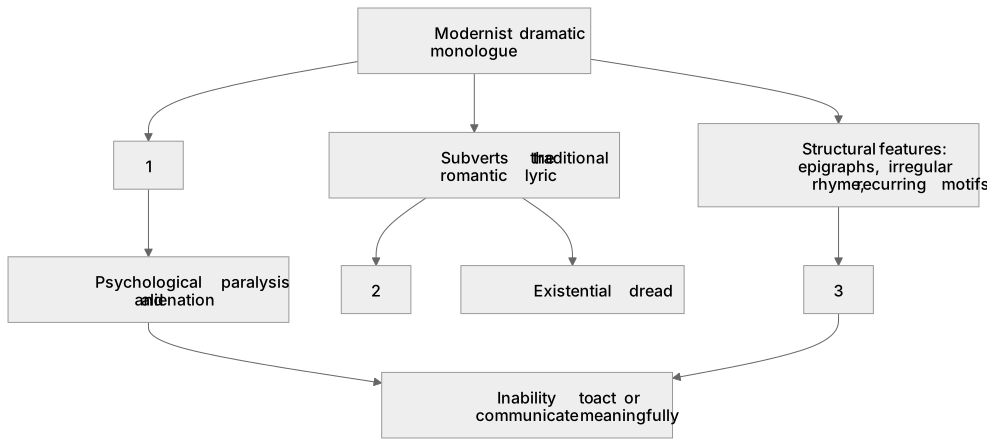
1Box 1
2Box 2
3Box 3
There is more to this lesson
The full lesson goes on to check your understanding and help you earn the marks. Create a free account to carry on, with your progress saved.
A week of Premium from your first lesson · Then the free plan continues · No card, no charge
Test your understanding of Component 3: Poetry – Section B: Specified Poetry Pre- or Post-1900 – Post-1900 – The Modernist Period – The Great Modern Poets, editor Michael Schmidt (Quercus, 2014): The Love Song of J. Alfred Prufrock
Active recall beats re-reading. Take an instant quiz now to test what you’ve learned and lock it into long-term memory.
A week of Premium from your first lesson · Then the free plan continues · No card, no charge