Pearson Edexcel · A-Level · English Literature
Course version: 9ET0 · Version from Sept 2015
Poetry – Section B: Specified Poetry Pre- or Post-1900 – Post-1900 – The…
Full specification wording
Component 3: Poetry – Section B: Specified Poetry Pre- or Post-1900 – Post-1900 – The Modernist Period – The Great Modern Poets, editor Michael Schmidt (Quercus, 2014): The Runaway Robert Frost
Robert Frost's 'The Runaway' records observers meeting a young Morgan colt frightened by the year's first snow.
Checked against the Pearson Edexcel 9ET0 specification (opens in a new tab) on .
- Point 1 of 21
- 4 key terms
Study notes
From the checked teaching notes for this specification point.
The idea
Robert Frost's 'The Runaway' records observers meeting a young Morgan colt frightened by the year's first snow. The colt bolts with 'miniature thunder', returns with whitened eyes and raised tail, and shudders as if trying to cast the snow off like flies. Human dialogue interprets its fear, wonders where its mother is and ends by blaming whoever left it outside. The poem's single 21-line stanza, variable line lengths, loose rhymes and movement between narration and quoted speech follow the animal's flight and return without smoothing the episode into a regular pastoral scene.
What earns the marks
- Analyse visual and sound details such as the curled forefoot, 'miniature thunder', falling flakes, clattering stone and whitened eyes in constructing the colt's fear.
- Evaluate how the single 21-line stanza, variable line lengths and loose rhymes accommodate the colt's bolt, disappearance and return.
- Explore how quoted conversation moves from interpretation of the colt's behaviour to concern about its absent mother.
- Discuss how the final judgement on whoever left the colt outside turns a brief encounter into a question of care and responsibility.
Common mistakes and how to put them right
Reading the poem as a decorative winter scene.
Put it right: Follow the colt's physical signs of fear and the speakers' increasing concern.
Calling the colt literally personified.
Put it right: It remains an animal whose behaviour the human observers interpret, compare and partly anthropomorphise.
Forcing the poem into a fixed allegory of modern life.
Put it right: Begin with its exact narrative, imagery and dialogue, then present broader readings as interpretations.
Exam tips
- Track the narrative sequence from first sight, through the bolt, to the colt's return and the final criticism of its owner.
- Compare the speakers' guesses with the poem's directly observed details to distinguish interpretation from description.
- Use the relation between variable form and changing action, rather than claiming irregularity automatically proves panic.
Try the lesson
The start of the Component 3: Poetry – Section B: Specified Poetry Pre- or Post-1900 – Post-1900 – The Modernist Period – The Great Modern Poets, editor Michael Schmidt (Quercus, 2014): The Runaway Robert Frost lesson, made from checked teaching notes for this specification point.
Have a go first
How does Frost use the speaker's final statement, "I doubt if even his mother could tell him, / 'Sakes, it's only weather'", to develop the poem's meaning?
Listen
Robert Frost's 'The Runaway' records observers meeting a young Morgan colt frightened by the year's first snow. The colt bolts with 'miniature thunder', returns with whitened eyes and raised tail, and shudders as if trying to cast the snow off like flies. Human dialogue interprets its fear, wonders where its mother is and ends by blaming whoever left it outside. The poem's single 21-line stanza, variable line lengths, loose rhymes and movement between narration and quoted speech follow the animal's flight and return without smoothing the episode into a regular pastoral scene. A strong answer earns marks for these points. Analyse visual and sound details such as the curled forefoot, 'miniature thunder', falling flakes, clattering stone and whitened eyes in constructing the colt's fear. Evaluate how the single 21-line stanza, variable line lengths and loose rhymes accommodate the colt's bolt, disappearance and return. Explore how quoted conversation moves from interpretation of the colt's behaviour to concern about its absent mother. Discuss how the final judgement on whoever left the colt outside turns a brief encounter into a question of care and responsibility. A common slip: Reading the poem as a decorative winter scene. Instead, follow the colt's physical signs of fear and the speakers' increasing concern. Exam tip: Track the narrative sequence from first sight, through the bolt, to the colt's return and the final criticism of its owner.
See it
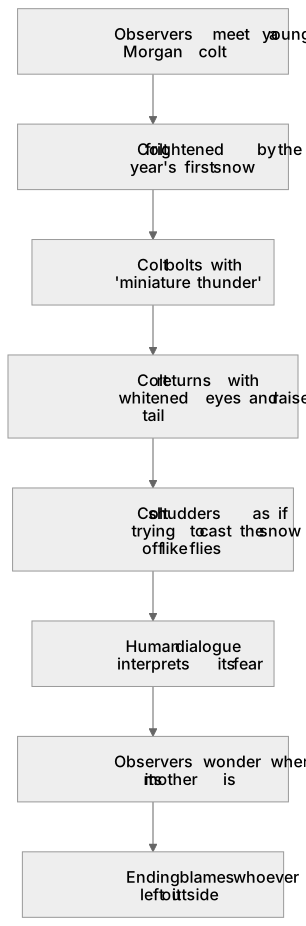
Put it in order
Put these steps in the order they happen.
- 1. Colt shudders as if trying to cast the snow off like flies
- 2. Ending blames whoever left it outside
- 3. Human dialogue interprets its fear
- 4. Observers meet a young Morgan colt
- 5. Colt frightened by the year's first snow
- 6. Observers wonder where its mother is
- 7. Colt bolts with 'miniature thunder'
- 8. Colt returns with whitened eyes and raised tail
Key words
Say what each word means before you turn the card.
Fear and vulnerability
Try answering aloud or in your head before turning the card.
Human observation and empathy
Try answering aloud or in your head before turning the card.
Care and responsibility
Try answering aloud or in your head before turning the card.
Animals and weather
Try answering aloud or in your head before turning the card.
See every definition
- Fear and vulnerability
- The colt's fright is shown through physical signs, and the observers' concern grows for a vulnerable creature left outside.
- Human observation and empathy
- Precise visual and sound images turn the observers' watching of the colt into sympathy, while their guesses remain interpretation rather than description.
- Care and responsibility
- The final judgement on whoever left the colt outside turns a brief encounter into a question of care and responsibility.
- Animals and weather
- The year's first snow frightens the young Morgan colt, which shudders as if trying to cast the snow off like flies.
Label the diagram
Some boxes have lost their names. Pick the right name for each number.
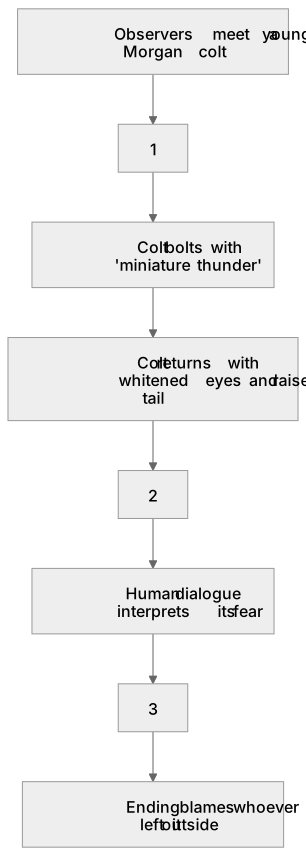
1Box 1
2Box 2
3Box 3
There is more to this lesson
The full lesson goes on to check your understanding and help you earn the marks. Create a free account to carry on, with your progress saved.
A week of Premium from your first lesson · Then the free plan continues · No card, no charge
Test your understanding of Component 3: Poetry – Section B: Specified Poetry Pre- or Post-1900 – Post-1900 – The Modernist Period – The Great Modern Poets, editor Michael Schmidt (Quercus, 2014): The Runaway Robert Frost
Active recall beats re-reading. Take an instant quiz now to test what you’ve learned and lock it into long-term memory.
A week of Premium from your first lesson · Then the free plan continues · No card, no charge