Pearson Edexcel · A-Level · English Literature
Course version: 9ET0 · Version from Sept 2015
Poetry – Section B: Specified Poetry Pre- or Post-1900 – Post-1900 – The…
Full specification wording
Component 3: Poetry – Section B: Specified Poetry Pre- or Post-1900 – Post-1900 – The Modernist Period – The Great Modern Poets, editor Michael Schmidt (Quercus, 2014): Mending Wall
Robert Frost’s ‘Mending Wall’ explores the tension between human connection and isolation through the annual ritual of repairing a boundary.
Checked against the Pearson Edexcel 9ET0 specification (opens in a new tab) on .
- Point 2 of 21
- 4 key terms
Study notes
From the checked teaching notes for this specification point.
The idea
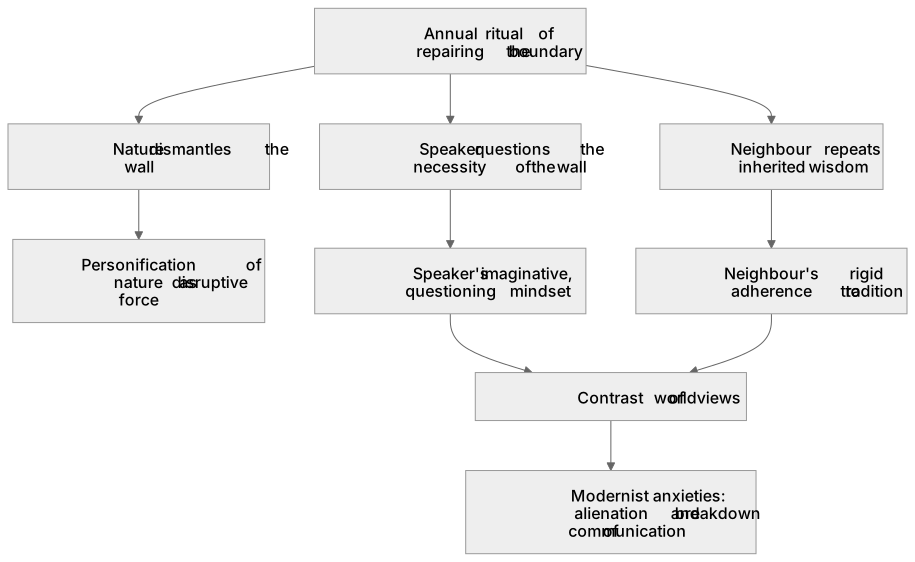
Robert Frost’s ‘Mending Wall’ explores the tension between human connection and isolation through the annual ritual of repairing a boundary. The speaker questions the necessity of the wall, noting that nature itself dismantles it (‘Something there is that doesn’t love a wall’), while his neighbour blindly repeats inherited wisdom (‘Good fences make good neighbours’). Written in continuous blank verse, the poem’s form mirrors natural speech rhythms, grounding its philosophical inquiry in rural realism. As a Modernist text, it interrogates the breakdown of communication and the arbitrary nature of human divisions, contrasting the speaker’s imaginative, questioning mindset with the neighbour’s rigid adherence to outdated traditions.
What earns the marks
- Analyse the use of blank verse to create a conversational yet structured tone that reflects the physical act of building the wall.
- Evaluate the symbolic significance of the wall as both a physical barrier and a psychological boundary between individuals.
- Discuss the contrast between the speaker's progressive questioning and the neighbour's dogmatic traditionalism.
- Explore the personification of nature as an active, disruptive force resisting artificial human boundaries.
Common mistakes and how to put them right
Assuming the speaker entirely opposes the wall.
Put it right: Recognise that the speaker initiates the mending process, showing a complex complicity in the ritual.
Treating the poem as purely pastoral.
Put it right: Analyse the underlying Modernist anxieties regarding alienation and the breakdown of human connection.
Misattributing the phrase 'Good fences make good neighbours' to the speaker.
Put it right: Attribute this aphorism to the neighbour, representing inherited, unquestioned dogma.
Exam tips
- Compare the neighbour's reliance on aphorisms with the speaker's use of imaginative metaphors like 'elves'.
- Link the poem's continuous, stanza-less structure to the physical appearance of a solid stone wall.
- Contextualise the poem within Modernism by discussing its focus on psychological isolation and the questioning of established truths.
Try the lesson
The start of the Component 3: Poetry – Section B: Specified Poetry Pre- or Post-1900 – Post-1900 – The Modernist Period – The Great Modern Poets, editor Michael Schmidt (Quercus, 2014): Mending Wall lesson, made from checked teaching notes for this specification point.
Have a go first
In Robert Frost's poem 'Mending Wall', what phrase does the speaker's neighbour repeatedly use to justify rebuilding the wall?
Listen
Robert Frost’s ‘Mending Wall’ explores the tension between human connection and isolation through the annual ritual of repairing a boundary. The speaker questions the necessity of the wall, noting that nature itself dismantles it (‘Something there is that doesn’t love a wall’), while his neighbour blindly repeats inherited wisdom (‘Good fences make good neighbours’). Written in continuous blank verse, the poem’s form mirrors natural speech rhythms, grounding its philosophical inquiry in rural realism. As a Modernist text, it interrogates the breakdown of communication and the arbitrary nature of human divisions, contrasting the speaker’s imaginative, questioning mindset with the neighbour’s rigid adherence to outdated traditions. A strong answer earns marks for these points. Analyse the use of blank verse to create a conversational yet structured tone that reflects the physical act of building the wall. Evaluate the symbolic significance of the wall as both a physical barrier and a psychological boundary between individuals. Discuss the contrast between the speaker's progressive questioning and the neighbour's dogmatic traditionalism. Explore the personification of nature as an active, disruptive force resisting artificial human boundaries. A common slip: Assuming the speaker entirely opposes the wall. Instead, recognise that the speaker initiates the mending process, showing a complex complicity in the ritual. Exam tip: Compare the neighbour's reliance on aphorisms with the speaker's use of imaginative metaphors like 'elves'.
See it
Key words
Say what each word means before you turn the card.
Boundaries and Isolation
Try answering aloud or in your head before turning the card.
Tradition versus Progress
Try answering aloud or in your head before turning the card.
Man and Nature
Try answering aloud or in your head before turning the card.
Communication and Alienation
Try answering aloud or in your head before turning the card.
See every definition
- Boundaries and Isolation
- The tension between human connection and isolation, explored through the annual ritual of repairing a boundary.
- Tradition versus Progress
- The contrast between the neighbour's rigid adherence to outdated traditions and the speaker's imaginative, questioning mindset.
- Man and Nature
- The personification of nature as an active, disruptive force resisting artificial human boundaries.
- Communication and Alienation
- A Modernist concern with the breakdown of communication and the arbitrary nature of human divisions.
Label the diagram
Some boxes have lost their names. Pick the right name for each number.
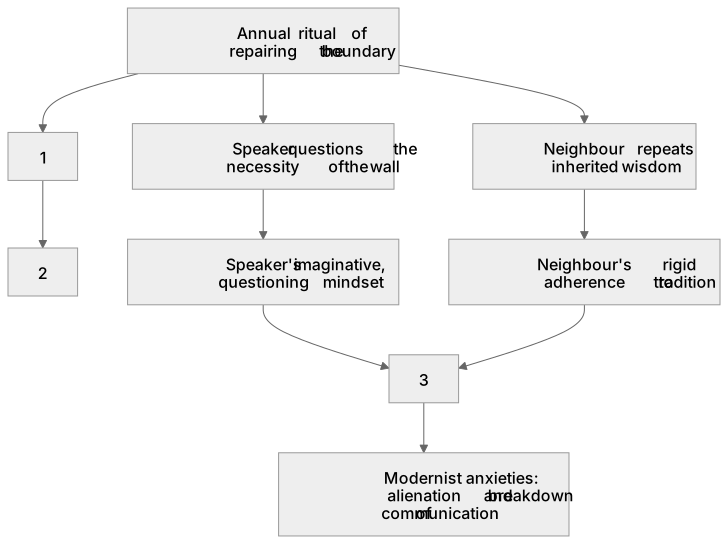
1Box 1
2Box 2
3Box 3
There is more to this lesson
The full lesson goes on to check your understanding and help you earn the marks. Create a free account to carry on, with your progress saved.
A week of Premium from your first lesson · Then the free plan continues · No card, no charge
Test your understanding of Component 3: Poetry – Section B: Specified Poetry Pre- or Post-1900 – Post-1900 – The Modernist Period – The Great Modern Poets, editor Michael Schmidt (Quercus, 2014): Mending Wall
Active recall beats re-reading. Take an instant quiz now to test what you’ve learned and lock it into long-term memory.
A week of Premium from your first lesson · Then the free plan continues · No card, no charge