Pearson Edexcel · A-Level · English Literature
Course version: 9ET0 · Version from Sept 2015
Poetry – Section B: Specified Poetry Pre- or Post-1900 – Post-1900 – The…
Full specification wording
Component 3: Poetry – Section B: Specified Poetry Pre- or Post-1900 – Post-1900 – The Modernist Period – The Great Modern Poets, editor Michael Schmidt (Quercus, 2014): The Shield of Achilles
In 'The Shield of Achilles', W.H. Auden subverts the classical Homeric epic to critique the brutality and totalitarianism of the modern world.
Checked against the Pearson Edexcel 9ET0 specification (opens in a new tab) on .
- Point 21 of 21
- 4 key terms
Study notes
From the checked teaching notes for this specification point.
The idea
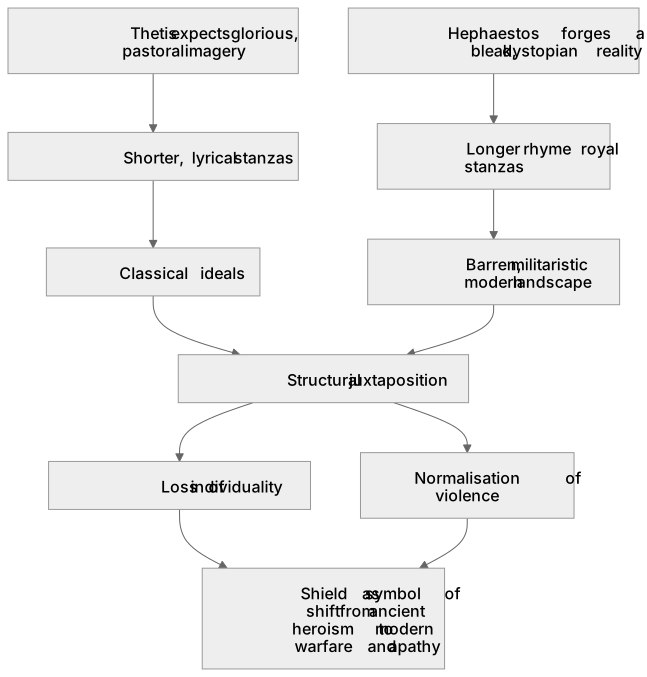
In 'The Shield of Achilles', W.H. Auden subverts the classical Homeric epic to critique the brutality and totalitarianism of the modern world. The poem contrasts the expectations of Thetis, who looks for glorious, pastoral imagery on her son’s shield, with the bleak, dystopian reality forged by Hephaestos. Auden alternates between two distinct stanza forms: shorter, lyrical stanzas reflecting Thetis’s classical ideals, and longer rhyme royal stanzas detailing a barren, militaristic modern landscape.
What earns the marks
- Analysis of the structural contrast between the shorter stanzas (Thetis's expectations) and the longer rhyme royal stanzas (Hephaestos's reality).
- Exploration of the poem as an anti-war critique, reflecting post-WWII anxieties and the rise of totalitarian regimes.
- Evaluation of the subversion of classical mythology, specifically the contrast between Homer's glorious shield and Auden's bleak vision.
- Discussion of the imagery of barrenness and conformity, such as the 'million eyes, a million boots in line', to depict the loss of individuality.
Common mistakes and how to put them right
Confusing the perspectives of Thetis and Hephaestos.
Put it right: Thetis expects classical beauty, while Hephaestos creates the grim modern reality.
Treating the poem merely as a retelling of the Iliad.
Put it right: It must be analysed as a Modernist critique of 20th-century warfare and society.
Ignoring the specific metrical and stanzaic shifts; students often miss how the form directly mirrors the thematic contrast between expectation and reality.
Exam tips
- Focus on the sensory deprivation in the modern stanzas, noting the lack of colour, music, and individuality to emphasise the bleakness of modern conflict.
- Connect the 'barbed wire' and 'arbitrary spot' to 20th-century historical contexts, such as concentration camps or totalitarian states, for AO3 (context).
- Contrast the passive, observing role of Thetis with the active, destructive reality of the modern soldiers to explore power dynamics and helplessness.
Try the lesson
The start of the Component 3: Poetry – Section B: Specified Poetry Pre- or Post-1900 – Post-1900 – The Modernist Period – The Great Modern Poets, editor Michael Schmidt (Quercus, 2014): The Shield of Achilles lesson, made from checked teaching notes for this specification point.
Have a go first
In W.H. Auden's poem 'The Shield of Achilles', what is the primary contrast between the expectations of Thetis and the reality of the shield forged by Hephaestos?
Listen
In 'The Shield of Achilles', W.H. Auden subverts the classical Homeric epic to critique the brutality and totalitarianism of the modern world. The poem contrasts the expectations of Thetis, who looks for glorious, pastoral imagery on her son’s shield, with the bleak, dystopian reality forged by Hephaestos. Auden alternates between two distinct stanza forms: shorter, lyrical stanzas reflecting Thetis’s classical ideals, and longer rhyme royal stanzas detailing a barren, militaristic modern landscape. A strong answer earns marks for these points. Analysis of the structural contrast between the shorter stanzas (Thetis's expectations) and the longer rhyme royal stanzas (Hephaestos's reality). Exploration of the poem as an anti-war critique, reflecting post-WWII anxieties and the rise of totalitarian regimes. Evaluation of the subversion of classical mythology, specifically the contrast between Homer's glorious shield and Auden's bleak vision. Discussion of the imagery of barrenness and conformity, such as the 'million eyes, a million boots in line', to depict the loss of individuality. Exam tip: Focus on the sensory deprivation in the modern stanzas, noting the lack of colour, music, and individuality to emphasise the bleakness of modern conflict.
See it
Key words
Say what each word means before you turn the card.
War and totalitarianism
Try answering aloud or in your head before turning the card.
The subversion of myth
Try answering aloud or in your head before turning the card.
Loss of individuality
Try answering aloud or in your head before turning the card.
Expectation versus reality
Try answering aloud or in your head before turning the card.
See every definition
- War and totalitarianism
- The brutality and totalitarianism of the modern world are what Auden critiques by subverting the classical Homeric epic.
- The subversion of myth
- Auden subverts the classical Homeric epic, contrasting Homer's glorious shield with his own bleak vision.
- Loss of individuality
- Highlighted by the structural juxtaposition and by imagery of conformity such as the 'million eyes, a million boots in line'.
- Expectation versus reality
- Thetis expects glorious, pastoral imagery on her son's shield, while Hephaestos forges a bleak, dystopian reality.
Label the diagram
Some boxes have lost their names. Pick the right name for each number.
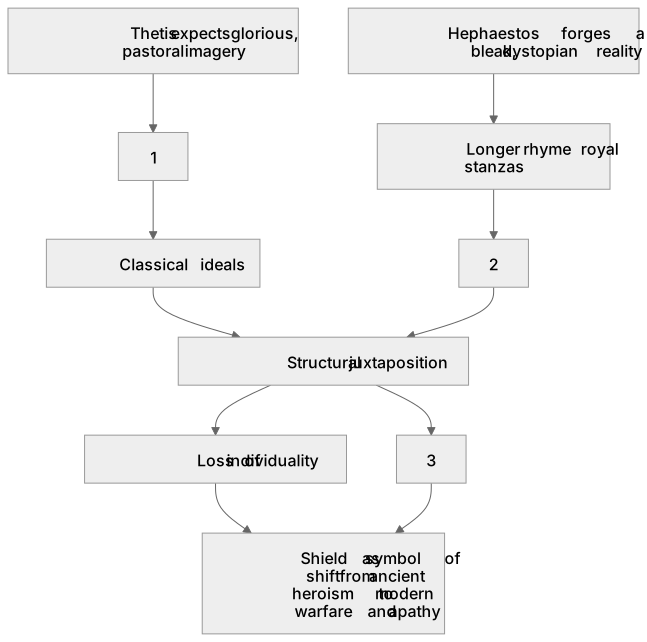
1Box 1
2Box 2
3Box 3
There is more to this lesson
The full lesson goes on to check your understanding and help you earn the marks. Create a free account to carry on, with your progress saved.
A week of Premium from your first lesson · Then the free plan continues · No card, no charge
Test your understanding of Component 3: Poetry – Section B: Specified Poetry Pre- or Post-1900 – Post-1900 – The Modernist Period – The Great Modern Poets, editor Michael Schmidt (Quercus, 2014): The Shield of Achilles
Active recall beats re-reading. Take an instant quiz now to test what you’ve learned and lock it into long-term memory.
A week of Premium from your first lesson · Then the free plan continues · No card, no charge