Pearson Edexcel · A-Level · English Literature
Course version: 9ET0 · Version from Sept 2015
Poetry – Section B: Specified Poetry Pre- or Post-1900 – Post-1900 – The…
Full specification wording
Component 3: Poetry – Section B: Specified Poetry Pre- or Post-1900 – Post-1900 – The Modernist Period – The Great Modern Poets, editor Michael Schmidt (Quercus, 2014): Musée des Beaux Arts
W.H. Auden’s 'Musée des Beaux Arts' explores the profound human truth that individual suffering occurs against the backdrop of an indifferent, ordinary world.
Checked against the Pearson Edexcel 9ET0 specification (opens in a new tab) on .
- Point 20 of 21
- 4 key terms
Study notes
From the checked teaching notes for this specification point.
The idea
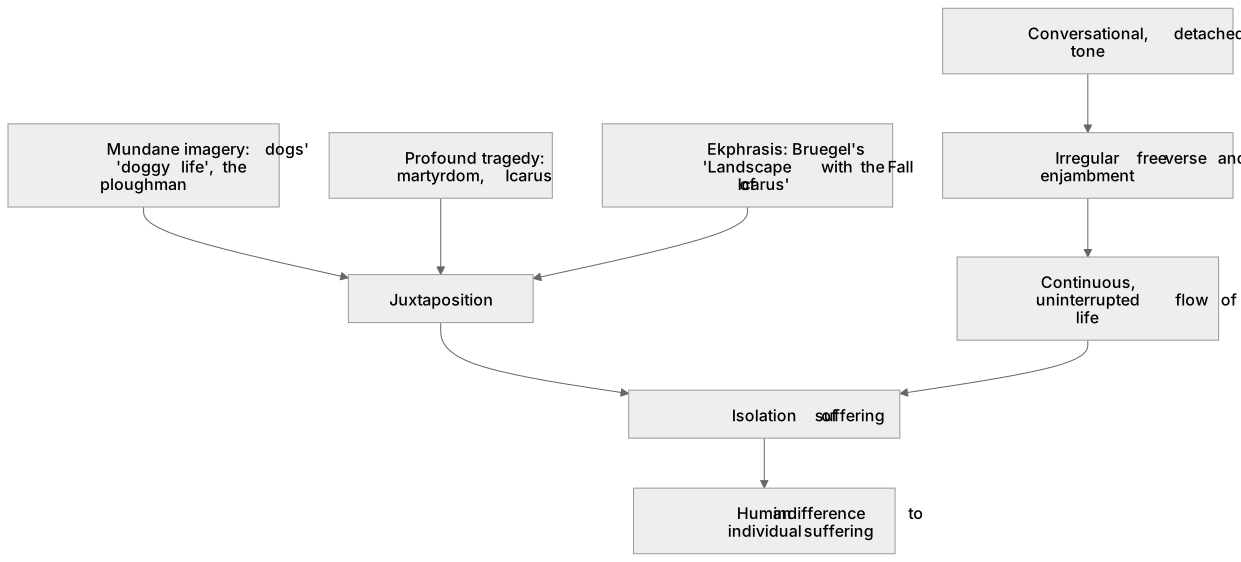
W.H. Auden’s 'Musée des Beaux Arts' explores the profound human truth that individual suffering occurs against the backdrop of an indifferent, ordinary world. Inspired by Pieter Bruegel’s painting 'Landscape with the Fall of Icarus', Auden uses a conversational, almost detached tone and irregular free verse to mirror the casual nature of tragedy. The poem juxtaposes mundane activities, such as dogs going on with their 'doggy life' or a ploughman ignoring a boy falling from the sky, with mythological disaster.
What earns the marks
- Analysis of the conversational, detached narrative voice and its effect on the poem's thematic focus on human indifference.
- Exploration of ekphrasis, specifically how Auden interprets Bruegel's 'Landscape with the Fall of Icarus' to convey his central message.
- Evaluation of structural features, such as irregular rhyme and enjambment, reflecting the chaotic, ongoing nature of ordinary life.
- Discussion of the juxtaposition between mundane, everyday imagery (dogs, the ploughman) and profound tragedy (martyrdom, Icarus).
Common mistakes and how to put them right
Assuming the poem explicitly criticises the bystanders.
Put it right: It observes the natural, inevitable human tendency to focus on one's own life.
Misidentifying the form as a strict traditional structure.
Put it right: It is written in free verse with irregular rhyme to mimic natural, philosophical speech.
Exam tips
- Use the poem's engagement with Bruegel and its 1938 setting to support AO3 context while keeping the argument centred on Auden's language and form.
- Use the term 'ekphrasis' when discussing how Auden translates visual art into a poetic meditation on human apathy.
- Analyse the specific diction used to describe the mundane, such as 'doggy life' or 'scratching its innocent behind', to illustrate the stark contrast with tragedy.
Try the lesson
The start of the Component 3: Poetry – Section B: Specified Poetry Pre- or Post-1900 – Post-1900 – The Modernist Period – The Great Modern Poets, editor Michael Schmidt (Quercus, 2014): Musée des Beaux Arts lesson, made from checked teaching notes for this specification point.
Have a go first
In W.H. Auden's poem 'Musée des Beaux Arts', what central theme is explored through the speaker's observation of the Old Masters' paintings?
Listen
W.H. Auden’s 'Musée des Beaux Arts' explores the profound human truth that individual suffering occurs against the backdrop of an indifferent, ordinary world. Inspired by Pieter Bruegel’s painting 'Landscape with the Fall of Icarus', Auden uses a conversational, almost detached tone and irregular free verse to mirror the casual nature of tragedy. The poem juxtaposes mundane activities, such as dogs going on with their 'doggy life' or a ploughman ignoring a boy falling from the sky, with mythological disaster. A strong answer earns marks for these points. Analysis of the conversational, detached narrative voice and its effect on the poem's thematic focus on human indifference. Exploration of ekphrasis, specifically how Auden interprets Bruegel's 'Landscape with the Fall of Icarus' to convey his central message. Evaluation of structural features, such as irregular rhyme and enjambment, reflecting the chaotic, ongoing nature of ordinary life. Discussion of the juxtaposition between mundane, everyday imagery (dogs, the ploughman) and profound tragedy (martyrdom, Icarus). A common slip: Assuming the poem explicitly criticises the bystanders. Instead, it observes the natural, inevitable human tendency to focus on one's own life. Exam tip: Use the poem's engagement with Bruegel and its 1938 setting to support AO3 context while keeping the argument centred on Auden's language and form.
See it
Key words
Say what each word means before you turn the card.
Human indifference
Try answering aloud or in your head before turning the card.
Suffering and isolation
Try answering aloud or in your head before turning the card.
Ekphrasis
Try answering aloud or in your head before turning the card.
The mundane versus the tragic
Try answering aloud or in your head before turning the card.
See every definition
- Human indifference
- The profound human truth that individual suffering occurs against the backdrop of an indifferent, ordinary world, a thematic focus of the poem.
- Suffering and isolation
- The poem highlights the isolation of suffering, as isolated moments of agony occur within the continuous, uninterrupted flow of life.
- Ekphrasis
- How Auden interprets Bruegel's 'Landscape with the Fall of Icarus' to convey his central message, translating visual art into a poetic meditation on human apathy.
- The mundane versus the tragic
- The juxtaposition between mundane, everyday imagery such as dogs and the ploughman and profound tragedy such as martyrdom and Icarus.
Label the diagram
Some boxes have lost their names. Pick the right name for each number.
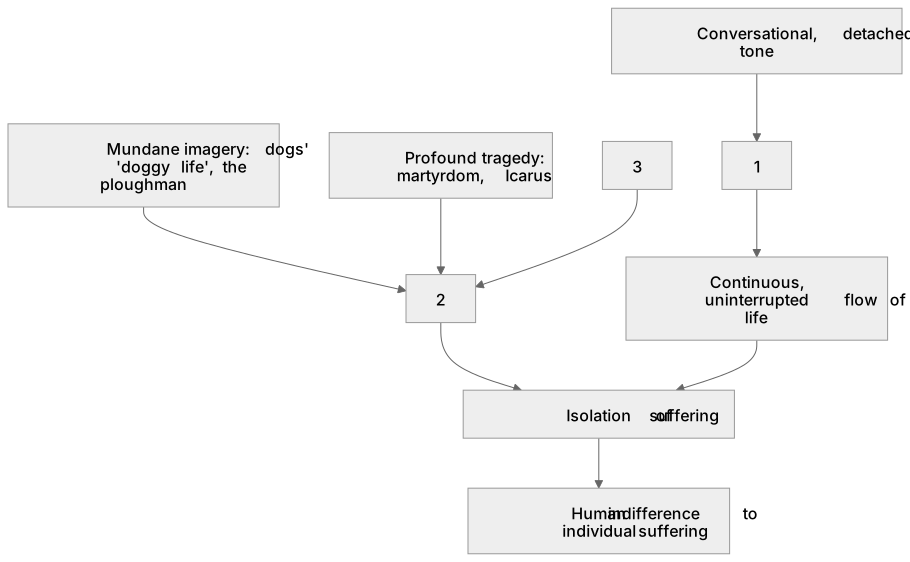
1Box 1
2Box 2
3Box 3
There is more to this lesson
The full lesson goes on to check your understanding and help you earn the marks. Create a free account to carry on, with your progress saved.
A week of Premium from your first lesson · Then the free plan continues · No card, no charge
Test your understanding of Component 3: Poetry – Section B: Specified Poetry Pre- or Post-1900 – Post-1900 – The Modernist Period – The Great Modern Poets, editor Michael Schmidt (Quercus, 2014): Musée des Beaux Arts
Active recall beats re-reading. Take an instant quiz now to test what you’ve learned and lock it into long-term memory.
A week of Premium from your first lesson · Then the free plan continues · No card, no charge