Pearson Edexcel · A-Level · English Literature
Course version: 9ET0 · Version from Sept 2015
Poetry – Section B: Specified Poetry Pre- or Post-1900 – Post-1900 – The…
Full specification wording
Component 3: Poetry – Section B: Specified Poetry Pre- or Post-1900 – Post-1900 – The Modernist Period – The Great Modern Poets, editor Michael Schmidt (Quercus, 2014): The Great Figure
In ‘The Great Figure’, William Carlos Williams captures a fleeting, dynamic moment of urban life through the lens of Imagism.
Checked against the Pearson Edexcel 9ET0 specification (opens in a new tab) on .
- Point 10 of 21
- 4 key terms
Study notes
From the checked teaching notes for this specification point.
The idea
In ‘The Great Figure’, William Carlos Williams captures a fleeting, dynamic moment of urban life through the lens of Imagism. The poem describes a fire engine speeding through a rainy city, focusing intensely on the golden number five painted on its red side. Williams strips away narrative and subjective reflection, presenting a single, vivid image that appeals to both visual and auditory senses. The short, fragmented lines and relentless enjambment mimic the rapid, jarring movement of the vehicle and the suddenness of the encounter. By elevating an ordinary, industrial object to a subject of poetic focus, Williams exemplifies the Modernist commitment to finding beauty and energy in the modern, mechanised world without relying on traditional poetic ornamentation.
What earns the marks
- Analyse the poem's embodiment of Imagist principles, focusing on the direct treatment of the 'thing' and the economy of language.
- Evaluate the use of sensory imagery, particularly the contrast between the visual (gold, red, dark) and the auditory (gongs, siren, wheels).
- Discuss the structural choices, such as the extremely short lines and enjambment, and how they replicate the speed and motion of the fire engine.
- Explore the theme of urban modernity and the aesthetic appreciation of industrial, everyday objects.
Common mistakes and how to put them right
Searching for a deep, hidden symbolic meaning behind the number five.
Put it right: Focus on the Imagist principle that the image itself is the meaning; the '5' is a concrete visual detail of the urban landscape.
Overlooking the auditory imagery in favour of the visual.
Put it right: Give equal weight to the sounds (gongs, siren, rumbling wheels) that contribute to the poem's dynamic energy.
Ignoring the poem's physical shape on the page.
Put it right: Analyse how the narrow, vertical structure of the poem forces a rapid reading pace, mirroring the fire engine's speed.
Exam tips
- Contrast the fast-paced, urban energy of 'The Great Figure' with the static, rural scenes found in other Williams poems or Modernist works.
- Discuss how the poem's lack of punctuation and continuous enjambment create a single, unbroken impression of movement.
- Connect the poem to the broader Modernist movement's fascination with the machine age and city life.
Try the lesson
The start of the Component 3: Poetry – Section B: Specified Poetry Pre- or Post-1900 – Post-1900 – The Modernist Period – The Great Modern Poets, editor Michael Schmidt (Quercus, 2014): The Great Figure lesson, made from checked teaching notes for this specification point.
Have a go first
Which central image is the primary focus of William Carlos Williams's poem 'The Great Figure'?
Listen
In ‘The Great Figure’, William Carlos Williams captures a fleeting, dynamic moment of urban life through the lens of Imagism. The poem describes a fire engine speeding through a rainy city, focusing intensely on the golden number five painted on its red side. Williams strips away narrative and subjective reflection, presenting a single, vivid image that appeals to both visual and auditory senses. The short, fragmented lines and relentless enjambment mimic the rapid, jarring movement of the vehicle and the suddenness of the encounter. By elevating an ordinary, industrial object to a subject of poetic focus, Williams exemplifies the Modernist commitment to finding beauty and energy in the modern, mechanised world without relying on traditional poetic ornamentation. A strong answer earns marks for these points. Analyse the poem's embodiment of Imagist principles, focusing on the direct treatment of the 'thing' and the economy of language. Evaluate the use of sensory imagery, particularly the contrast between the visual (gold, red, dark) and the auditory (gongs, siren, wheels). Discuss the structural choices, such as the extremely short lines and enjambment, and how they replicate the speed and motion of the fire engine. Explore the theme of urban modernity and the aesthetic appreciation of industrial, everyday objects. A common slip: Searching for a deep, hidden symbolic meaning behind the number five. Instead, Focus on the Imagist principle that the image itself is the meaning; the '5' is a concrete visual detail of the urban landscape. Exam tip: Contrast the fast-paced, urban energy of 'The Great Figure' with the static, rural scenes found in other Williams poems or Modernist works.
See it
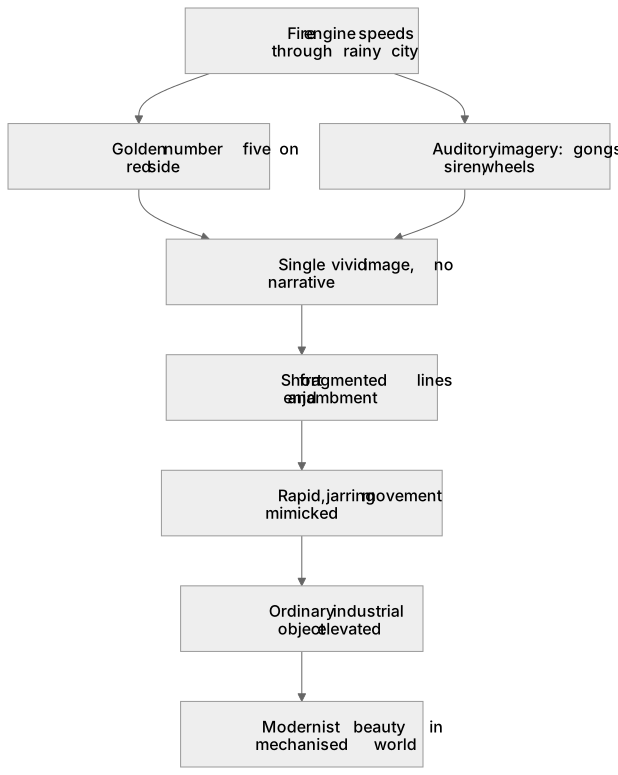
Key words
Say what each word means before you turn the card.
Urban Modernity
Try answering aloud or in your head before turning the card.
Motion and Speed
Try answering aloud or in your head before turning the card.
Sensory Experience
Try answering aloud or in your head before turning the card.
The Beauty of the Ordinary
Try answering aloud or in your head before turning the card.
See every definition
- Urban Modernity
- The modern, mechanised world of city life that the poem represents, finding beauty and energy in industrial, everyday objects.
- Motion and Speed
- The rapid, jarring movement of the fire engine, replicated through extremely short lines and relentless enjambment.
- Sensory Experience
- The appeal to both visual and auditory senses, contrasting colours such as gold, red and dark with sounds such as gongs, siren and wheels.
- The Beauty of the Ordinary
- Elevating an ordinary, industrial object to a subject of poetic focus without relying on traditional poetic ornamentation.
Label the diagram
Some boxes have lost their names. Pick the right name for each number.
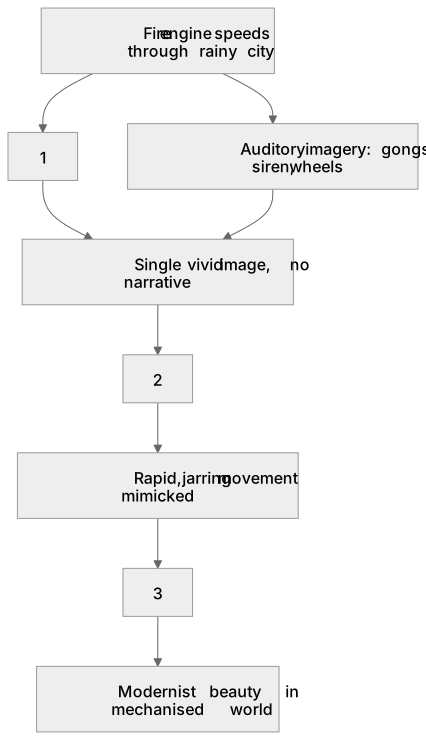
1Box 1
2Box 2
3Box 3
There is more to this lesson
The full lesson goes on to check your understanding and help you earn the marks. Create a free account to carry on, with your progress saved.
A week of Premium from your first lesson · Then the free plan continues · No card, no charge
Test your understanding of Component 3: Poetry – Section B: Specified Poetry Pre- or Post-1900 – Post-1900 – The Modernist Period – The Great Modern Poets, editor Michael Schmidt (Quercus, 2014): The Great Figure
Active recall beats re-reading. Take an instant quiz now to test what you’ve learned and lock it into long-term memory.
A week of Premium from your first lesson · Then the free plan continues · No card, no charge