Pearson Edexcel · A-Level · English Literature
Course version: 9ET0 · Version from Sept 2015
Poetry – Section B: Specified Poetry Pre- or Post-1900 – Post-1900 – The…
Full specification wording
Component 3: Poetry – Section B: Specified Poetry Pre- or Post-1900 – Post-1900 – The Modernist Period – The Great Modern Poets, editor Michael Schmidt (Quercus, 2014): Snake D H Lawrence
D.H. Lawrence's 'Snake' explores the tension between human instinct and societal conditioning through an encounter at a water trough in Sicily.
Checked against the Pearson Edexcel 9ET0 specification (opens in a new tab) on .
- Point 11 of 21
- 4 key terms
Study notes
From the checked teaching notes for this specification point.
The idea
D.H. Lawrence's 'Snake' explores the tension between human instinct and societal conditioning through an encounter at a water trough in Sicily. The speaker's innate reverence for the majestic, 'earth-golden' snake conflicts with the 'voices of [his] accursed human education' demanding he kill it. Lawrence uses free verse, rich sensory imagery, and sibilance to capture the snake's fluid movements and the oppressive heat. The poem culminates in a moment of petty violence when the speaker throws a log, instantly followed by profound regret and a sense of having missed a chance with 'one of the lords of life'. It serves as a Modernist critique of how rationalism and toxic masculinity sever humanity's vital connection to the natural world.
What earns the marks
- Analyse Lawrence's use of free verse and varying line lengths to mirror the unpredictable, fluid movement of the snake and the speaker's shifting thoughts.
- Evaluate the conflict between the speaker's intuitive respect for nature and the destructive dictates of his 'human education'.
- Examine the religious and mythological elevation of the snake as a 'king in exile, uncrowned' and one of the 'lords of life', contrasting with traditions that associate the serpent with sin.
- Discuss the significance of the sensory language and phonetic devices, particularly sibilance and assonance, in establishing the oppressive atmosphere of the 'hot, hot day'.
Common mistakes and how to put them right
Assuming the poem is a traditional religious allegory.
Put it right: Lawrence subverts the biblical trope of the serpent to critique human arrogance and celebrate primal nature.
Treating the speaker's final act of throwing the log as a triumph.
Put it right: It must be recognised as a 'paltry' and 'vulgar' failure of character that brings immediate, profound regret.
Ignoring the specific Modernist context; students often read it purely as a nature poem rather than a critique of modern rationalism and societal conditioning.
Exam tips
- Compare the speaker's internal conflict in 'Snake' with other Modernist explorations of alienation from nature or the self.
- Analyse the simile 'like a god' and the metaphorical title 'king in exile, uncrowned' to show how the speaker elevates the snake.
- Use the intense Sicilian heat and the shared water trough to explain the physical conditions of the encounter before interpreting the speaker's conflict.
Try the lesson
The start of the Component 3: Poetry – Section B: Specified Poetry Pre- or Post-1900 – Post-1900 – The Modernist Period – The Great Modern Poets, editor Michael Schmidt (Quercus, 2014): Snake D H Lawrence lesson, made from checked teaching notes for this specification point.
Have a go first
In D.H. Lawrence's poem 'Snake', how does the speaker initially respond to finding the snake at his water-trough?
Listen
D.H. Lawrence's 'Snake' explores the tension between human instinct and societal conditioning through an encounter at a water trough in Sicily. The speaker's innate reverence for the majestic, 'earth-golden' snake conflicts with the 'voices of [his] accursed human education' demanding he kill it. Lawrence uses free verse, rich sensory imagery, and sibilance to capture the snake's fluid movements and the oppressive heat. The poem culminates in a moment of petty violence when the speaker throws a log, instantly followed by profound regret and a sense of having missed a chance with 'one of the lords of life'. It serves as a Modernist critique of how rationalism and toxic masculinity sever humanity's vital connection to the natural world. A strong answer earns marks for these points. Analyse Lawrence's use of free verse and varying line lengths to mirror the unpredictable, fluid movement of the snake and the speaker's shifting thoughts. Evaluate the conflict between the speaker's intuitive respect for nature and the destructive dictates of his 'human education'. Examine the religious and mythological elevation of the snake as a 'king in exile, uncrowned' and one of the 'lords of life', contrasting with traditions that associate the serpent with sin. Discuss the significance of the sensory language and phonetic devices, particularly sibilance and assonance, in establishing the oppressive atmosphere of the 'hot, hot day'. A common slip: Assuming the poem is a traditional religious allegory. Instead, Lawrence subverts the biblical trope of the serpent to critique human arrogance and celebrate primal nature. Exam tip: Compare the speaker's internal conflict in 'Snake' with other Modernist explorations of alienation from nature or the self.
See it
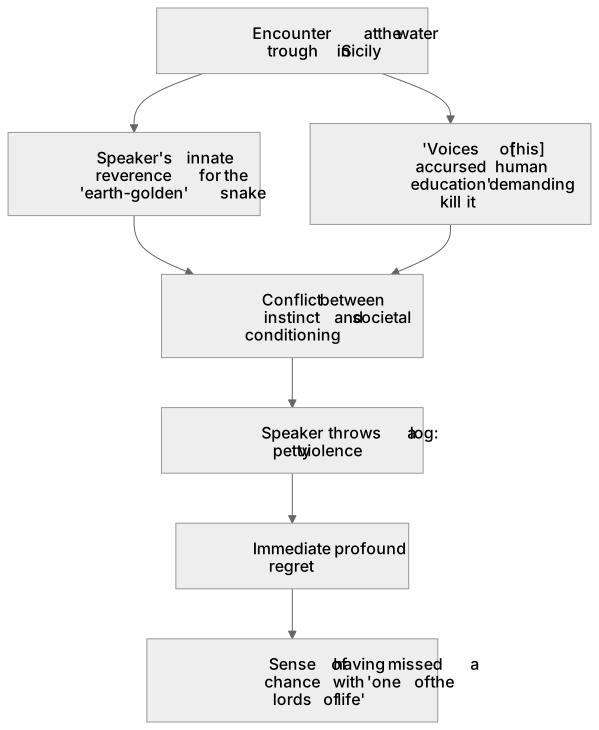
Key words
Say what each word means before you turn the card.
Humanity versus Nature
Try answering aloud or in your head before turning the card.
Societal Conditioning and Education
Try answering aloud or in your head before turning the card.
Masculinity and Violence
Try answering aloud or in your head before turning the card.
Regret and Atonement
Try answering aloud or in your head before turning the card.
See every definition
- Humanity versus Nature
- The tension between human instinct and societal conditioning, shown through an encounter at a water trough in Sicily where the speaker's reverence for the snake conflicts with his education.
- Societal Conditioning and Education
- The 'voices of [his] accursed human education' demanding the speaker kill the snake, set against his innate reverence for the majestic, 'earth-golden' creature.
- Masculinity and Violence
- A moment of petty violence when the speaker throws a log, read as a Modernist critique of how toxic masculinity severs humanity's vital connection to the natural world.
- Regret and Atonement
- The profound regret instantly following the thrown log, and a sense of having missed a chance with 'one of the lords of life'.
Label the diagram
Some boxes have lost their names. Pick the right name for each number.
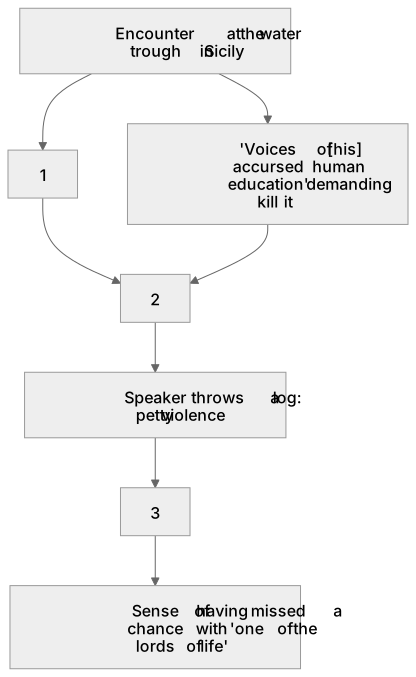
1Box 1
2Box 2
3Box 3
There is more to this lesson
The full lesson goes on to check your understanding and help you earn the marks. Create a free account to carry on, with your progress saved.
A week of Premium from your first lesson · Then the free plan continues · No card, no charge
Test your understanding of Component 3: Poetry – Section B: Specified Poetry Pre- or Post-1900 – Post-1900 – The Modernist Period – The Great Modern Poets, editor Michael Schmidt (Quercus, 2014): Snake D H Lawrence
Active recall beats re-reading. Take an instant quiz now to test what you’ve learned and lock it into long-term memory.
A week of Premium from your first lesson · Then the free plan continues · No card, no charge