Pearson Edexcel · A-Level · English Literature
Course version: 9ET0 · Version from Sept 2015
Poetry – Section B: Specified Poetry Pre- or Post-1900 – Post-1900 – The…
Full specification wording
Component 3: Poetry – Section B: Specified Poetry Pre- or Post-1900 – Post-1900 – The Movement – Philip Larkin: The Less Deceived (Faber, 2011): Coming
Larkin’s 'Coming' offers a rare glimpse of optimism within 'The Less Deceived', focusing on the transition from winter to spring.
Checked against the Pearson Edexcel 9ET0 specification (opens in a new tab) on .
- Point 4 of 9
- 4 key terms
Study notes
From the checked teaching notes for this specification point.
The idea
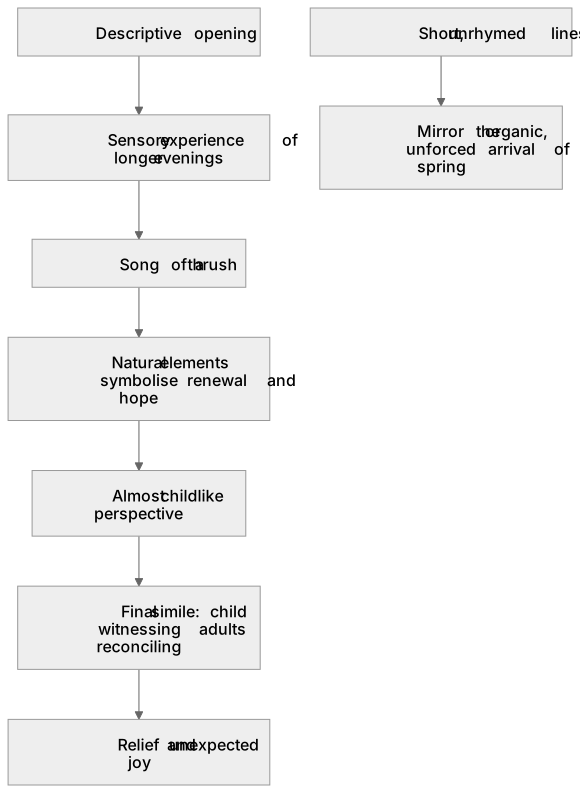
Larkin’s 'Coming' offers a rare glimpse of optimism within 'The Less Deceived', focusing on the transition from winter to spring. The poem captures the sensory experience of longer evenings and the song of a thrush, using these natural elements to symbolise renewal and hope. Unlike his typically cynical Movement contemporaries, Larkin adopts an almost childlike perspective here, culminating in the powerful simile of a child witnessing adults reconciling. This imagery evokes a profound sense of relief and unexpected joy. By examining the shift from the descriptive opening to the emotional climax, readers can understand how Larkin balances his characteristic melancholy with fleeting moments of pure anticipation.
What earns the marks
- Analyse the use of sensory imagery, particularly light and sound, to establish the atmosphere of early spring.
- Evaluate the significance of the poem's short, unrhymed lines in conveying a sense of simplicity and organic growth.
- Explore the psychological depth of the final simile, comparing the arrival of spring to a child witnessing adult reconciliation.
- Discuss how the poem's tone of cautious optimism contrasts with the broader scepticism typical of Larkin and The Movement.
Common mistakes and how to put them right
Describing the poem as entirely joyful without noting the underlying tension.
Put it right: Acknowledge the implicit sadness in the final simile, which relies on the prior existence of adult conflict to make the reconciliation meaningful.
Overlooking the poem's unusual form in the context of Larkin's work.
Put it right: Explicitly contrast the short, unrhymed lines of 'Coming' with the strict, traditional stanzaic forms Larkin usually employs.
Misinterpreting the thrush as a complex mythological symbol.
Put it right: Treat the thrush as a grounded, everyday element of the English suburban landscape, fitting The Movement's focus on the ordinary.
Exam tips
- Contrast the hopeful tone of 'Coming' with the bleaker outlook of other poems in the collection to demonstrate a nuanced understanding of Larkin's range.
- Pay close attention to the enjambment and how it propels the reader forward, mimicking the inevitable arrival of the new season.
- Use the final simile to discuss Larkin's exploration of childhood innocence versus adult experience.
Try the lesson
The start of the Component 3: Poetry – Section B: Specified Poetry Pre- or Post-1900 – Post-1900 – The Movement – Philip Larkin: The Less Deceived (Faber, 2011): Coming lesson, made from checked teaching notes for this specification point.
Have a go first
In Philip Larkin's poem 'Coming', which phrase is used to describe the song of the thrush in the garden?
Listen
Larkin’s 'Coming' offers a rare glimpse of optimism within 'The Less Deceived', focusing on the transition from winter to spring. The poem captures the sensory experience of longer evenings and the song of a thrush, using these natural elements to symbolise renewal and hope. Unlike his typically cynical Movement contemporaries, Larkin adopts an almost childlike perspective here, culminating in the powerful simile of a child witnessing adults reconciling. This imagery evokes a profound sense of relief and unexpected joy. By examining the shift from the descriptive opening to the emotional climax, readers can understand how Larkin balances his characteristic melancholy with fleeting moments of pure anticipation. A strong answer earns marks for these points. Analyse the use of sensory imagery, particularly light and sound, to establish the atmosphere of early spring. Evaluate the significance of the poem's short, unrhymed lines in conveying a sense of simplicity and organic growth. Explore the psychological depth of the final simile, comparing the arrival of spring to a child witnessing adult reconciliation. Discuss how the poem's tone of cautious optimism contrasts with the broader scepticism typical of Larkin and The Movement. A common slip: Describing the poem as entirely joyful without noting the underlying tension. Instead, Acknowledge the implicit sadness in the final simile, which relies on the prior existence of adult conflict to make the reconciliation meaningful. Exam tip: Contrast the hopeful tone of 'Coming' with the bleaker outlook of other poems in the collection to demonstrate a nuanced understanding of Larkin's range.
See it
Key words
Say what each word means before you turn the card.
Renewal and the passage of time
Try answering aloud or in your head before turning the card.
Childhood innocence
Try answering aloud or in your head before turning the card.
Nature and the suburban landscape
Try answering aloud or in your head before turning the card.
Cautious optimism
Try answering aloud or in your head before turning the card.
See every definition
- Renewal and the passage of time
- The transition from winter to spring, which the poem uses to symbolise renewal and hope.
- Childhood innocence
- An almost childlike perspective, culminating in the simile of a child witnessing adults reconciling.
- Nature and the suburban landscape
- Grounded, everyday elements such as the thrush, fitting The Movement's focus on the ordinary.
- Cautious optimism
- A tone that contrasts with the broader scepticism typical of Larkin and The Movement.
Label the diagram
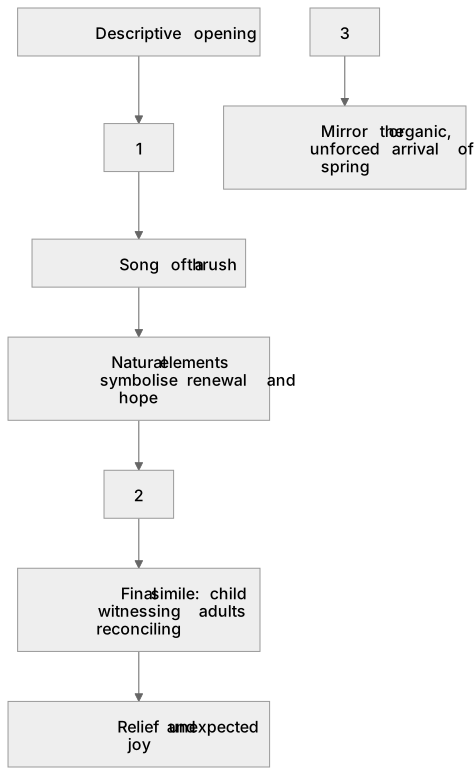
Some boxes have lost their names. Pick the right name for each number.
1Box 1
2Box 2
3Box 3
There is more to this lesson
The full lesson goes on to check your understanding and help you earn the marks. Create a free account to carry on, with your progress saved.
A week of Premium from your first lesson · Then the free plan continues · No card, no charge
Test your understanding of Component 3: Poetry – Section B: Specified Poetry Pre- or Post-1900 – Post-1900 – The Movement – Philip Larkin: The Less Deceived (Faber, 2011): Coming
Active recall beats re-reading. Take an instant quiz now to test what you’ve learned and lock it into long-term memory.
A week of Premium from your first lesson · Then the free plan continues · No card, no charge