Pearson Edexcel · A-Level · English Literature
Course version: 9ET0 · Version from Sept 2015
Poetry – Section B: Specified Poetry Pre- or Post-1900 – Post-1900 – The…
Full specification wording
Component 3: Poetry – Section B: Specified Poetry Pre- or Post-1900 – Post-1900 – The Movement – Philip Larkin: The Less Deceived (Faber, 2011): Reasons for Attendance
In 'Reasons for Attendance', Larkin explores the tension between social participation and artistic isolation.
Checked against the Pearson Edexcel 9ET0 specification (opens in a new tab) on .
- Point 5 of 9
- 4 key terms
Study notes
From the checked teaching notes for this specification point.
The idea
In 'Reasons for Attendance', Larkin explores the tension between social participation and artistic isolation. The speaker observes young dancers through a lit window, initially sensing the physical allure of the jazz-driven scene. However, he deliberately distances himself, attributing their connection to sexual instinct rather than genuine intimacy. He retreats to his own pursuit of art, symbolised by the 'lifted, rough-tongued bell' of his calling. The poem concludes with poignant ambiguity: while the speaker asserts that both he and the dancers are satisfied with their choices, the final line, 'If no one has misjudged himself. Or lied.', introduces a lingering doubt about self-deception, a central motif in The Less Deceived.
What earns the marks
- Analyse the use of sensory imagery, such as 'lighted glass' and 'smoke and sweat', to establish the physical and psychological barrier between the observer and the observed.
- Evaluate the effect of the trumpet's "loud and authoritative" voice as it draws the speaker towards the dancers before he resists their collective attraction.
- Discuss the structural shift from observing the collective social experience to asserting an individual, solitary artistic purpose.
- Explore the significance of the final caesura and conditional clause in undermining the speaker's confident assertions about his life choices.
Common mistakes and how to put them right
Assuming the speaker genuinely despises the dancers from the outset.
Put it right: Recognise the speaker's ambivalence; he acknowledges the appeal of their youth and vitality before rationalising his exclusion.
Ignoring the specific context of the collection's title.
Put it right: Connect the poem's ending to the overarching theme of avoiding self-deception and romantic illusions found throughout The Less Deceived.
Misinterpreting the 'rough-tongued bell' as a literal physical object.
Put it right: Analyse the bell as a metaphor for the demanding, solitary calling of poetry and art.
Exam tips
- Compare the speaker's isolated, voyeuristic stance here with similar observational perspectives in other Larkin poems.
- Focus on the interplay between the regular rhyme scheme and the conversational, sometimes hesitant rhythm created by enjambment.
- Use the final line to evaluate how successfully the speaker convinces the reader, and himself, of his chosen path of isolation.
Try the lesson
The start of the Component 3: Poetry – Section B: Specified Poetry Pre- or Post-1900 – Post-1900 – The Movement – Philip Larkin: The Less Deceived (Faber, 2011): Reasons for Attendance lesson, made from checked teaching notes for this specification point.
Have a go first
In Philip Larkin's poem 'Reasons for Attendance', what is the primary setting that the speaker observes from the outside?
Listen
In 'Reasons for Attendance', Larkin explores the tension between social participation and artistic isolation. The speaker observes young dancers through a lit window, initially sensing the physical allure of the jazz-driven scene. However, he deliberately distances himself, attributing their connection to sexual instinct rather than genuine intimacy. He retreats to his own pursuit of art, symbolised by the 'lifted, rough-tongued bell' of his calling. The poem concludes with poignant ambiguity: while the speaker asserts that both he and the dancers are satisfied with their choices, the final line, 'If no one has misjudged himself. Or lied.', introduces a lingering doubt about self-deception, a central motif in The Less Deceived. A strong answer earns marks for these points. Analyse the use of sensory imagery, such as 'lighted glass' and 'smoke and sweat', to establish the physical and psychological barrier between the observer and the observed. Evaluate the effect of the trumpet's "loud and authoritative" voice as it draws the speaker towards the dancers before he resists their collective attraction. Discuss the structural shift from observing the collective social experience to asserting an individual, solitary artistic purpose. Explore the significance of the final caesura and conditional clause in undermining the speaker's confident assertions about his life choices. A common slip: Assuming the speaker genuinely despises the dancers from the outset. Instead, Recognise the speaker's ambivalence; he acknowledges the appeal of their youth and vitality before rationalising his exclusion. Exam tip: Compare the speaker's isolated, voyeuristic stance here with similar observational perspectives in other Larkin poems.
See it
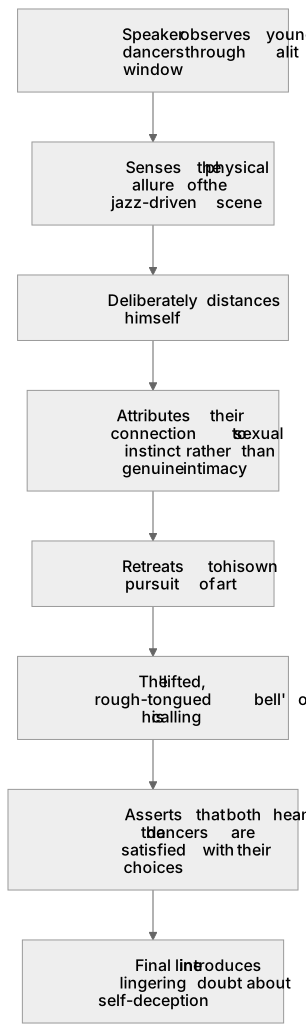
Put it in order
Put these steps in the order they happen.
- 1. Retreats to his own pursuit of art
- 2. Final line introduces lingering doubt about self-deception
- 3. The 'lifted, rough-tongued bell' of his calling
- 4. Speaker observes young dancers through a lit window
- 5. Senses the physical allure of the jazz-driven scene
- 6. Asserts that both he and the dancers are satisfied with their choices
- 7. Deliberately distances himself
- 8. Attributes their connection to sexual instinct rather than genuine intimacy
Key words
Say what each word means before you turn the card.
Isolation versus Community
Try answering aloud or in your head before turning the card.
Art versus Life
Try answering aloud or in your head before turning the card.
Self-Deception
Try answering aloud or in your head before turning the card.
Youth and Sexuality
Try answering aloud or in your head before turning the card.
See every definition
- Isolation versus Community
- The tension between social participation and artistic isolation, as the speaker distances himself from the dancers to pursue his own calling.
- Art versus Life
- The contrast between the collective social experience of the dancers and the speaker's individual, solitary artistic purpose.
- Self-Deception
- A lingering doubt about whether the speaker has misjudged himself or lied, a central motif in The Less Deceived.
- Youth and Sexuality
- The appeal of the dancers' youth and vitality, which the speaker attributes to sexual instinct rather than genuine intimacy.
Label the diagram
Some boxes have lost their names. Pick the right name for each number.
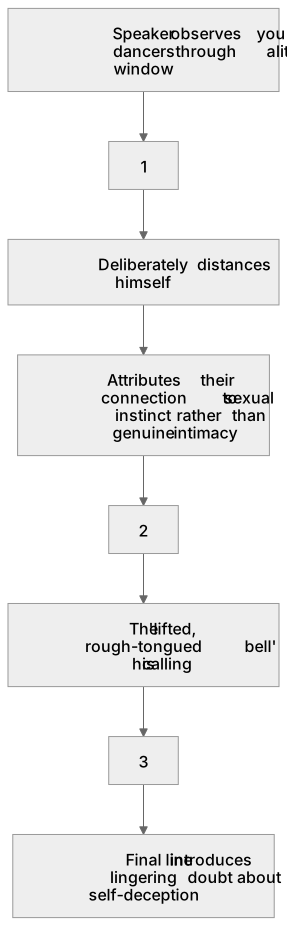
1Box 1
2Box 2
3Box 3
There is more to this lesson
The full lesson goes on to check your understanding and help you earn the marks. Create a free account to carry on, with your progress saved.
A week of Premium from your first lesson · Then the free plan continues · No card, no charge
Test your understanding of Component 3: Poetry – Section B: Specified Poetry Pre- or Post-1900 – Post-1900 – The Movement – Philip Larkin: The Less Deceived (Faber, 2011): Reasons for Attendance
Active recall beats re-reading. Take an instant quiz now to test what you’ve learned and lock it into long-term memory.
A week of Premium from your first lesson · Then the free plan continues · No card, no charge