Pearson Edexcel · A-Level · English Literature
Course version: 9ET0 · Version from Sept 2015
Poetry – Section B: Specified Poetry Pre- or Post-1900 – Post-1900 – The…
Full specification wording
Component 3: Poetry – Section B: Specified Poetry Pre- or Post-1900 – Post-1900 – The Movement – The Oxford Book of Twentieth Century English Verse, editor Philip Larkin with foreword by Andrew Motion (OUP, 1973): Farewell to Kurdistan
Rosemary Tonks's 'Farewell to Kurdistan' is a poem of urban transition whose exotic title overlays contemporary London with an invented private geography.
Checked against the Pearson Edexcel 9ET0 specification (opens in a new tab) on .
- Point 18 of 18
- 4 key terms
Study notes
From the checked teaching notes for this specification point.
The idea
Rosemary Tonks's 'Farewell to Kurdistan' is a poem of urban transition whose exotic title overlays contemporary London with an invented private geography. Trains, hotels, soap, papers, commerce and spoiled hours are rendered through visceral, often disgusted sensory detail, while references to souks, deserts, Berbers and Kurdistan lend the departure a deliberately artificial glamour. The speaker announces a new life, but the movement is never clean: a lurching boat becomes Charon's ferry, bringing death and decay into the language of escape.
What earns the marks
- Explain how Oriental place names and objects estrange a recognisably modern London rather than document a literal stay in Kurdistan.
- Analyse how dirty trains, strong smells, papers and commercial details embody the speaker's disgust with contemporary urban life.
- Explore how the language of a new beginning is repeatedly undercut by physical decay, lost hours and the Charon allusion.
- Evaluate the ending's ambiguity: movement away from an old life occurs, but the poem offers no secure or purified destination.
Common mistakes and how to put them right
Attributing the poem to Robert Conquest.
Put it right: It is Rosemary Tonks's poem, and its exuberant, visceral voice must not be replaced with a generic account of Movement restraint.
Reading the title as proof that the poem is a documentary elegy for the Kurdish landscape.
Put it right: Track the London details beneath its exoticised imaginative vocabulary.
Treating departure as uncomplicated liberation.
Put it right: Use the fouled Charon image and decaying urban matter to show why the new life remains uncertain.
Exam tips
- Identify the concrete London object in each passage before explaining how Tonks transforms it through Oriental or mythic language.
- Use sensory verbs and adjectives to analyse alienation as a bodily response, rather than summarising the speaker as merely unhappy.
- Build an argument around transition and undercutting: each gesture toward escape carries material from the old world with it.
Try the lesson
The start of the Component 3: Poetry – Section B: Specified Poetry Pre- or Post-1900 – Post-1900 – The Movement – The Oxford Book of Twentieth Century English Verse, editor Philip Larkin with foreword by Andrew Motion (OUP, 1973): Farewell to Kurdistan lesson, made from checked teaching notes for this specification point.
Have a go first
Despite its title, what environment does Rosemary Tonks's 'Farewell to Kurdistan' primarily transform through exotic, Oriental imagery?
Listen
Rosemary Tonks's 'Farewell to Kurdistan' is a poem of urban transition whose exotic title overlays contemporary London with an invented private geography. Trains, hotels, soap, papers, commerce and spoiled hours are rendered through visceral, often disgusted sensory detail, while references to souks, deserts, Berbers and Kurdistan lend the departure a deliberately artificial glamour. The speaker announces a new life, but the movement is never clean: a lurching boat becomes Charon's ferry, bringing death and decay into the language of escape. A strong answer earns marks for these points. Explain how Oriental place names and objects estrange a recognisably modern London rather than document a literal stay in Kurdistan. Analyse how dirty trains, strong smells, papers and commercial details embody the speaker's disgust with contemporary urban life. Explore how the language of a new beginning is repeatedly undercut by physical decay, lost hours and the Charon allusion. Evaluate the ending's ambiguity: movement away from an old life occurs, but the poem offers no secure or purified destination. A common slip: Attributing the poem to Robert Conquest. Instead, It is Rosemary Tonks's poem, and its exuberant, visceral voice must not be replaced with a generic account of Movement restraint. Exam tip: Identify the concrete London object in each passage before explaining how Tonks transforms it through Oriental or mythic language.
See it
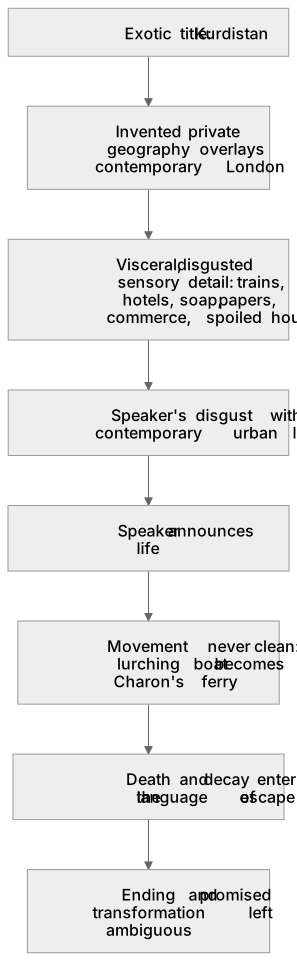
Put it in order
Put these steps in the order they happen.
- 1. Speaker announces a new life
- 2. Ending and promised transformation left ambiguous
- 3. Movement never clean: lurching boat becomes Charon's ferry
- 4. Exotic title: Kurdistan
- 5. Invented private geography overlays contemporary London
- 6. Death and decay enter the language of escape
- 7. Visceral, disgusted sensory detail: trains, hotels, soap, papers, commerce, spoiled hours
- 8. Speaker's disgust with contemporary urban life
Key words
Say what each word means before you turn the card.
Urban alienation
Try answering aloud or in your head before turning the card.
Transition and escape
Try answering aloud or in your head before turning the card.
Exoticism and artifice
Try answering aloud or in your head before turning the card.
Death and ambiguous renewal
Try answering aloud or in your head before turning the card.
See every definition
- Urban alienation
- The speaker's disgust with contemporary urban life, expressed through visceral sensory detail such as dirty trains, strong smells, papers and commercial details.
- Transition and escape
- The poem's movement of departure in which the speaker announces a new life, yet each gesture toward escape carries material from the old world with it.
- Exoticism and artifice
- References to souks, deserts, Berbers and Kurdistan that lend the departure a deliberately artificial glamour and overlay contemporary London with an invented private geography.
- Death and ambiguous renewal
- A lurching boat becomes Charon's ferry, bringing death and decay into the language of escape, so the ending and promised transformation remain ambiguous.
Label the diagram
Some boxes have lost their names. Pick the right name for each number.
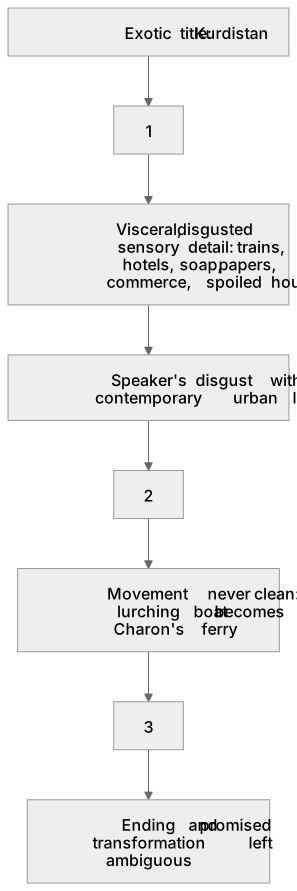
1Box 1
2Box 2
3Box 3
There is more to this lesson
The full lesson goes on to check your understanding and help you earn the marks. Create a free account to carry on, with your progress saved.
A week of Premium from your first lesson · Then the free plan continues · No card, no charge
Test your understanding of Component 3: Poetry – Section B: Specified Poetry Pre- or Post-1900 – Post-1900 – The Movement – The Oxford Book of Twentieth Century English Verse, editor Philip Larkin with foreword by Andrew Motion (OUP, 1973): Farewell to Kurdistan
Active recall beats re-reading. Take an instant quiz now to test what you’ve learned and lock it into long-term memory.
A week of Premium from your first lesson · Then the free plan continues · No card, no charge