Pearson Edexcel · A-Level · English Literature
Course version: 9ET0 · Version from Sept 2015
Poetry – Section B: Specified Poetry Pre- or Post-1900 – Post-1900 – The…
Full specification wording
Component 3: Poetry – Section B: Specified Poetry Pre- or Post-1900 – Post-1900 – The Movement – The Oxford Book of Twentieth Century English Verse, editor Philip Larkin with foreword by Andrew Motion (OUP, 1973): When I am Dead
George MacBeth's ‘When I am Dead’ takes the form of a detailed first-person set of funeral instructions.
Checked against the Pearson Edexcel 9ET0 specification (opens in a new tab) on .
- Point 17 of 18
- 4 key terms
Study notes
From the checked teaching notes for this specification point.
The idea
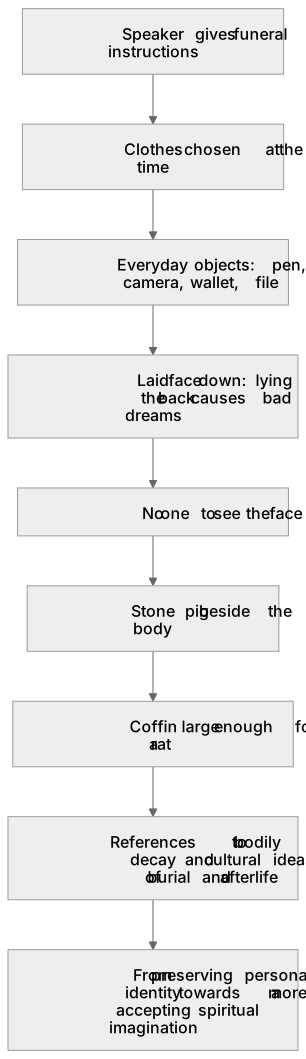
George MacBeth's ‘When I am Dead’ takes the form of a detailed first-person set of funeral instructions. The speaker wants to be buried in clothes chosen at the time, with everyday objects—'pen, camera, wallet, file'—and laid face down because lying on the back causes bad dreams. Requests that no one see the face, that a 'stone pig' lie beside the body, and that the coffin be large enough for a rat combine practical specificity, anxiety, dark humour and ritual. As the catalogue develops, its references range across bodily decay and several cultural ideas of burial and afterlife, moving from preserving personal identity towards a more accepting spiritual imagination. Nine tercets, interrupted by three single-line stanzas, and repeated openings with 'And' make the will sound cumulative while the isolated lines mark changes in the speaker's relation to death.
What earns the marks
- Analyse how the catalogue of clothes and pocket objects tries to carry the speaker's living identity into burial.
- Explore the mixture of anxiety and dark humour in the requests to lie face down, hide the face, include the stone pig and leave room for a rat.
- Evaluate how MacBeth draws on different funeral practices and spiritual traditions without reducing the poem to one settled doctrine of the afterlife.
- Discuss how nine tercets, three isolated lines and the anaphoric 'And' organise the speaker's movement from control and denial towards greater acceptance.
Common mistakes and how to put them right
Confusing this poem with a similarly titled Victorian lyric.
Put it right: MacBeth's speaker gives concrete burial instructions involving clothes, possessions, body position, a stone pig and a large coffin.
Treating every request as merely eccentric comedy.
Put it right: Connect the practical detail and humour to fear of lost identity, bodily decay and hopes for continuation.
Assigning all the funeral images to a single religion.
Put it right: Recognise the poem's deliberate accumulation of material from different cultural and spiritual traditions.
Exam tips
- Build an argument from the order of the requests: personal appearance and possessions come before increasingly physical and spiritual considerations.
- Use the repeated 'And' and the interruptions by single-line stanzas to show both accumulation and shifts in emotional control.
- Name George MacBeth and distinguish the poem from similarly titled texts before making contextual claims.
Try the lesson
The start of the Component 3: Poetry – Section B: Specified Poetry Pre- or Post-1900 – Post-1900 – The Movement – The Oxford Book of Twentieth Century English Verse, editor Philip Larkin with foreword by Andrew Motion (OUP, 1973): When I am Dead lesson, made from checked teaching notes for this specification point.
Have a go first
How does George MacBeth's 'When I am Dead' approach the subject of the speaker's mortality?
Listen
George MacBeth's ‘When I am Dead’ takes the form of a detailed first-person set of funeral instructions. The speaker wants to be buried in clothes chosen at the time, with everyday objects—'pen, camera, wallet, file'—and laid face down because lying on the back causes bad dreams. Requests that no one see the face, that a 'stone pig' lie beside the body, and that the coffin be large enough for a rat combine practical specificity, anxiety, dark humour and ritual. As the catalogue develops, its references range across bodily decay and several cultural ideas of burial and afterlife, moving from preserving personal identity towards a more accepting spiritual imagination. Nine tercets, interrupted by three single-line stanzas, and repeated openings with 'And' make the will sound cumulative while the isolated lines mark changes in the speaker's relation to death. A strong answer earns marks for these points. Analyse how the catalogue of clothes and pocket objects tries to carry the speaker's living identity into burial. Explore the mixture of anxiety and dark humour in the requests to lie face down, hide the face, include the stone pig and leave room for a rat. Evaluate how MacBeth draws on different funeral practices and spiritual traditions without reducing the poem to one settled doctrine of the afterlife. Discuss how nine tercets, three isolated lines and the anaphoric 'And' organise the speaker's movement from control and denial towards greater acceptance. A common slip: Confusing this poem with a similarly titled Victorian lyric. Instead, MacBeth's speaker gives concrete burial instructions involving clothes, possessions, body position, a stone pig and a large coffin. Exam tip: Build an argument from the order of the requests: personal appearance and possessions come before increasingly physical and spiritual considerations.
See it
Key words
Say what each word means before you turn the card.
Death and bodily identity
Try answering aloud or in your head before turning the card.
Funeral ritual and material objects
Try answering aloud or in your head before turning the card.
Fear and acceptance
Try answering aloud or in your head before turning the card.
Spirituality and the afterlife
Try answering aloud or in your head before turning the card.
See every definition
- Death and bodily identity
- The poem's catalogue of clothes and pocket objects tries to carry the speaker's living identity into burial, while its references range across bodily decay.
- Funeral ritual and material objects
- Detailed first-person funeral instructions combine practical specificity, anxiety, dark humour and ritual, drawing on different funeral practices without reducing the poem to one settled doctrine.
- Fear and acceptance
- The speaker's relation to death changes as the will sounds cumulative, moving from control and denial towards greater acceptance.
- Spirituality and the afterlife
- References range across several cultural ideas of burial and afterlife, moving from preserving personal identity towards a more accepting spiritual imagination.
Label the diagram
Some boxes have lost their names. Pick the right name for each number.
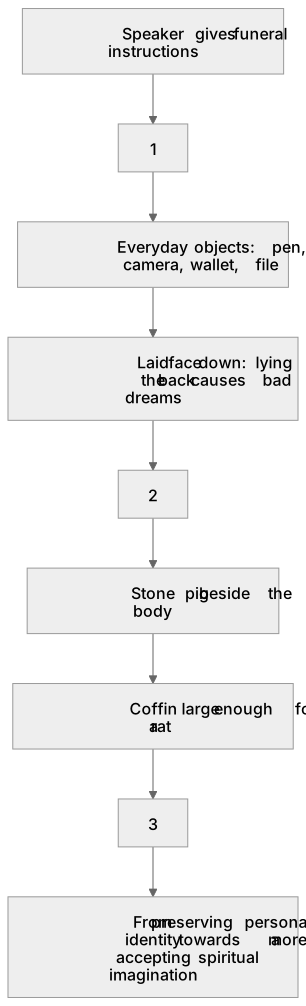
1Box 1
2Box 2
3Box 3
There is more to this lesson
The full lesson goes on to check your understanding and help you earn the marks. Create a free account to carry on, with your progress saved.
A week of Premium from your first lesson · Then the free plan continues · No card, no charge
Test your understanding of Component 3: Poetry – Section B: Specified Poetry Pre- or Post-1900 – Post-1900 – The Movement – The Oxford Book of Twentieth Century English Verse, editor Philip Larkin with foreword by Andrew Motion (OUP, 1973): When I am Dead
Active recall beats re-reading. Take an instant quiz now to test what you’ve learned and lock it into long-term memory.
A week of Premium from your first lesson · Then the free plan continues · No card, no charge