Pearson Edexcel · A-Level · English Literature
Course version: 9ET0 · Version from Sept 2015
Poetry – Section B: Specified Poetry Pre- or Post-1900 – Post-1900 – The…
Full specification wording
Component 3: Poetry – Section B: Specified Poetry Pre- or Post-1900 – Post-1900 – The Movement – The Oxford Book of Twentieth Century English Verse, editor Philip Larkin with foreword by Andrew Motion (OUP, 1973): Giant Decorative Dahlias
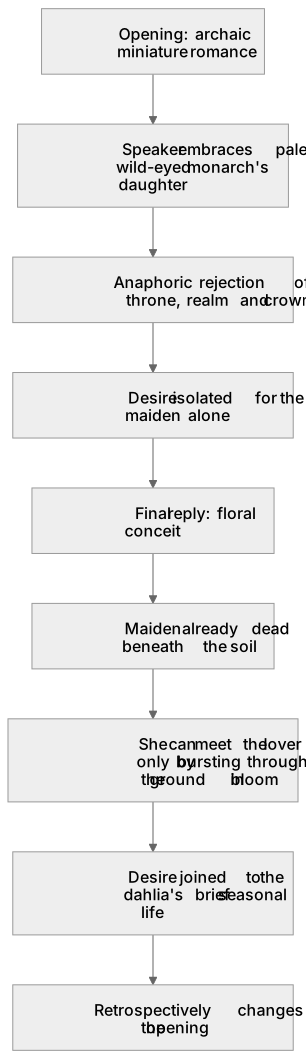
Molly Holden's 'Giant Decorative Dahlias' begins as an archaic miniature romance: a speaker embraces a pale, wild-eyed monarch's daughter and rejects her father's throne, realm and crown in favour…
Checked against the Pearson Edexcel 9ET0 specification (opens in a new tab) on .
- Point 13 of 18
- 4 key terms
Study notes
From the checked teaching notes for this specification point.
The idea
Molly Holden's 'Giant Decorative Dahlias' begins as an archaic miniature romance: a speaker embraces a pale, wild-eyed monarch's daughter and rejects her father's throne, realm and crown in favour of the maiden alone. The final reply transforms that human courtship into a floral conceit. The maiden is already dead beneath the soil and can meet the lover only by bursting through the ground in bloom, joining desire to the dahlia's brief seasonal life. Three rhyming quatrains, paired rhymes, anaphora and ballad-like diction make the narrative compact and emphatic.
What earns the marks
- Trace how monarch, maiden and lover initially establish the expectations of an archaic ballad or romance.
- Analyse the anaphoric rejection of throne, realm and crown as a cumulative declaration that isolates desire for the maiden.
- Explain how the final reference to being dead beneath the soil reveals the maiden as a dahlia and retrospectively changes the opening.
- Evaluate how three compact rhyming quatrains balance comic conceit with the poignancy of seasonal bloom and death.
Common mistakes and how to put them right
Treating the poem as a literal critique of oversized cultivated flowers.
Put it right: Follow the dramatic speakers and explain the sustained conceit that makes the maiden a dahlia.
Reading the royal vocabulary as a real political dispute.
Put it right: Show how romance conventions prepare the contrast between human vows and the flower's life cycle.
Calling the ending a happy union.
Put it right: The dahlia can emerge for the lover, but its voice also insists that it is already dead, making fulfilment brief and paradoxical.
Exam tips
- Structure an answer around the final revelation, then show how it reinterprets details in the first two quatrains.
- Name anaphora and paired rhyme only when explaining how they heighten the lover's absolute, stylised declaration.
- Keep both tones in view: the transformation is witty, while the beloved's temporary bloom gives the wit an elegiac edge.
Try the lesson
The start of the Component 3: Poetry – Section B: Specified Poetry Pre- or Post-1900 – Post-1900 – The Movement – The Oxford Book of Twentieth Century English Verse, editor Philip Larkin with foreword by Andrew Motion (OUP, 1973): Giant Decorative Dahlias lesson, made from checked teaching notes for this specification point.
Have a go first
What revelation in the final stanza changes how the maiden in Molly Holden's 'Giant Decorative Dahlias' is understood?
Listen
Molly Holden's 'Giant Decorative Dahlias' begins as an archaic miniature romance: a speaker embraces a pale, wild-eyed monarch's daughter and rejects her father's throne, realm and crown in favour of the maiden alone. The final reply transforms that human courtship into a floral conceit. The maiden is already dead beneath the soil and can meet the lover only by bursting through the ground in bloom, joining desire to the dahlia's brief seasonal life. Three rhyming quatrains, paired rhymes, anaphora and ballad-like diction make the narrative compact and emphatic. A strong answer earns marks for these points. Trace how monarch, maiden and lover initially establish the expectations of an archaic ballad or romance. Analyse the anaphoric rejection of throne, realm and crown as a cumulative declaration that isolates desire for the maiden. Explain how the final reference to being dead beneath the soil reveals the maiden as a dahlia and retrospectively changes the opening. Evaluate how three compact rhyming quatrains balance comic conceit with the poignancy of seasonal bloom and death. A common slip: Treating the poem as a literal critique of oversized cultivated flowers. Instead, Follow the dramatic speakers and explain the sustained conceit that makes the maiden a dahlia. Exam tip: Structure an answer around the final revelation, then show how it reinterprets details in the first two quatrains.
See it
Key words
Say what each word means before you turn the card.
Transient love
Try answering aloud or in your head before turning the card.
Flowering and death
Try answering aloud or in your head before turning the card.
Romantic convention
Try answering aloud or in your head before turning the card.
Desire and impossibility
Try answering aloud or in your head before turning the card.
See every definition
- Transient love
- A relationship that is brief and passing, here joined to the dahlia's short seasonal life so that the encounter is impossible and fleeting.
- Flowering and death
- The dahlia's cycle of bursting through the ground in bloom and dying, which makes the imagined relationship both comic and poignant.
- Romantic convention
- The archaic ballad or romance expectations set up by monarch, maiden and lover, which prepare the contrast between human vows and the flower's life cycle.
- Desire and impossibility
- The lover's longing for the maiden, which can only be met by her blooming from beneath the soil, making fulfilment brief and paradoxical.
Label the diagram
Some boxes have lost their names. Pick the right name for each number.
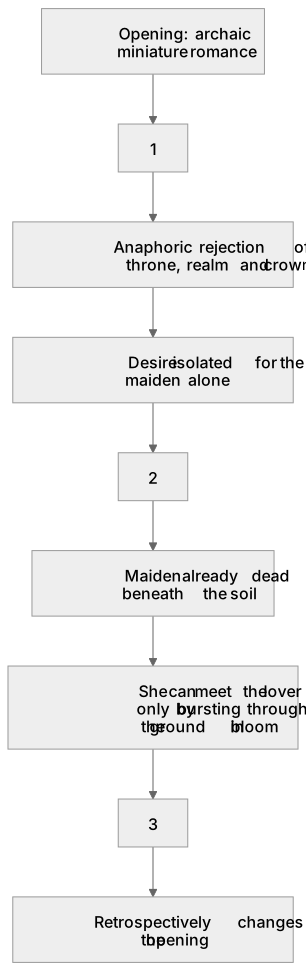
1Box 1
2Box 2
3Box 3
There is more to this lesson
The full lesson goes on to check your understanding and help you earn the marks. Create a free account to carry on, with your progress saved.
A week of Premium from your first lesson · Then the free plan continues · No card, no charge
Test your understanding of Component 3: Poetry – Section B: Specified Poetry Pre- or Post-1900 – Post-1900 – The Movement – The Oxford Book of Twentieth Century English Verse, editor Philip Larkin with foreword by Andrew Motion (OUP, 1973): Giant Decorative Dahlias
Active recall beats re-reading. Take an instant quiz now to test what you’ve learned and lock it into long-term memory.
A week of Premium from your first lesson · Then the free plan continues · No card, no charge