Pearson Edexcel · A-Level · English Literature
Course version: 9ET0 · Version from Sept 2015
Poetry – Section B: Specified Poetry Pre- or Post-1900 – Post-1900 – The…
Full specification wording
Component 3: Poetry – Section B: Specified Poetry Pre- or Post-1900 – Post-1900 – The Movement – The Oxford Book of Twentieth Century English Verse, editor Philip Larkin with foreword by Andrew Motion (OUP, 1973): Metamorphosis Peter Porter
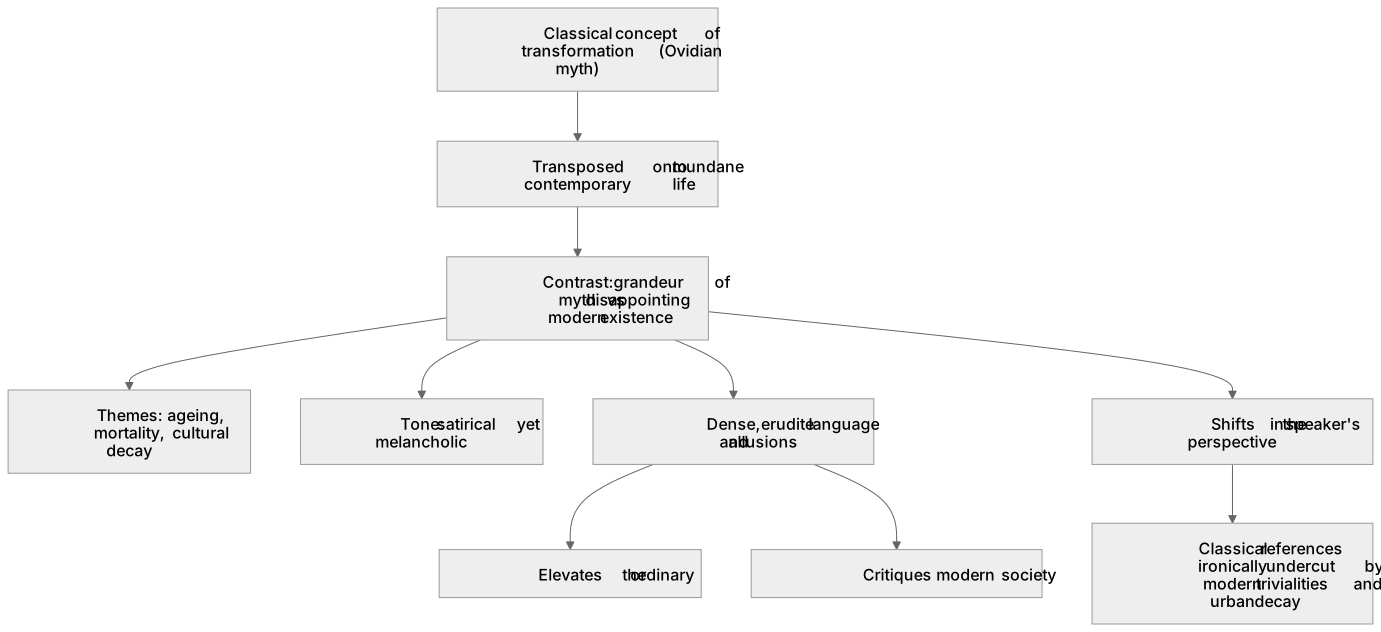
Peter Porter’s ‘Metamorphosis’ transposes the classical concept of transformation onto the mundane realities of contemporary life.
Checked against the Pearson Edexcel 9ET0 specification (opens in a new tab) on .
- Point 14 of 18
- 4 key terms
Study notes
From the checked teaching notes for this specification point.
The idea
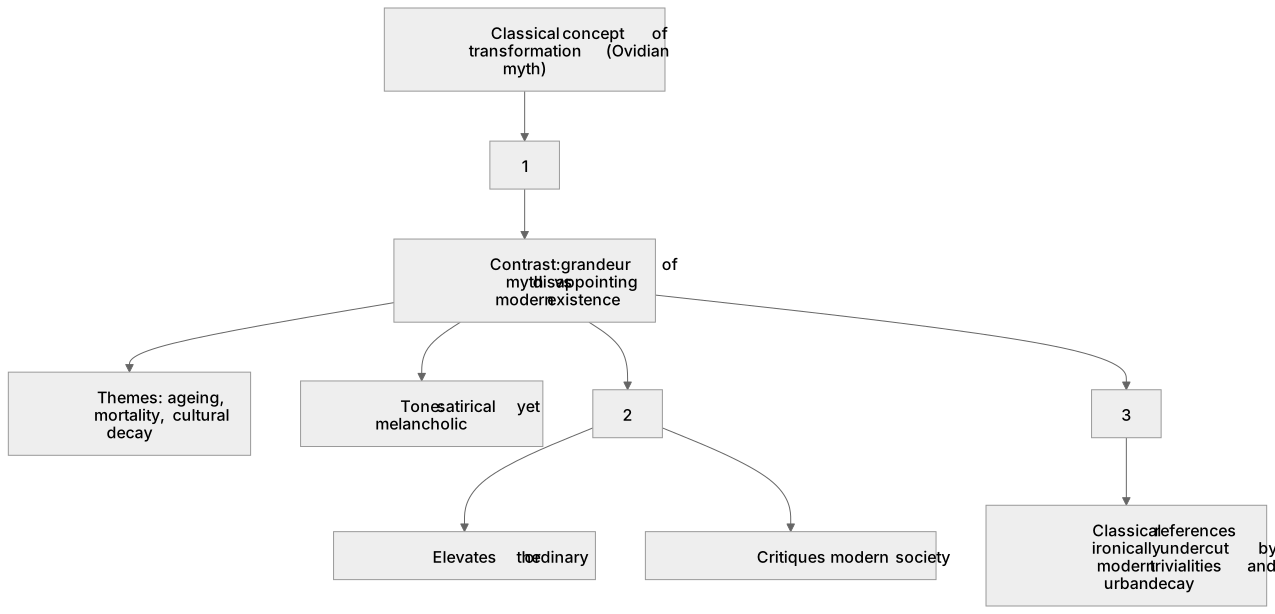
Peter Porter’s ‘Metamorphosis’ transposes the classical concept of transformation onto the mundane realities of contemporary life. The poem explores themes of ageing, mortality, and cultural decay by contrasting the grandeur of Ovidian myth with the disappointing nature of modern existence. Porter employs a satirical yet melancholic tone, using erudite allusions alongside everyday observations to highlight the inevitability of change. A concrete method is to trace the shifts in the speaker’s perspective, noting how classical references are ironically undercut by modern trivialities and urban decay.
What earns the marks
- Analyse Porter's integration of classical mythological allusions within a contemporary, everyday setting.
- Evaluate the use of satirical and melancholic tones to explore themes of ageing, mortality, and societal change.
- Examine the contrast between the elevated language of myth and the colloquial realities of modern urban life.
- Assess how the poem aligns with or diverges from the typical stylistic restraint of The Movement, noting Porter's denser, allusion-heavy style.
Common mistakes and how to put them right
Misinterpreting the classical allusions as purely decorative.
Put it right: Analyse how the allusions actively contrast with and critique contemporary reality.
Focusing only on the satirical elements while ignoring the underlying melancholy.
Put it right: Acknowledge the dual tone of the poem, balancing the humour with the serious themes of mortality and decay.
Treating Porter as a strict Movement poet without nuance.
Put it right: Recognise that while included in Larkin's anthology, Porter's work often features a denser, more cosmopolitan erudition than typical Movement poetry.
Exam tips
- Select short, embedded quotations that demonstrate the juxtaposition of classical myth and modern mundanity.
- Discuss the significance of the title 'Metamorphosis' and how the concept of change is applied to both the individual and society.
- Compare Porter's use of irony and erudition with the more understated observational style of poets like Philip Larkin.
Try the lesson
The start of the Component 3: Poetry – Section B: Specified Poetry Pre- or Post-1900 – Post-1900 – The Movement – The Oxford Book of Twentieth Century English Verse, editor Philip Larkin with foreword by Andrew Motion (OUP, 1973): Metamorphosis Peter Porter lesson, made from checked teaching notes for this specification point.
Have a go first
Which of the following best describes the poetic voice and tone employed by Peter Porter in 'Metamorphosis'?
Listen
Peter Porter’s ‘Metamorphosis’ transposes the classical concept of transformation onto the mundane realities of contemporary life. The poem explores themes of ageing, mortality, and cultural decay by contrasting the grandeur of Ovidian myth with the disappointing nature of modern existence. Porter employs a satirical yet melancholic tone, using erudite allusions alongside everyday observations to highlight the inevitability of change. A concrete method is to trace the shifts in the speaker’s perspective, noting how classical references are ironically undercut by modern trivialities and urban decay. A strong answer earns marks for these points. Analyse Porter's integration of classical mythological allusions within a contemporary, everyday setting. Evaluate the use of satirical and melancholic tones to explore themes of ageing, mortality, and societal change. Examine the contrast between the elevated language of myth and the colloquial realities of modern urban life. Assess how the poem aligns with or diverges from the typical stylistic restraint of The Movement, noting Porter's denser, allusion-heavy style. A common slip: Misinterpreting the classical allusions as purely decorative. Instead, Analyse how the allusions actively contrast with and critique contemporary reality. Exam tip: Select short, embedded quotations that demonstrate the juxtaposition of classical myth and modern mundanity.
See it
Key words
Say what each word means before you turn the card.
Transformation and change
Try answering aloud or in your head before turning the card.
Mortality and ageing
Try answering aloud or in your head before turning the card.
Myth versus reality
Try answering aloud or in your head before turning the card.
Cultural decay
Try answering aloud or in your head before turning the card.
See every definition
- Transformation and change
- The classical concept of metamorphosis, which Porter transposes onto the mundane realities of contemporary life and applies to both the individual and society.
- Mortality and ageing
- Themes explored through the contrast between the grandeur of Ovidian myth and the disappointing nature of modern existence.
- Myth versus reality
- The contrast between the elevated language of myth and the colloquial realities of modern urban life, with classical references ironically undercut by modern trivialities and urban decay.
- Cultural decay
- A theme explored alongside ageing and mortality by contrasting classical myth with the disappointing nature of modern existence, including urban decay.
Label the diagram
Some boxes have lost their names. Pick the right name for each number.
1Box 1
2Box 2
3Box 3
There is more to this lesson
The full lesson goes on to check your understanding and help you earn the marks. Create a free account to carry on, with your progress saved.
A week of Premium from your first lesson · Then the free plan continues · No card, no charge
Test your understanding of Component 3: Poetry – Section B: Specified Poetry Pre- or Post-1900 – Post-1900 – The Movement – The Oxford Book of Twentieth Century English Verse, editor Philip Larkin with foreword by Andrew Motion (OUP, 1973): Metamorphosis Peter Porter
Active recall beats re-reading. Take an instant quiz now to test what you’ve learned and lock it into long-term memory.
A week of Premium from your first lesson · Then the free plan continues · No card, no charge