Pearson Edexcel · A-Level · English Literature
Course version: 9ET0 · Version from Sept 2015
Poetry – Section B: Specified Poetry Pre- or Post-1900 – Post-1900 – The…
Full specification wording
Component 3: Poetry – Section B: Specified Poetry Pre- or Post-1900 – Post-1900 – The Movement – The Oxford Book of Twentieth Century English Verse, editor Philip Larkin with foreword by Andrew Motion (OUP, 1973): Delay Elizabeth Jennings
Elizabeth Jennings's 'Delay' uses the time taken for starlight to reach an observer as a conceit for emotional timing.
Checked against the Pearson Edexcel 9ET0 specification (opens in a new tab) on .
- Point 9 of 18
- 3 key terms
Study notes
From the checked teaching notes for this specification point.
The idea
Elizabeth Jennings's 'Delay' uses the time taken for starlight to reach an observer as a conceit for emotional timing. The radiance visible now began years earlier; likewise, love that exists now may arrive only after its original desire has been spent and the people are 'somewhere else'. Two quatrains with an alternating ABAB CDCD rhyme pattern give the lyric formal control, while enjambment across the stanza break carries the question 'how' directly into 'Love', joining physical and emotional delay. The second stanza returns to 'The star’s impulse', so the poem interweaves astronomy and feeling rather than assigning one topic neatly to each stanza.
What earns the marks
- Analyse how delayed starlight supplies a precise analogy for love that is real at its source but belated in reception.
- Trace the enjambment from the first stanza's 'how' into 'Love' and the return to 'The star’s impulse' in the second quatrain.
- Evaluate how the alternating ABAB CDCD rhyme and two-quatrain form control an emotionally unsettling mismatch in time.
- Explore the ending's possibility that love arrives after desire is spent and finds the people emotionally or physically 'somewhere else'.
Common mistakes and how to put them right
Claiming the observed star is stated to be dead.
Put it right: The poem says its present light may never be seen; it does not establish that the star has died.
Dividing the poem into a purely astronomical stanza followed by a purely emotional one.
Put it right: Syntax crosses the break and the star image returns in stanza two.
Describing the rhyme as ABBA CDDC.
Put it right: Track the alternating end sounds as ABAB CDCD, allowing for the slant rhyme of impulse/else.
Exam tips
- Follow the syntax across the stanza break before making claims about structure; 'how / Love' is central to the analogy.
- Use the exact progression from present love to spent desire and 'somewhere else' to explain the poem's temporal irony.
- Connect formal restraint to emotional uncertainty without treating every regular feature as proof of a single Movement doctrine.
Try the lesson
The start of the Component 3: Poetry – Section B: Specified Poetry Pre- or Post-1900 – Post-1900 – The Movement – The Oxford Book of Twentieth Century English Verse, editor Philip Larkin with foreword by Andrew Motion (OUP, 1973): Delay Elizabeth Jennings lesson, made from checked teaching notes for this specification point.
Have a go first
In Elizabeth Jennings's poem 'Delay', what central metaphor is used to explore the delayed realisation of love?
Listen
Elizabeth Jennings's 'Delay' uses the time taken for starlight to reach an observer as a conceit for emotional timing. The radiance visible now began years earlier; likewise, love that exists now may arrive only after its original desire has been spent and the people are 'somewhere else'. Two quatrains with an alternating ABAB CDCD rhyme pattern give the lyric formal control, while enjambment across the stanza break carries the question 'how' directly into 'Love', joining physical and emotional delay. The second stanza returns to 'The star’s impulse', so the poem interweaves astronomy and feeling rather than assigning one topic neatly to each stanza. A strong answer earns marks for these points. Analyse how delayed starlight supplies a precise analogy for love that is real at its source but belated in reception. Trace the enjambment from the first stanza's 'how' into 'Love' and the return to 'The star’s impulse' in the second quatrain. Evaluate how the alternating ABAB CDCD rhyme and two-quatrain form control an emotionally unsettling mismatch in time. Explore the ending's possibility that love arrives after desire is spent and finds the people emotionally or physically 'somewhere else'. A common slip: claiming the observed star is stated to be dead. Instead, the poem says its present light may never be seen; it does not establish that the star has died. Exam tip: Follow the syntax across the stanza break before making claims about structure; 'how / Love' is central to the analogy.
See it
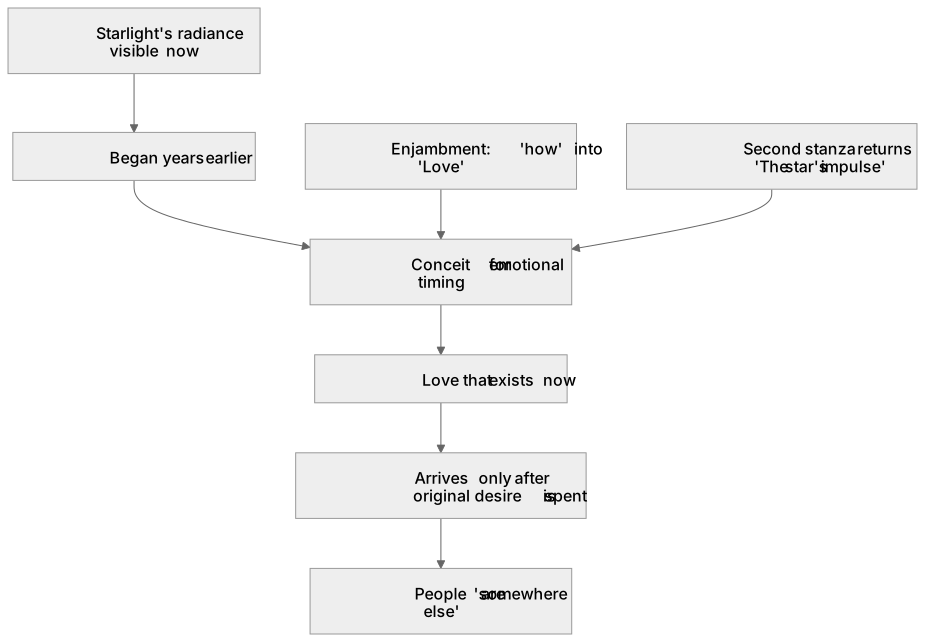
Key words
Say what each word means before you turn the card.
Love and missed connection
Try answering aloud or in your head before turning the card.
Perception and distance
Try answering aloud or in your head before turning the card.
Formal restraint
Try answering aloud or in your head before turning the card.
See every definition
- Love and missed connection
- Love that is real at its source but belated in reception, arriving after desire is spent and finding the people 'somewhere else'.
- Perception and distance
- The time taken for starlight to reach an observer, used as a conceit for emotional timing and the distance between source and reception.
- Formal restraint
- Two quatrains with an alternating ABAB CDCD rhyme pattern that give the lyric formal control over an emotionally unsettling mismatch in time.
Label the diagram
Some boxes have lost their names. Pick the right name for each number.
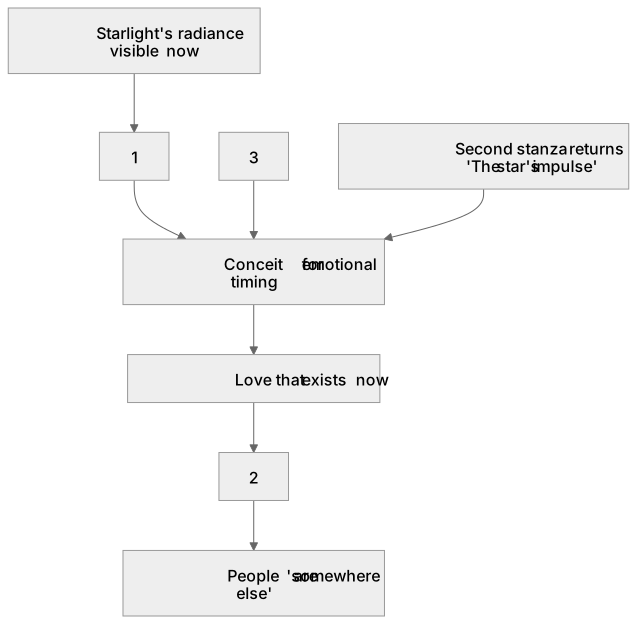
1Box 1
2Box 2
3Box 3
There is more to this lesson
The full lesson goes on to check your understanding and help you earn the marks. Create a free account to carry on, with your progress saved.
A week of Premium from your first lesson · Then the free plan continues · No card, no charge
Test your understanding of Component 3: Poetry – Section B: Specified Poetry Pre- or Post-1900 – Post-1900 – The Movement – The Oxford Book of Twentieth Century English Verse, editor Philip Larkin with foreword by Andrew Motion (OUP, 1973): Delay Elizabeth Jennings
Active recall beats re-reading. Take an instant quiz now to test what you’ve learned and lock it into long-term memory.
A week of Premium from your first lesson · Then the free plan continues · No card, no charge