Pearson Edexcel · A-Level · English Literature
Course version: 9ET0 · Version from Sept 2015
Poetry – Section B: Specified Poetry Pre- or Post-1900 – Post-1900 – The…
Full specification wording
Component 3: Poetry – Section B: Specified Poetry Pre- or Post-1900 – Post-1900 – The Movement – The Oxford Book of Twentieth Century English Verse, editor Philip Larkin with foreword by Andrew Motion (OUP, 1973): Song at the Beginning of Autumn
Jennings presents autumn as a sensory and linguistic event before it becomes visually obvious.
Checked against the Pearson Edexcel 9ET0 specification (opens in a new tab) on .
- Point 10 of 18
- 3 key terms
Study notes
From the checked teaching notes for this specification point.
The idea
Jennings presents autumn as a sensory and linguistic event before it becomes visually obvious. The first stanza says the season arrives through smell while the landscape still looks like summer. A reference to Proust’s madeleine introduces involuntary memory; later, the scent carries the speaker back to childhood associations of bonfires, marbles and smoke. The poem also asks why people name seasons and give moods outward forms. Its final act of saying ‘autumn’ appears to make the season break, linking perception, memory and language.
What earns the marks
- Analyse the opening contrast between autumn detected through smell and a landscape that still appears full of summer growth.
- Explain how the Proust allusion frames scent as a trigger for involuntary memory rather than merely decorative seasonal imagery.
- Trace the argument about naming seasons and giving inward moods an outward, apparently solid form.
- Examine how the isolated final line makes the spoken name of autumn coincide with the season’s arrival.
Common mistakes and how to put them right
Reducing the poem to an extended metaphor for ageing (Correction.
Put it right: Centre its explicit concerns with smell, involuntary memory, naming and seasonal perception).
Ignoring the Proust allusion (Correction.
Put it right: Connect the remembered child’s cake with the speaker’s own smell-triggered childhood recollection).
Treating the ending as simple weather description (Correction.
Put it right: Consider the apparent power of naming in the final line).
Exam tips
- Follow the poem’s movement from present sensory observation to literary allusion, general reflection on naming, and personal childhood memory.
- Use the four sextains and recurring abcabc rhyme pattern to discuss the formal control placed on unstable memory and seasonal ambiguity.
- Keep claims about mortality secondary unless they are supported through the poem’s concrete treatment of time, memory and seasonal change.
Try the lesson
The start of the Component 3: Poetry – Section B: Specified Poetry Pre- or Post-1900 – Post-1900 – The Movement – The Oxford Book of Twentieth Century English Verse, editor Philip Larkin with foreword by Andrew Motion (OUP, 1973): Song at the Beginning of Autumn lesson, made from checked teaching notes for this specification point.
Have a go first
In Elizabeth Jennings' 'Song at the Beginning of Autumn', which sensory experience does the speaker identify as the primary initial indicator of the changing season?
Listen
Jennings presents autumn as a sensory and linguistic event before it becomes visually obvious. The first stanza says the season arrives through smell while the landscape still looks like summer. A reference to Proust’s madeleine introduces involuntary memory; later, the scent carries the speaker back to childhood associations of bonfires, marbles and smoke. The poem also asks why people name seasons and give moods outward forms. Its final act of saying ‘autumn’ appears to make the season break, linking perception, memory and language. A strong answer earns marks for these points. Analyse the opening contrast between autumn detected through smell and a landscape that still appears full of summer growth. Explain how the Proust allusion frames scent as a trigger for involuntary memory rather than merely decorative seasonal imagery. Trace the argument about naming seasons and giving inward moods an outward, apparently solid form. Examine how the isolated final line makes the spoken name of autumn coincide with the season’s arrival. Exam tip: Follow the poem’s movement from present sensory observation to literary allusion, general reflection on naming, and personal childhood memory.
See it
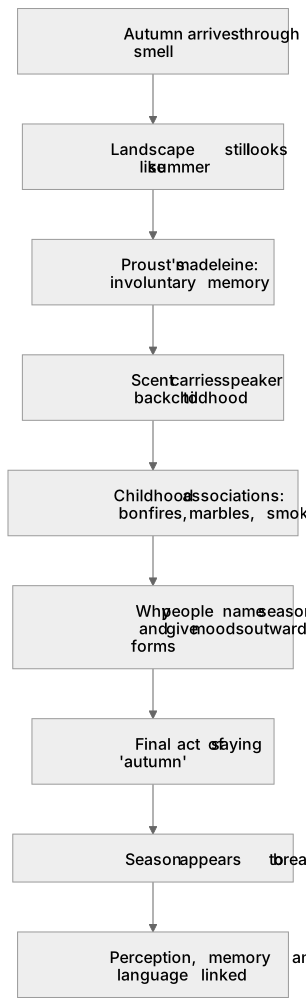
Key words
Say what each word means before you turn the card.
Smell and seasonal perception
Try answering aloud or in your head before turning the card.
Naming and language
Try answering aloud or in your head before turning the card.
Childhood recollection
Try answering aloud or in your head before turning the card.
See every definition
- Smell and seasonal perception
- The opening contrast in which autumn is detected through smell while the landscape still appears full of summer growth.
- Naming and language
- The poem's argument about why people name seasons and give inward moods an outward, apparently solid form.
- Childhood recollection
- The speaker's smell-triggered return to childhood associations of bonfires, marbles and smoke.
Label the diagram
Some boxes have lost their names. Pick the right name for each number.
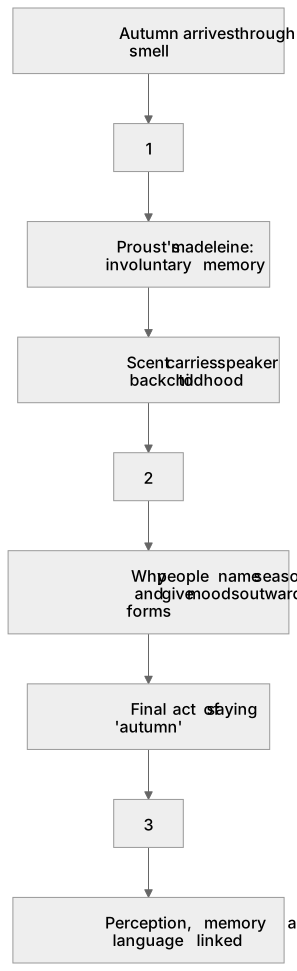
1Box 1
2Box 2
3Box 3
There is more to this lesson
The full lesson goes on to check your understanding and help you earn the marks. Create a free account to carry on, with your progress saved.
A week of Premium from your first lesson · Then the free plan continues · No card, no charge
Test your understanding of Component 3: Poetry – Section B: Specified Poetry Pre- or Post-1900 – Post-1900 – The Movement – The Oxford Book of Twentieth Century English Verse, editor Philip Larkin with foreword by Andrew Motion (OUP, 1973): Song at the Beginning of Autumn
Active recall beats re-reading. Take an instant quiz now to test what you’ve learned and lock it into long-term memory.
A week of Premium from your first lesson · Then the free plan continues · No card, no charge