Pearson Edexcel · A-Level · English Literature
Course version: 9ET0 · Version from Sept 2015
Poetry – Section B: Specified Poetry Pre- or Post-1900 – Post-1900 – The…
Full specification wording
Component 3: Poetry – Section B: Specified Poetry Pre- or Post-1900 – Post-1900 – The Movement – The Oxford Book of Twentieth Century English Verse, editor Philip Larkin with foreword by Andrew Motion (OUP, 1973): One Flesh
Elizabeth Jennings’ ‘One Flesh’ explores the poignant physical and emotional distance between an elderly married couple, contrasting their current estrangement with the biblical ideal of marital…
Checked against the Pearson Edexcel 9ET0 specification (opens in a new tab) on .
- Point 11 of 18
- 4 key terms
Study notes
From the checked teaching notes for this specification point.
The idea
Elizabeth Jennings’ ‘One Flesh’ explores the poignant physical and emotional distance between an elderly married couple, contrasting their current estrangement with the biblical ideal of marital unity implied by the title. The poem observes the parents in bed, separated by a ‘light on late’ and a book, symbolising their lack of communication. Jennings uses powerful imagery of coldness and stasis, such as ‘tossed up like flotsam’, to depict how time and fading passion have left them stranded. The regular three-stanza structure and controlled rhyme scheme reflect the rigid, unchanging nature of their routine, while the final rhetorical question, ‘Whose fire from which I came, has now grown cold?’, highlights the speaker’s own existential anxiety about love, ageing, and the inevitable decay of human connection.
What earns the marks
- Analysis of the biblical allusion in the title 'One Flesh' and its ironic contrast with the couple's physical separation.
- Exploration of the simile 'tossed up like flotsam' to convey feelings of abandonment and the destructive passage of time.
- Evaluation of the speaker's perspective as the child observing the parents, creating a tone of melancholic detachment.
- Discussion of the structural use of three regular stanzas to mirror the static, constrained reality of the couple's marriage.
Common mistakes and how to put them right
Assuming the poem is entirely critical of the parents' marriage.
Put it right: Recognise the tone of tender melancholy and the speaker's empathy for their 'chastity'.
Ignoring the significance of the speaker's identity.
Put it right: Explicitly discuss how the speaker being the couple's child adds existential weight to the final stanza.
Misinterpreting 'flotsam' as a positive image of survival.
Put it right: Analyse 'flotsam' as wreckage, emphasising the destructive power of time on their former passion.
Exam tips
- Compare the depiction of ageing and lost passion in 'One Flesh' with other Movement poets' treatments of time and disillusionment.
- Analyse the specific function of the caesura in the final stanza to demonstrate the speaker's hesitation and emotional vulnerability.
- Link the poem's restrained, observational tone to the broader characteristics of The Movement's rejection of excessive romanticism.
Try the lesson
The start of the Component 3: Poetry – Section B: Specified Poetry Pre- or Post-1900 – Post-1900 – The Movement – The Oxford Book of Twentieth Century English Verse, editor Philip Larkin with foreword by Andrew Motion (OUP, 1973): One Flesh lesson, made from checked teaching notes for this specification point.
Have a go first
In the opening stanza of Elizabeth Jennings' poem 'One Flesh', how does the speaker immediately establish the physical and emotional distance between her parents?
Listen
Elizabeth Jennings’ ‘One Flesh’ explores the poignant physical and emotional distance between an elderly married couple, contrasting their current estrangement with the biblical ideal of marital unity implied by the title. The poem observes the parents in bed, separated by a ‘light on late’ and a book, symbolising their lack of communication. Jennings uses powerful imagery of coldness and stasis, such as ‘tossed up like flotsam’, to depict how time and fading passion have left them stranded. The regular three-stanza structure and controlled rhyme scheme reflect the rigid, unchanging nature of their routine, while the final rhetorical question, ‘Whose fire from which I came, has now grown cold?’, highlights the speaker’s own existential anxiety about love, ageing, and the inevitable decay of human connection. A strong answer earns marks for these points. Analysis of the biblical allusion in the title 'One Flesh' and its ironic contrast with the couple's physical separation. Exploration of the simile 'tossed up like flotsam' to convey feelings of abandonment and the destructive passage of time. Evaluation of the speaker's perspective as the child observing the parents, creating a tone of melancholic detachment. Discussion of the structural use of three regular stanzas to mirror the static, constrained reality of the couple's marriage. A common slip: Assuming the poem is entirely critical of the parents' marriage. Instead, recognise the tone of tender melancholy and the speaker's empathy for their 'chastity'. Exam tip: Compare the depiction of ageing and lost passion in 'One Flesh' with other Movement poets' treatments of time and disillusionment.
See it
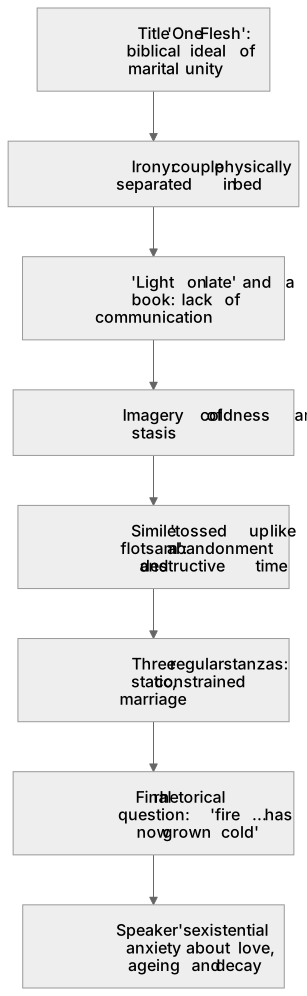
Put it in order
Put these steps in the order they happen.
- 1. Simile 'tossed up like flotsam': abandonment and destructive time
- 2. Speaker's existential anxiety about love, ageing and decay
- 3. Three regular stanzas: static, constrained marriage
- 4. Title 'One Flesh': biblical ideal of marital unity
- 5. Irony: couple physically separated in bed
- 6. Final rhetorical question: 'fire ... has now grown cold'
- 7. 'Light on late' and a book: lack of communication
- 8. Imagery of coldness and stasis
Key words
Say what each word means before you turn the card.
One Flesh
Try answering aloud or in your head before turning the card.
flotsam
Try answering aloud or in your head before turning the card.
Ageing and Time
Try answering aloud or in your head before turning the card.
Loss of Passion
Try answering aloud or in your head before turning the card.
See every definition
- One Flesh
- The title alludes to the biblical ideal of marital unity, ironically contrasted with the couple's physical separation.
- flotsam
- Wreckage used in the simile 'tossed up like flotsam' to convey abandonment and the destructive passage of time.
- Ageing and Time
- Explored through imagery of coldness and stasis, showing how time and fading passion have left the couple stranded.
- Loss of Passion
- Depicted through the couple's estrangement and the final rhetorical question about a fire that has now grown cold.
Label the diagram
Some boxes have lost their names. Pick the right name for each number.
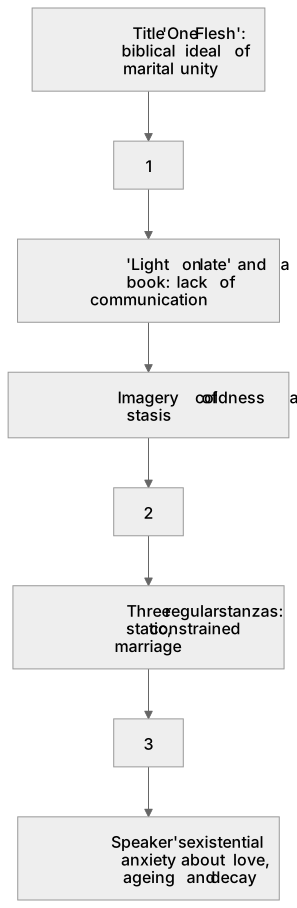
1Box 1
2Box 2
3Box 3
There is more to this lesson
The full lesson goes on to check your understanding and help you earn the marks. Create a free account to carry on, with your progress saved.
A week of Premium from your first lesson · Then the free plan continues · No card, no charge
Test your understanding of Component 3: Poetry – Section B: Specified Poetry Pre- or Post-1900 – Post-1900 – The Movement – The Oxford Book of Twentieth Century English Verse, editor Philip Larkin with foreword by Andrew Motion (OUP, 1973): One Flesh
Active recall beats re-reading. Take an instant quiz now to test what you’ve learned and lock it into long-term memory.
A week of Premium from your first lesson · Then the free plan continues · No card, no charge