Pearson Edexcel · A-Level · English Literature
Course version: 9ET0 · Version from Sept 2015
Poetry – Section B: Specified Poetry Pre- or Post-1900 – Post-1900 – The…
Full specification wording
Component 3: Poetry – Section B: Specified Poetry Pre- or Post-1900 – Post-1900 – The Movement – The Oxford Book of Twentieth Century English Verse, editor Philip Larkin with foreword by Andrew Motion (OUP, 1973): Coming
In ‘Coming’, Philip Larkin presents a rare moment of optimism, capturing the transition from winter to spring.
Checked against the Pearson Edexcel 9ET0 specification (opens in a new tab) on .
- Point 5 of 18
- 4 key terms
Study notes
From the checked teaching notes for this specification point.
The idea
In ‘Coming’, Philip Larkin presents a rare moment of optimism, capturing the transition from winter to spring. The poem contrasts the ‘bare’ suburban garden and brickwork with a thrush’s ‘fresh-peeled voice’, which awakens an unfamiliar happiness. The closing simile compares the speaker to a child who witnesses adults reconciling and does not understand the words but shares their laughter; the child observes the reconciliation rather than participating in it. Short lines and enjambment carry the poem towards this surprised, partly uneasy renewal.
What earns the marks
- Analyse the sensory imagery used to contrast the sterile, suburban winter landscape with the vitality of the approaching spring.
- Evaluate the significance of the thrush's song as a catalyst for the speaker's emotional awakening and shift in perspective.
- Discuss the structural effects of short lines and enjambment in building a sense of anticipation and forward momentum.
- Distinguish the metaphor "childhood / Is a forgotten boredom" from the following simile in which the speaker feels like a child witnessing adults reconcile.
Common mistakes and how to put them right
Viewing the poem as entirely joyful.
Put it right: Recognise the unease within the childhood passage, where the metaphor of "forgotten boredom" precedes the simile of adult reconciliation.
Overlooking the specific suburban setting.
Put it right: Analyse how the 'brickwork' and 'deep bare garden' ground the poem in the realistic, everyday context typical of The Movement.
Assuming the poem uses a strict rhyme scheme like other Larkin works.
Put it right: Note the absence of a regular rhyme scheme, which reflects the organic, unpredictable arrival of spring.
Exam tips
- Contrast the tone of 'Coming' with Larkin's more pessimistic poems to demonstrate an understanding of his thematic range within the anthology.
- Analyse the shift in temporal focus from the static present to the anticipated future, highlighting the significance of the title.
- Examine the use of synaesthesia or mixed sensory descriptions, such as the 'fresh-peeled voice' of the thrush, to show how Larkin intensifies the experience of spring.
Try the lesson
The start of the Component 3: Poetry – Section B: Specified Poetry Pre- or Post-1900 – Post-1900 – The Movement – The Oxford Book of Twentieth Century English Verse, editor Philip Larkin with foreword by Andrew Motion (OUP, 1973): Coming lesson, made from checked teaching notes for this specification point.
Have a go first
In Philip Larkin's poem 'Coming', which image is used to signal the transition from winter to spring and prompt the speaker's sense of anticipation?
Listen
In ‘Coming’, Philip Larkin presents a rare moment of optimism, capturing the transition from winter to spring. The poem contrasts the ‘bare’ suburban garden and brickwork with a thrush’s ‘fresh-peeled voice’, which awakens an unfamiliar happiness. The closing simile compares the speaker to a child who witnesses adults reconciling and does not understand the words but shares their laughter; the child observes the reconciliation rather than participating in it. Short lines and enjambment carry the poem towards this surprised, partly uneasy renewal. A strong answer earns marks for these points. Analyse the sensory imagery used to contrast the sterile, suburban winter landscape with the vitality of the approaching spring. Evaluate the significance of the thrush's song as a catalyst for the speaker's emotional awakening and shift in perspective. Discuss the structural effects of short lines and enjambment in building a sense of anticipation and forward momentum. Distinguish the metaphor "childhood / Is a forgotten boredom" from the following simile in which the speaker feels like a child witnessing adults reconcile. A common slip: Viewing the poem as entirely joyful. Instead, recognise the unease within the childhood passage, where the metaphor of "forgotten boredom" precedes the simile of adult reconciliation. Exam tip: Contrast the tone of 'Coming' with Larkin's more pessimistic poems to demonstrate an understanding of his thematic range within the anthology.
See it
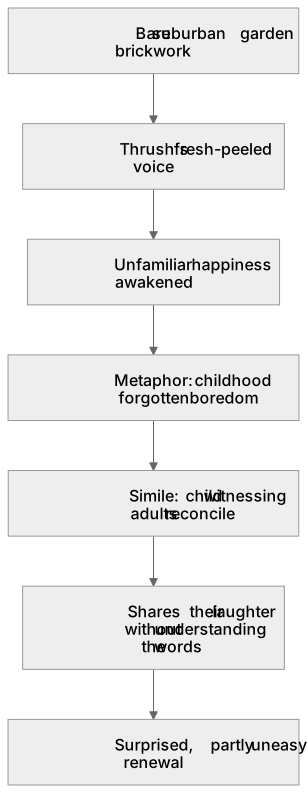
Put it in order
Put these steps in the order they happen.
- 1. Surprised, partly uneasy renewal
- 2. Shares their laughter without understanding the words
- 3. Unfamiliar happiness awakened
- 4. Simile: child witnessing adults reconcile
- 5. Bare suburban garden and brickwork
- 6. Thrush's fresh-peeled voice
- 7. Metaphor: childhood is a forgotten boredom
Key words
Say what each word means before you turn the card.
Nature and Renewal
Try answering aloud or in your head before turning the card.
Childhood and Memory
Try answering aloud or in your head before turning the card.
Hope vs Melancholy
Try answering aloud or in your head before turning the card.
The Suburban Landscape
Try answering aloud or in your head before turning the card.
See every definition
- Nature and Renewal
- The contrast between the bare suburban garden and brickwork and the thrush's fresh-peeled voice, which awakens an unfamiliar happiness.
- Childhood and Memory
- The closing simile compares the speaker to a child who witnesses adults reconciling and does not understand the words but shares their laughter.
- Hope vs Melancholy
- A rare moment of optimism carrying the poem towards a surprised, partly uneasy renewal.
- The Suburban Landscape
- The bare suburban garden and brickwork that the thrush's song is contrasted with.
Label the diagram
Some boxes have lost their names. Pick the right name for each number.
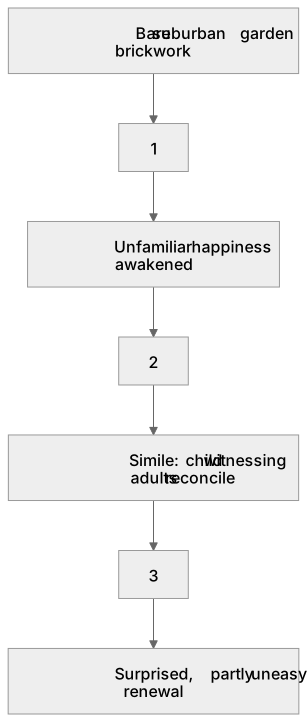
1Box 1
2Box 2
3Box 3
There is more to this lesson
The full lesson goes on to check your understanding and help you earn the marks. Create a free account to carry on, with your progress saved.
A week of Premium from your first lesson · Then the free plan continues · No card, no charge
Test your understanding of Component 3: Poetry – Section B: Specified Poetry Pre- or Post-1900 – Post-1900 – The Movement – The Oxford Book of Twentieth Century English Verse, editor Philip Larkin with foreword by Andrew Motion (OUP, 1973): Coming
Active recall beats re-reading. Take an instant quiz now to test what you’ve learned and lock it into long-term memory.
A week of Premium from your first lesson · Then the free plan continues · No card, no charge