Pearson Edexcel · A-Level · English Literature
Course version: 9ET0 · Version from Sept 2015
Poetry – Section B: Specified Poetry Pre- or Post-1900 – Pre-1900 –…
Full specification wording
Component 3: Poetry – Section B: Specified Poetry Pre- or Post-1900 – Pre-1900 – Metaphysical Poetry – John Donne Selected Poems (Penguin Classics, 2006): A Nocturnal upon St Lucy’s Day, Being the Shortest Day
"A Nocturnal upon St Lucy’s Day" explores profound grief and the absolute annihilation of the self following the death of a beloved.
Checked against the Pearson Edexcel 9ET0 specification (opens in a new tab) on .
- Point 14 of 22
- 4 key terms
Study notes
From the checked teaching notes for this specification point.
The idea
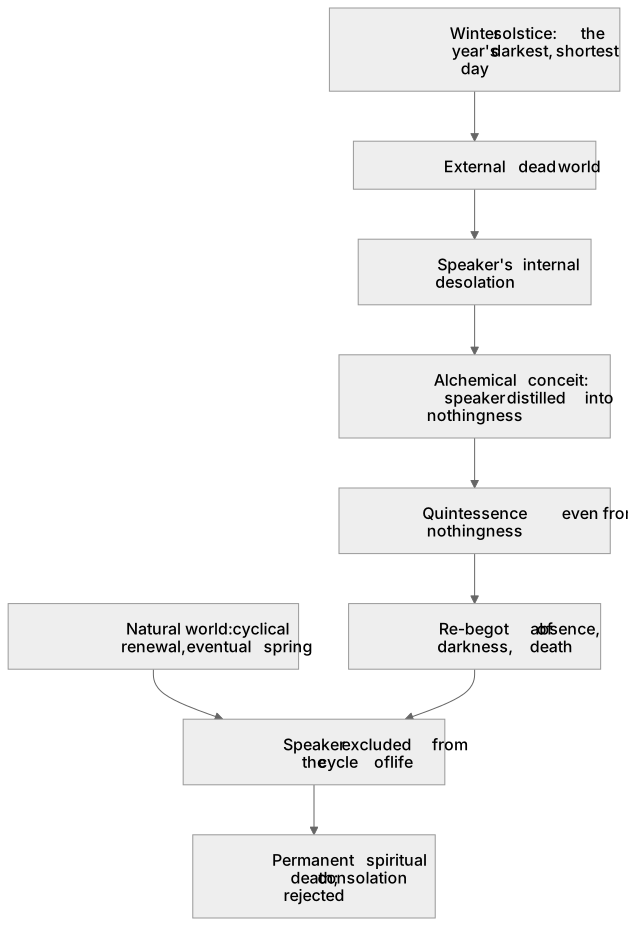
"A Nocturnal upon St Lucy’s Day" explores profound grief and the absolute annihilation of the self following the death of a beloved. Set on the winter solstice, the year's darkest and shortest day, Donne uses the bleakness of the season to mirror the speaker's internal desolation. The poem employs complex alchemical conceits, presenting the speaker as having been distilled into the very essence of nothingness, "re-begot / Of absence, darkness, death". While ordinary alchemy seeks to create gold and life, love's alchemy has reduced the speaker to the "quintessence even from nothingness".
What earns the marks
- Analyse the use of alchemical imagery to express the absolute reduction and annihilation of the speaker's identity.
- Evaluate the significance of the setting on the winter solstice as a macrocosmic reflection of the speaker's microcosmic grief.
- Explore the contrast between the cyclical nature of the physical world and the linear, irreversible nature of the speaker's loss.
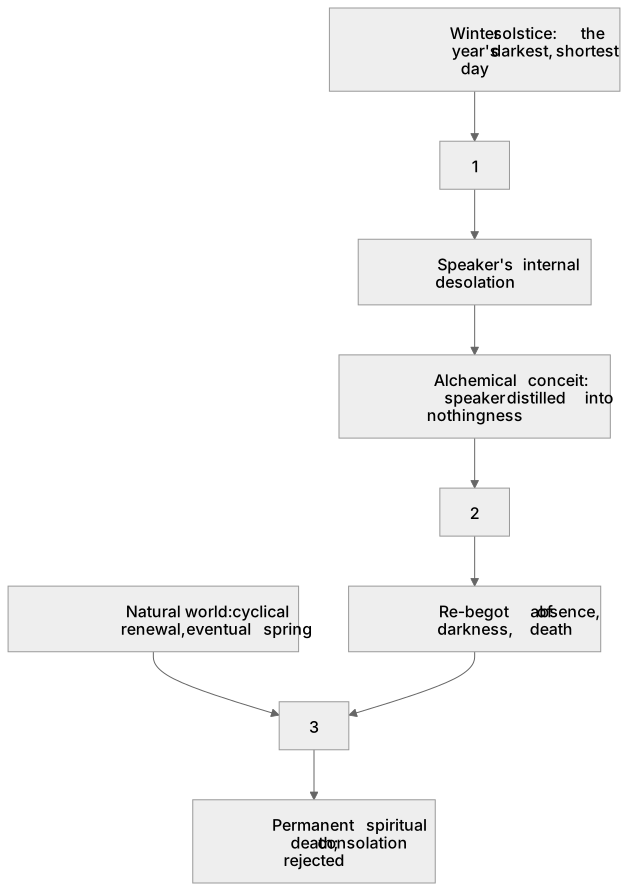
- Discuss the structural progression of the stanzas, moving from the external dead world to the internal void of the speaker.
Common mistakes and how to put them right
Assuming St Lucy's Day refers to a modern December 21st solstice.
Put it right: Note that in the Julian calendar used in Donne's time, St Lucy's Day on December 13th was the winter solstice.
Interpreting the poem as a standard elegy seeking consolation.
Put it right: Recognise that the poem actively rejects consolation, insisting on the speaker's unique status as absolute nothingness.
Misunderstanding the alchemical term 'quintessence' as a positive perfection.
Put it right: Explain that Donne subverts this term; the speaker is the perfection of 'nothingness' and 'ruin', not a purified life force.
Exam tips
- Connect the poem's bleak, irregular metre to the speaker's disrupted emotional state and sense of profound emptiness.
- Compare the destructive 'alchemy' of love in this poem with the more celebratory, unifying alchemy found in Donne's earlier love poetry.
- Use the concept of the macrocosm and microcosm to explain how the dying year reflects the death of the speaker's world.
Try the lesson
The start of the Component 3: Poetry – Section B: Specified Poetry Pre- or Post-1900 – Pre-1900 – Metaphysical Poetry – John Donne Selected Poems (Penguin Classics, 2006): A Nocturnal upon St Lucy’s Day, Being the Shortest Day lesson, made from checked teaching notes for this specification point.
Have a go first
What is the significance of the setting in John Donne's 'A Nocturnal upon St Lucy’s Day'?
Listen
A Nocturnal upon St Lucy’s Day" explores profound grief and the absolute annihilation of the self following the death of a beloved. Set on the winter solstice, the year's darkest and shortest day, Donne uses the bleakness of the season to mirror the speaker's internal desolation. The poem employs complex alchemical conceits, presenting the speaker as having been distilled into the very essence of nothingness, "re-begot / Of absence, darkness, death". While ordinary alchemy seeks to create gold and life, love's alchemy has reduced the speaker to the "quintessence even from nothingness". A strong answer earns marks for these points. Analyse the use of alchemical imagery to express the absolute reduction and annihilation of the speaker's identity. Evaluate the significance of the setting on the winter solstice as a macrocosmic reflection of the speaker's microcosmic grief. Explore the contrast between the cyclical nature of the physical world and the linear, irreversible nature of the speaker's loss. Discuss the structural progression of the stanzas, moving from the external dead world to the internal void of the speaker. A common slip: Assuming St Lucy's Day refers to a modern December 21st solstice. Instead, Note that in the Julian calendar used in Donne's time, St Lucy's Day on December 13th was the winter solstice. Exam tip: Connect the poem's bleak, irregular metre to the speaker's disrupted emotional state and sense of profound emptiness.
See it
Key words
Say what each word means before you turn the card.
Grief and Loss
Try answering aloud or in your head before turning the card.
Nothingness and Annihilation
Try answering aloud or in your head before turning the card.
Time and the Seasons
Try answering aloud or in your head before turning the card.
Love's Destructive Power
Try answering aloud or in your head before turning the card.
See every definition
- Grief and Loss
- Profound grief and the absolute annihilation of the self following the death of a beloved.
- Nothingness and Annihilation
- The speaker is presented as distilled into the very essence of nothingness, the "quintessence even from nothingness".
- Time and the Seasons
- The bleakness of the winter solstice, the year's darkest and shortest day, mirrors the speaker's internal desolation.
- Love's Destructive Power
- Love's alchemy has reduced the speaker to nothingness, in contrast with ordinary alchemy, which seeks to create gold and life.
Label the diagram
Some boxes have lost their names. Pick the right name for each number.
1Box 1
2Box 2
3Box 3
There is more to this lesson
The full lesson goes on to check your understanding and help you earn the marks. Create a free account to carry on, with your progress saved.
A week of Premium from your first lesson · Then the free plan continues · No card, no charge
Test your understanding of Component 3: Poetry – Section B: Specified Poetry Pre- or Post-1900 – Pre-1900 – Metaphysical Poetry – John Donne Selected Poems (Penguin Classics, 2006): A Nocturnal upon St Lucy’s Day, Being the Shortest Day
Active recall beats re-reading. Take an instant quiz now to test what you’ve learned and lock it into long-term memory.
A week of Premium from your first lesson · Then the free plan continues · No card, no charge