Pearson Edexcel · A-Level · English Literature
Course version: 9ET0 · Version from Sept 2015
Poetry – Section B: Specified Poetry Pre- or Post-1900 – Pre-1900 –…
Full specification wording
Component 3: Poetry – Section B: Specified Poetry Pre- or Post-1900 – Pre-1900 – Metaphysical Poetry – John Donne Selected Poems (Penguin Classics, 2006): The Apparition
"The Apparition" is a darkly vindictive poem in which the speaker threatens to haunt his rejecting mistress after his death.
Checked against the Pearson Edexcel 9ET0 specification (opens in a new tab) on .
- Point 15 of 22
- 4 key terms
Study notes
From the checked teaching notes for this specification point.
The idea
"The Apparition" is a darkly vindictive poem in which the speaker threatens to haunt his rejecting mistress after his death. Subverting the traditional Petrarchan trope where the lover 'dies' of unrequited love, Donne literalises this conceit, transforming the speaker into a vengeful ghost. The poem vividly imagines the terrified mistress in bed with a new, exhausted lover who ignores her pleas, leaving her "bathed in a cold quicksilver sweat". The poem explores the intersection of eroticism, violence, and the supernatural, culminating in the speaker's cruel refusal to reveal his ghostly message, preferring to leave her in perpetual, agonising suspense.
What earns the marks
- Analyse the subversion of the Petrarchan conceit of the 'dying lover' into a literal, vengeful haunting.
- Examine the use of sensory and supernatural imagery, such as the "sick taper" and "cold quicksilver sweat", to create a terrifying atmosphere.
- Evaluate the dramatic monologue form and how the single, unbroken stanza builds relentless psychological pressure.
- Discuss the shifting tone of the speaker, from bitter accusation to sadistic triumph over the imagined terror of the mistress.
Common mistakes and how to put them right
Reading the poem as a genuine supernatural encounter.
Put it right: Analyse the poem as a psychological threat and a revenge fantasy constructed by the living speaker.
Ignoring the role of the new lover in the imagined scene.
Put it right: Discuss how the new lover's exhaustion and indifference are crucial to isolating and punishing the mistress.
Assuming the speaker wants to win the mistress back.
Put it right: Recognise that the speaker's primary motivation is vindictive punishment and psychological torture, not reconciliation.
Exam tips
- Contrast the bitter, vengeful tone of this poem with Donne's more tender or spiritually elevated love poetry to demonstrate his thematic range.
- Analyse the irregular rhyme scheme and metre as reflections of the speaker's volatile, unpredictable anger.
- Focus on the final lines to explore how the withholding of information (the ghost's message) serves as the ultimate psychological weapon.
Try the lesson
The start of the Component 3: Poetry – Section B: Specified Poetry Pre- or Post-1900 – Pre-1900 – Metaphysical Poetry – John Donne Selected Poems (Penguin Classics, 2006): The Apparition lesson, made from checked teaching notes for this specification point.
Have a go first
In John Donne's "The Apparition", what central threat does the speaker make to his former lover?
Listen
The Apparition" is a darkly vindictive poem in which the speaker threatens to haunt his rejecting mistress after his death. Subverting the traditional Petrarchan trope where the lover 'dies' of unrequited love, Donne literalises this conceit, transforming the speaker into a vengeful ghost. The poem vividly imagines the terrified mistress in bed with a new, exhausted lover who ignores her pleas, leaving her "bathed in a cold quicksilver sweat". The poem explores the intersection of eroticism, violence, and the supernatural, culminating in the speaker's cruel refusal to reveal his ghostly message, preferring to leave her in perpetual, agonising suspense. A strong answer earns marks for these points. Analyse the subversion of the Petrarchan conceit of the 'dying lover' into a literal, vengeful haunting. Examine the use of sensory and supernatural imagery, such as the "sick taper" and "cold quicksilver sweat", to create a terrifying atmosphere. Evaluate the dramatic monologue form and how the single, unbroken stanza builds relentless psychological pressure. Discuss the shifting tone of the speaker, from bitter accusation to sadistic triumph over the imagined terror of the mistress. A common slip: Reading the poem as a genuine supernatural encounter. Instead, Analyse the poem as a psychological threat and a revenge fantasy constructed by the living speaker. Exam tip: Contrast the bitter, vengeful tone of this poem with Donne's more tender or spiritually elevated love poetry to demonstrate his thematic range.
See it
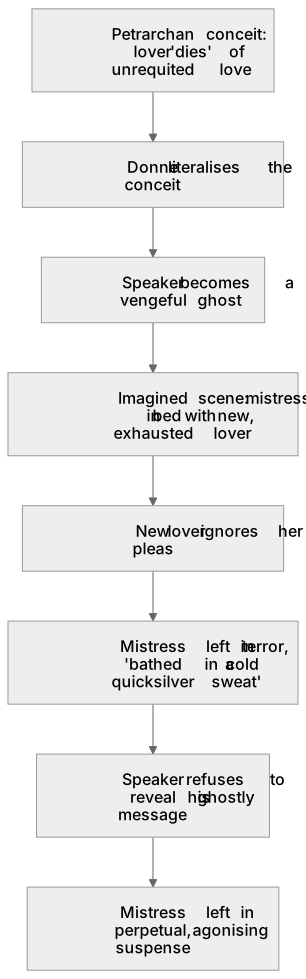
Put it in order
Put these steps in the order they happen.
- 1. New lover ignores her pleas
- 2. Mistress left in perpetual, agonising suspense
- 3. Mistress left in terror, 'bathed in a cold quicksilver sweat'
- 4. Petrarchan conceit: lover 'dies' of unrequited love
- 5. Donne literalises the conceit
- 6. Speaker refuses to reveal his ghostly message
- 7. Speaker becomes a vengeful ghost
- 8. Imagined scene: mistress in bed with new, exhausted lover
Key words
Say what each word means before you turn the card.
Revenge and Vindictiveness
Try answering aloud or in your head before turning the card.
The Supernatural
Try answering aloud or in your head before turning the card.
Eroticism and Violence
Try answering aloud or in your head before turning the card.
Rejection and Jealousy
Try answering aloud or in your head before turning the card.
See every definition
- Revenge and Vindictiveness
- The speaker's primary motivation is vindictive punishment and psychological torture, not reconciliation, as he threatens to haunt his rejecting mistress after his death.
- The Supernatural
- The poem uses supernatural imagery, such as the "sick taper" and "cold quicksilver sweat", to create a terrifying atmosphere around the imagined haunting.
- Eroticism and Violence
- The poem explores the intersection of eroticism, violence, and the supernatural, culminating in the speaker's cruel refusal to reveal his ghostly message.
- Rejection and Jealousy
- The speaker threatens to haunt his rejecting mistress, imagining her terrified in bed with a new, exhausted lover who ignores her pleas.
Label the diagram
Some boxes have lost their names. Pick the right name for each number.
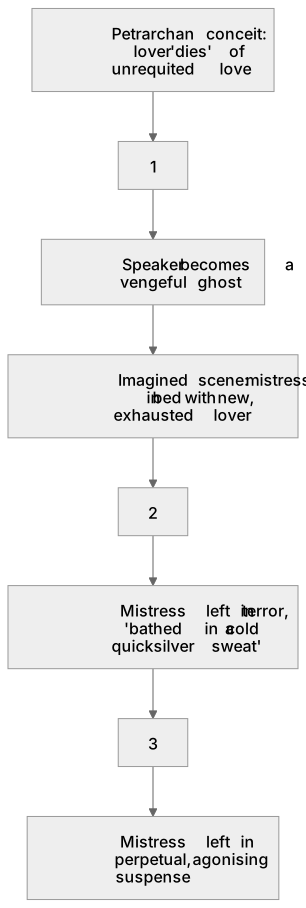
1Box 1
2Box 2
3Box 3
There is more to this lesson
The full lesson goes on to check your understanding and help you earn the marks. Create a free account to carry on, with your progress saved.
A week of Premium from your first lesson · Then the free plan continues · No card, no charge
Test your understanding of Component 3: Poetry – Section B: Specified Poetry Pre- or Post-1900 – Pre-1900 – Metaphysical Poetry – John Donne Selected Poems (Penguin Classics, 2006): The Apparition
Active recall beats re-reading. Take an instant quiz now to test what you’ve learned and lock it into long-term memory.
A week of Premium from your first lesson · Then the free plan continues · No card, no charge