Pearson Edexcel · A-Level · English Literature
Course version: 9ET0 · Version from Sept 2015
Poetry – Section B: Specified Poetry Pre- or Post-1900 – Pre-1900 –…
Full specification wording
Component 3: Poetry – Section B: Specified Poetry Pre- or Post-1900 – Pre-1900 – Metaphysical Poetry – John Donne Selected Poems (Penguin Classics, 2006): Air and Angels
In ‘Air and Angels’, John Donne explores the metaphysical relationship between spiritual love and physical incarnation.
Checked against the Pearson Edexcel 9ET0 specification (opens in a new tab) on .
- Point 7 of 22
- 4 key terms
Study notes
From the checked teaching notes for this specification point.
The idea
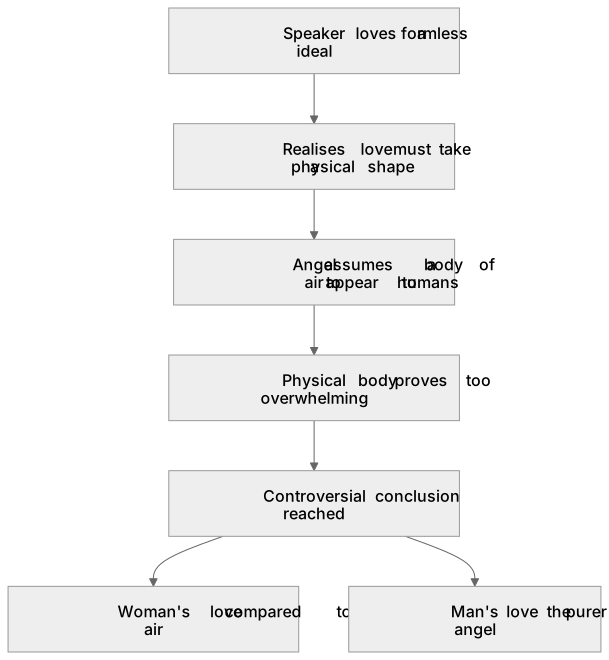
In ‘Air and Angels’, John Donne explores the metaphysical relationship between spiritual love and physical incarnation. The speaker initially loves a formless ideal, but realises love must take a physical shape, just as an angel assumes a body of air to appear to humans. Discovering the physical body is too overwhelming, the speaker reaches a controversial conclusion: a woman’s love is compared to air, while a man’s love is the purer angel. The poem exemplifies metaphysical poetry through its rigorous intellectual exploration of abstract concepts, demanding close attention to its shifting arguments, paradoxes, and Renaissance gender dynamics.
What earns the marks
- Analyse the central conceit of angels assuming bodies of air to explain how spiritual love must manifest in the physical world.
- Evaluate the philosophical shift between the first and second stanzas, tracing the speaker's changing understanding of love's incarnation.
- Examine the use of Renaissance scholastic theology and Neoplatonic ideas regarding the hierarchy of spirit and matter.
- Critically assess the final lines concerning the disparity between male and female love, considering different critical interpretations of its tone.
Common mistakes and how to put them right
Misinterpreting the ending as purely misogynistic without context.
Put it right by exploring the Renaissance philosophical context where 'air' and 'angels' represent different levels of purity rather than simple insults.
Overlooking the structural division of the poem.
Put it right: Ensure you contrast the search for physical form in stanza one with the realisation of its limitations in stanza two.
Treating the poem as a simple love lyric.
Put it right by addressing the dense theological and philosophical arguments that drive the speaker's logic.
Exam tips
- Use 'Air and Angels' to discuss the metaphysical tension between the body and the soul, comparing it to poems like 'The Ecstasy'.
- Pay close attention to the poem's complex syntax and enjambment, discussing how they reflect the speaker's ongoing, evolving thought process.
- Acknowledge the ambiguity of the final lines, offering multiple interpretations to demonstrate a sophisticated understanding of Donne's wit.
Try the lesson
The start of the Component 3: Poetry – Section B: Specified Poetry Pre- or Post-1900 – Pre-1900 – Metaphysical Poetry – John Donne Selected Poems (Penguin Classics, 2006): Air and Angels lesson, made from checked teaching notes for this specification point.
Have a go first
In John Donne's 'Air and Angels', what is the primary metaphysical conceit used to explore the nature of love?
Listen
In ‘Air and Angels’, John Donne explores the metaphysical relationship between spiritual love and physical incarnation. The speaker initially loves a formless ideal, but realises love must take a physical shape, just as an angel assumes a body of air to appear to humans. Discovering the physical body is too overwhelming, the speaker reaches a controversial conclusion: a woman’s love is compared to air, while a man’s love is the purer angel. The poem exemplifies metaphysical poetry through its rigorous intellectual exploration of abstract concepts, demanding close attention to its shifting arguments, paradoxes, and Renaissance gender dynamics. A strong answer earns marks for these points. Analyse the central conceit of angels assuming bodies of air to explain how spiritual love must manifest in the physical world. Evaluate the philosophical shift between the first and second stanzas, tracing the speaker's changing understanding of love's incarnation. Examine the use of Renaissance scholastic theology and Neoplatonic ideas regarding the hierarchy of spirit and matter. Critically assess the final lines concerning the disparity between male and female love, considering different critical interpretations of its tone. A common slip: Misinterpreting the ending as purely misogynistic without context. Instead, exploring the Renaissance philosophical context where 'air' and 'angels' represent different levels of purity rather than simple insults. Exam tip: Use 'Air and Angels' to discuss the metaphysical tension between the body and the soul, comparing it to poems like 'The Ecstasy'.
See it
Key words
Say what each word means before you turn the card.
Body versus soul
Try answering aloud or in your head before turning the card.
The incarnation of love
Try answering aloud or in your head before turning the card.
Gender differences in love
Try answering aloud or in your head before turning the card.
Neoplatonism and theology
Try answering aloud or in your head before turning the card.
See every definition
- Body versus soul
- The metaphysical tension between the physical and the spiritual that the poem explores through its central conceit.
- The incarnation of love
- The idea that spiritual love must manifest in the physical world, which the speaker's understanding of develops across the stanzas.
- Gender differences in love
- The disparity between male and female love assessed in the final lines, where a woman's love is compared to air and a man's to the purer angel.
- Neoplatonism and theology
- Renaissance philosophical and scholastic ideas regarding the hierarchy of spirit and matter that inform the poem's argument.
Label the diagram
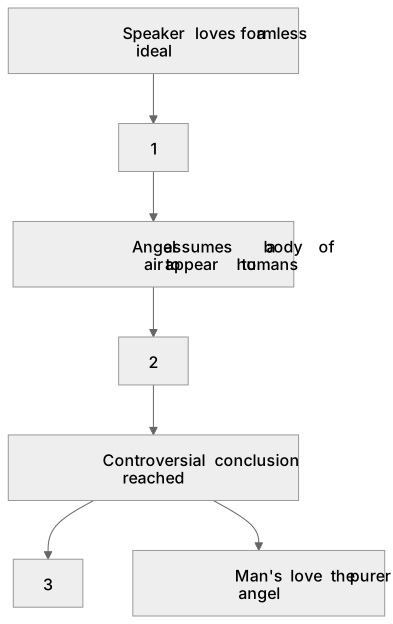
Some boxes have lost their names. Pick the right name for each number.
1Box 1
2Box 2
3Box 3
There is more to this lesson
The full lesson goes on to check your understanding and help you earn the marks. Create a free account to carry on, with your progress saved.
A week of Premium from your first lesson · Then the free plan continues · No card, no charge
Test your understanding of Component 3: Poetry – Section B: Specified Poetry Pre- or Post-1900 – Pre-1900 – Metaphysical Poetry – John Donne Selected Poems (Penguin Classics, 2006): Air and Angels
Active recall beats re-reading. Take an instant quiz now to test what you’ve learned and lock it into long-term memory.
A week of Premium from your first lesson · Then the free plan continues · No card, no charge