Pearson Edexcel · A-Level · English Literature
Course version: 9ET0 · Version from Sept 2015
Poetry – Section B: Specified Poetry Pre- or Post-1900 – Pre-1900 –…
Full specification wording
Component 3: Poetry – Section B: Specified Poetry Pre- or Post-1900 – Pre-1900 – Metaphysical Poetry – John Donne Selected Poems (Penguin Classics, 2006): Song (‘Sweetest love I do not go’)
John Donne’s ‘Song (Sweetest love I do not go)’ is a quintessential metaphysical lyric exploring the pain of parting and the spiritual transcendence of true love.
Checked against the Pearson Edexcel 9ET0 specification (opens in a new tab) on .
- Point 6 of 22
- 4 key terms
Study notes
From the checked teaching notes for this specification point.
The idea
John Donne’s ‘Song (Sweetest love I do not go)’ is a quintessential metaphysical lyric exploring the pain of parting and the spiritual transcendence of true love. The speaker addresses his beloved before a journey, arguing that his departure is merely a rehearsal for death, yet their profound connection renders physical separation meaningless. Donne employs striking conceits, comparing his journey to the sun’s daily orbit to reassure his lover of his inevitable return. The poem’s intricate stanzaic form, shifting meter, and direct, conversational tone reflect the complex interplay of emotion and intellect characteristic of metaphysical poetry.
What earns the marks
- Analyse the use of the sun conceit to represent the speaker's reliable return and the speed of his journey.
- Evaluate the poem's argument that true lovers cannot be truly parted because they keep each other alive in their hearts.
- Explore the metaphysical traits present, such as the blend of passionate emotion with rigorous logical argument and paradox.
- Examine the structural elements, including the regular rhyme scheme and shifting meter, which mirror the speaker's attempt to impose order on emotional chaos.
Common mistakes and how to put them right
Mistaking the poem for a literal deathbed farewell.
Put it right by recognising it as a temporary parting used as a metaphor to explore the concept of death.
Ignoring the complexity of the final stanza.
Put it right: Ensure you address the paradox that those who keep each other alive in memory 'ne'er parted be'.
Focusing solely on the emotion without analysing the rhetoric.
Put it right by examining how Donne uses logical deduction and persuasion to comfort the beloved.
Exam tips
- Compare the theme of parting in this poem with other Donne poems like 'A Valediction: Forbidding Mourning' to demonstrate wider textual knowledge.
- Quote specific metaphysical conceits, such as the comparison to the sun, to illustrate Donne's intellectual approach to romantic love.
- Discuss the significance of the direct address and imperative verbs in establishing the intimate, persuasive tone of the speaker.
Try the lesson
The start of the Component 3: Poetry – Section B: Specified Poetry Pre- or Post-1900 – Pre-1900 – Metaphysical Poetry – John Donne Selected Poems (Penguin Classics, 2006): Song (‘Sweetest love I do not go’) lesson, made from checked teaching notes for this specification point.
Have a go first
What is the primary reason the speaker gives for leaving his beloved in the opening stanza of 'Song (Sweetest love I do not go)'?
Listen
John Donne’s ‘Song (Sweetest love I do not go)’ is a quintessential metaphysical lyric exploring the pain of parting and the spiritual transcendence of true love. The speaker addresses his beloved before a journey, arguing that his departure is merely a rehearsal for death, yet their profound connection renders physical separation meaningless. Donne employs striking conceits, comparing his journey to the sun’s daily orbit to reassure his lover of his inevitable return. The poem’s intricate stanzaic form, shifting meter, and direct, conversational tone reflect the complex interplay of emotion and intellect characteristic of metaphysical poetry. A strong answer earns marks for these points. Analyse the use of the sun conceit to represent the speaker's reliable return and the speed of his journey. Evaluate the poem's argument that true lovers cannot be truly parted because they keep each other alive in their hearts. Explore the metaphysical traits present, such as the blend of passionate emotion with rigorous logical argument and paradox. Examine the structural elements, including the regular rhyme scheme and shifting meter, which mirror the speaker's attempt to impose order on emotional chaos. A common slip: Mistaking the poem for a literal deathbed farewell. Instead, recognising it as a temporary parting used as a metaphor to explore the concept of death. Exam tip: Compare the theme of parting in this poem with other Donne poems like 'A Valediction: Forbidding Mourning' to demonstrate wider textual knowledge.
See it
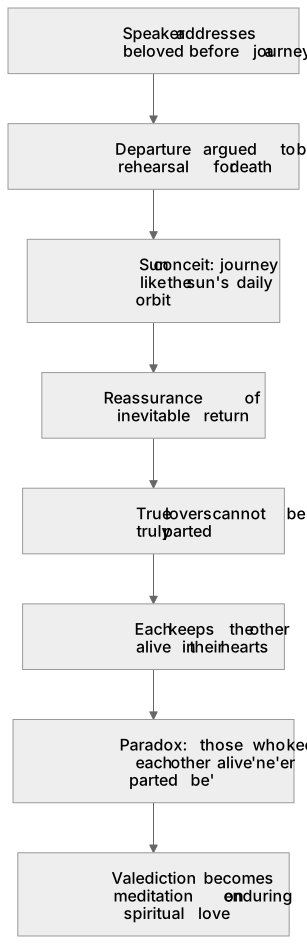
Put it in order
Put these steps in the order they happen.
- 1. True lovers cannot be truly parted
- 2. Valediction becomes meditation on enduring spiritual love
- 3. Each keeps the other alive in their hearts
- 4. Speaker addresses beloved before a journey
- 5. Departure argued to be a rehearsal for death
- 6. Paradox: those who keep each other alive 'ne'er parted be'
- 7. Sun conceit: journey like the sun's daily orbit
- 8. Reassurance of inevitable return
Key words
Say what each word means before you turn the card.
Parting and separation
Try answering aloud or in your head before turning the card.
The nature of true love
Try answering aloud or in your head before turning the card.
Mortality and death
Try answering aloud or in your head before turning the card.
The relationship between the physical and spiritual
Try answering aloud or in your head before turning the card.
See every definition
- Parting and separation
- The pain of parting is explored as the speaker addresses his beloved before a journey, arguing that his departure is merely a rehearsal for death.
- The nature of true love
- True love is presented as spiritually transcendent, so that profound connection renders physical separation meaningless and true lovers cannot be truly parted.
- Mortality and death
- Death is approached through the argument that the speaker's departure is merely a rehearsal for death, rather than a literal deathbed farewell.
- The relationship between the physical and spiritual
- Physical separation is rendered meaningless by spiritual transcendence, developing a valediction into a meditation on the enduring, indivisible nature of spiritual love.
Label the diagram
Some boxes have lost their names. Pick the right name for each number.
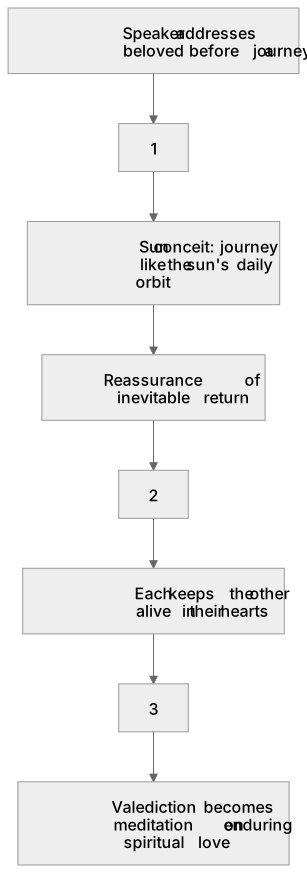
1Box 1
2Box 2
3Box 3
There is more to this lesson
The full lesson goes on to check your understanding and help you earn the marks. Create a free account to carry on, with your progress saved.
A week of Premium from your first lesson · Then the free plan continues · No card, no charge
Test your understanding of Component 3: Poetry – Section B: Specified Poetry Pre- or Post-1900 – Pre-1900 – Metaphysical Poetry – John Donne Selected Poems (Penguin Classics, 2006): Song (‘Sweetest love I do not go’)
Active recall beats re-reading. Take an instant quiz now to test what you’ve learned and lock it into long-term memory.
A week of Premium from your first lesson · Then the free plan continues · No card, no charge