Pearson Edexcel · A-Level · English Literature
Course version: 9ET0 · Version from Sept 2015
Poetry – Section B: Specified Poetry Pre- or Post-1900 – Pre-1900 –…
Full specification wording
Component 3: Poetry – Section B: Specified Poetry Pre- or Post-1900 – Pre-1900 – Metaphysical Poetry – John Donne Selected Poems (Penguin Classics, 2006): Elegy: To His Mistress Going to Bed
John Donne’s ‘Elegy: To His Mistress Going to Bed’ is a masterful metaphysical poem that blends erotic seduction with the language of religious devotion and imperial exploration.
Checked against the Pearson Edexcel 9ET0 specification (opens in a new tab) on .
- Point 20 of 22
- 4 key terms
Study notes
From the checked teaching notes for this specification point.
The idea
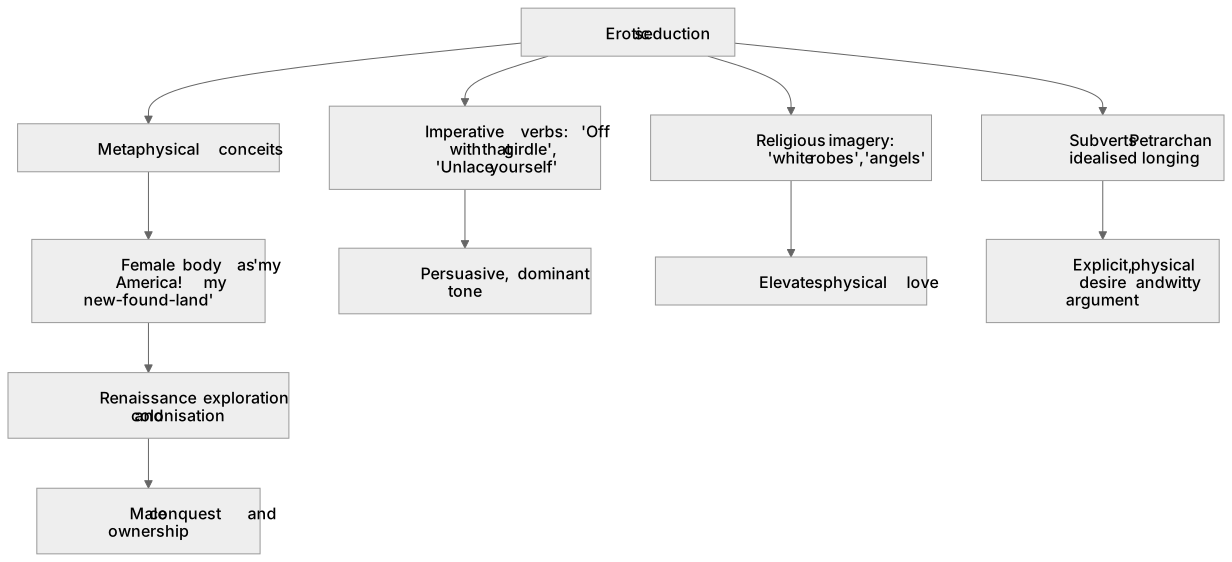
John Donne’s ‘Elegy: To His Mistress Going to Bed’ is a masterful metaphysical poem that blends erotic seduction with the language of religious devotion and imperial exploration. The speaker uses a series of elaborate conceits, famously comparing the undressing of his mistress to the discovery of ‘my America! my new-found-land’. This reflects the Renaissance fascination with exploration and colonisation, mapping the female body as a territory to be conquered and possessed. Donne employs imperative verbs and a persuasive, rhetorical structure to create a sense of urgency and intimacy.
What earns the marks
- Analyse the use of metaphysical conceits, particularly the comparison of the female body to an unexplored continent in the 'America' passage.
- Evaluate the effect of imperative verbs such as 'Off with that girdle' and 'Unlace yourself' in establishing the speaker's persuasive and dominant tone.
- Explore the blending of religious and erotic imagery, such as the reference to 'white robes' and 'angels', to elevate physical love.
- Discuss the poem's context within Renaissance exploration and how it reflects contemporary attitudes towards colonisation, mapping, and male ownership.
Common mistakes and how to put them right
Treating the poem solely as a romantic love lyric.
Put it right: Recognise it as a persuasive, rhetorical argument designed for seduction, typical of metaphysical poetry.
Ignoring the political implications of the 'America' conceit.
Put it right: Analyse how the language of discovery implies male conquest, ownership, and the colonisation of the female body.
Misinterpreting the religious imagery as purely pious.
Put it right: Explain how Donne subverts religious terminology to elevate and justify physical, erotic love.
Exam tips
- Link Donne's use of geographical conceits to the historical context of 16th-century maritime exploration and the expanding known world.
- Compare the explicit, physical nature of this elegy with the more spiritual or intellectual love depicted in Donne's other poems, such as 'A Valediction: Forbidding Mourning'.
- Analyse the structural shift in the final couplet, where the speaker reveals he is already naked, to demonstrate Donne's use of wit and dramatic reversal.
Try the lesson
The start of the Component 3: Poetry – Section B: Specified Poetry Pre- or Post-1900 – Pre-1900 – Metaphysical Poetry – John Donne Selected Poems (Penguin Classics, 2006): Elegy: To His Mistress Going to Bed lesson, made from checked teaching notes for this specification point.
Have a go first
In 'Elegy: To His Mistress Going to Bed', which famous metaphysical conceit does the speaker use to describe the woman's body as he undresses her?
Listen
John Donne’s ‘Elegy: To His Mistress Going to Bed’ is a masterful metaphysical poem that blends erotic seduction with the language of religious devotion and imperial exploration. The speaker uses a series of elaborate conceits, famously comparing the undressing of his mistress to the discovery of ‘my America! my new-found-land’. This reflects the Renaissance fascination with exploration and colonisation, mapping the female body as a territory to be conquered and possessed. Donne employs imperative verbs and a persuasive, rhetorical structure to create a sense of urgency and intimacy. A strong answer earns marks for these points. Analyse the use of metaphysical conceits, particularly the comparison of the female body to an unexplored continent in the 'America' passage. Evaluate the effect of imperative verbs such as 'Off with that girdle' and 'Unlace yourself' in establishing the speaker's persuasive and dominant tone. Explore the blending of religious and erotic imagery, such as the reference to 'white robes' and 'angels', to elevate physical love. Discuss the poem's context within Renaissance exploration and how it reflects contemporary attitudes towards colonisation, mapping, and male ownership. A common slip: Treating the poem solely as a romantic love lyric. Instead, Recognise it as a persuasive, rhetorical argument designed for seduction, typical of metaphysical poetry. Exam tip: Link Donne's use of geographical conceits to the historical context of 16th-century maritime exploration and the expanding known world.
See it
Key words
Say what each word means before you turn the card.
Erotic love and physical desire
Try answering aloud or in your head before turning the card.
Exploration and colonisation
Try answering aloud or in your head before turning the card.
Power and persuasion
Try answering aloud or in your head before turning the card.
Religion and the sacred versus the profane
Try answering aloud or in your head before turning the card.
See every definition
- Erotic love and physical desire
- The explicit, physical desire that replaces the idealised, distant longing of traditional Petrarchan love poetry, expressed through witty, intellectual arguments.
- Exploration and colonisation
- The Renaissance fascination with discovery, reflected in conceits that map the female body as a territory to be conquered and possessed.
- Power and persuasion
- The persuasive, rhetorical structure and imperative verbs that create a sense of urgency and establish the speaker's dominant tone.
- Religion and the sacred versus the profane
- The blending of religious and erotic imagery, such as references to 'white robes' and 'angels', used to elevate physical love.
Label the diagram
Some boxes have lost their names. Pick the right name for each number.
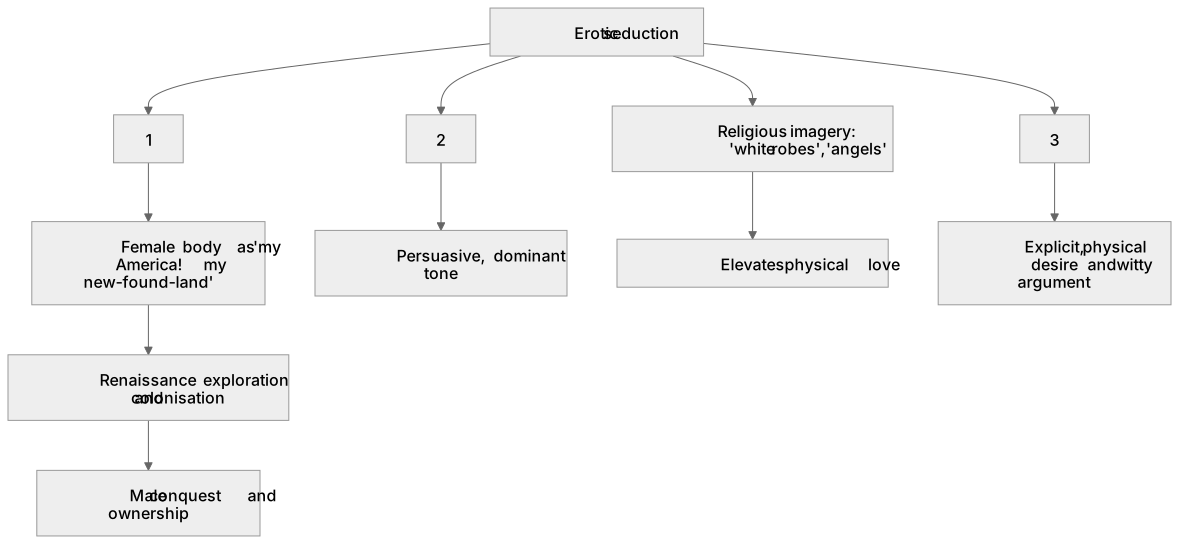
1Box 1
2Box 2
3Box 3
There is more to this lesson
The full lesson goes on to check your understanding and help you earn the marks. Create a free account to carry on, with your progress saved.
A week of Premium from your first lesson · Then the free plan continues · No card, no charge
Test your understanding of Component 3: Poetry – Section B: Specified Poetry Pre- or Post-1900 – Pre-1900 – Metaphysical Poetry – John Donne Selected Poems (Penguin Classics, 2006): Elegy: To His Mistress Going to Bed
Active recall beats re-reading. Take an instant quiz now to test what you’ve learned and lock it into long-term memory.
A week of Premium from your first lesson · Then the free plan continues · No card, no charge