Pearson Edexcel · A-Level · English Literature
Course version: 9ET0 · Version from Sept 2015
Poetry – Section B: Specified Poetry Pre- or Post-1900 – Pre-1900 –…
Full specification wording
Component 3: Poetry – Section B: Specified Poetry Pre- or Post-1900 – Pre-1900 – Metaphysical Poetry – John Donne Selected Poems (Penguin Classics, 2006): The Relic
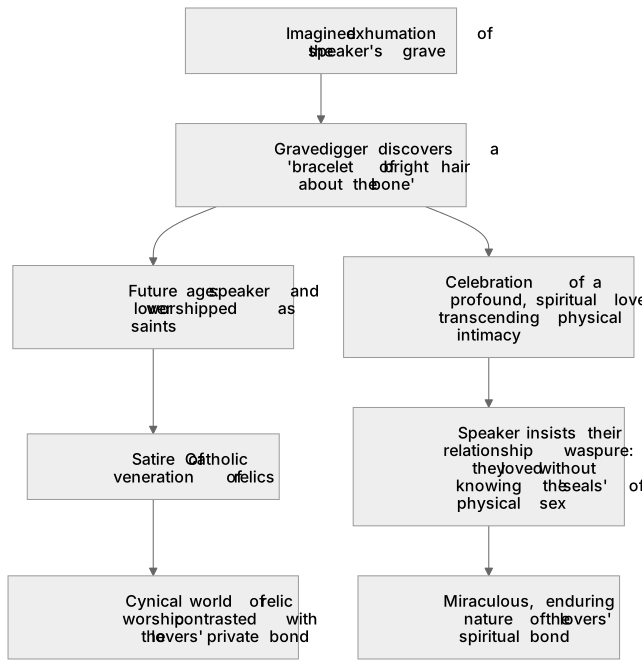
'The Relic' explores the imagined exhumation of the speaker's grave, where a gravedigger discovers a 'bracelet of bright hair about the bone'.
Checked against the Pearson Edexcel 9ET0 specification (opens in a new tab) on .
- Point 19 of 22
- 3 key terms
Study notes
From the checked teaching notes for this specification point.
The idea
'The Relic' explores the imagined exhumation of the speaker's grave, where a gravedigger discovers a 'bracelet of bright hair about the bone'. Donne uses this striking image to satirise the Catholic veneration of relics, suggesting that in a future age, the speaker and his lover will be worshipped as saints. Beyond this religious satire, the poem celebrates a profound, spiritual love that transcends physical intimacy. The speaker insists their relationship was pure, noting they loved without knowing the 'seals' of physical sex.
What earns the marks
- Analyse the central image of the 'bracelet of bright hair about the bone' as a symbol of enduring love amidst mortality.
- Evaluate Donne's satirical critique of religious superstition and the Catholic practice of relic veneration.
- Examine the portrayal of platonic love and the deliberate rejection of physical consummation ('difference of sex no more we knew').
- Compare the poem's treatment of death, memory, and spiritual connection with other poems in the Donne selection.
Common mistakes and how to put them right
Treating the poem as a genuine endorsement of Catholic relic worship.
Put it right: Recognise the satirical tone Donne uses to mock the superstition and commercialisation of 'misdevotion'.
Assuming the lovers in the poem had a physical, sexual relationship.
Put it right: Highlight the speaker's explicit claim of platonic purity, stating they did not break the 'seals' of physical intimacy.
Overlooking the significance of the gravedigger.
Put it right: Discuss how the gravedigger's intrusion introduces the theme of public misinterpretation of private love.
Exam tips
- Contrast the stark, monosyllabic reality of 'bone' with the vibrant 'bright hair' to explore Donne's juxtaposition of life and death.
- Discuss the significance of the reference to 'Mary Magdalen', linking it to themes of redemption, female devotion, and religious misinterpretation.
- Analyse the final stanza's shift from satirical narrative to a direct, earnest declaration of the miraculous nature of their love.
Try the lesson
The start of the Component 3: Poetry – Section B: Specified Poetry Pre- or Post-1900 – Pre-1900 – Metaphysical Poetry – John Donne Selected Poems (Penguin Classics, 2006): The Relic lesson, made from checked teaching notes for this specification point.
Have a go first
In John Donne's poem 'The Relic', what central object is imagined to be found in the speaker's grave when it is dug up?
Listen
The Relic' explores the imagined exhumation of the speaker's grave, where a gravedigger discovers a 'bracelet of bright hair about the bone'. Donne uses this striking image to satirise the Catholic veneration of relics, suggesting that in a future age, the speaker and his lover will be worshipped as saints. Beyond this religious satire, the poem celebrates a profound, spiritual love that transcends physical intimacy. The speaker insists their relationship was pure, noting they loved without knowing the 'seals' of physical sex. A strong answer earns marks for these points. Analyse the central image of the 'bracelet of bright hair about the bone' as a symbol of enduring love amidst mortality. Evaluate Donne's satirical critique of religious superstition and the Catholic practice of relic veneration. Examine the portrayal of platonic love and the deliberate rejection of physical consummation ('difference of sex no more we knew'). Compare the poem's treatment of death, memory, and spiritual connection with other poems in the Donne selection. A common slip: Treating the poem as a genuine endorsement of Catholic relic worship. Instead, Recognise the satirical tone Donne uses to mock the superstition and commercialisation of 'misdevotion'. Exam tip: Contrast the stark, monosyllabic reality of 'bone' with the vibrant 'bright hair' to explore Donne's juxtaposition of life and death.
See it
Key words
Say what each word means before you turn the card.
Relic
Try answering aloud or in your head before turning the card.
Spiritual love
Try answering aloud or in your head before turning the card.
Religious satire
Try answering aloud or in your head before turning the card.
See every definition
- Relic
- An object venerated in Catholic practice, which Donne uses to satirise the superstition and commercialisation of 'misdevotion'.
- Spiritual love
- A profound bond that transcends physical intimacy, celebrated as pure because the lovers did not break the 'seals' of physical sex.
- Religious satire
- Mockery of the superstition and commercialisation of relic veneration, suggesting the lovers will be worshipped as saints in a future age.
Label the diagram
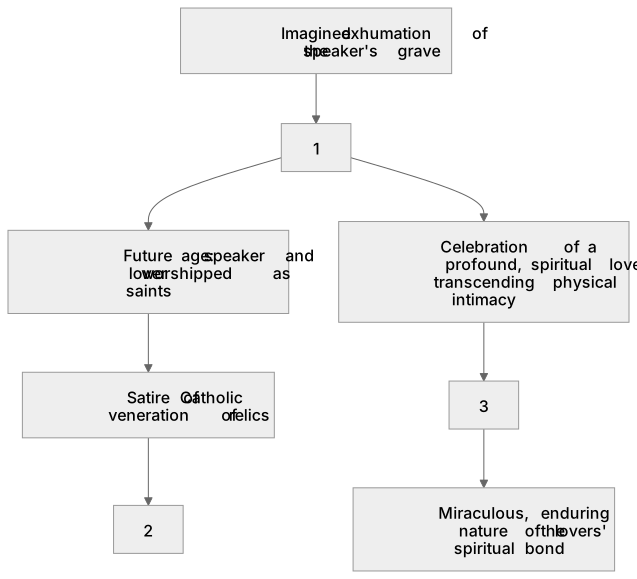
Some boxes have lost their names. Pick the right name for each number.
1Box 1
2Box 2
3Box 3
There is more to this lesson
The full lesson goes on to check your understanding and help you earn the marks. Create a free account to carry on, with your progress saved.
A week of Premium from your first lesson · Then the free plan continues · No card, no charge
Test your understanding of Component 3: Poetry – Section B: Specified Poetry Pre- or Post-1900 – Pre-1900 – Metaphysical Poetry – John Donne Selected Poems (Penguin Classics, 2006): The Relic
Active recall beats re-reading. Take an instant quiz now to test what you’ve learned and lock it into long-term memory.
A week of Premium from your first lesson · Then the free plan continues · No card, no charge