Pearson Edexcel · A-Level · English Literature
Course version: 9ET0 · Version from Sept 2015
Poetry – Section B: Specified Poetry Pre- or Post-1900 – Pre-1900 –…
Full specification wording
Component 3: Poetry – Section B: Specified Poetry Pre- or Post-1900 – Pre-1900 – Metaphysical Poetry – John Donne Selected Poems (Penguin Classics, 2006): Love’s Growth
In 'Love's Growth', Donne challenges the Neoplatonic ideal of static, infinite love by arguing that true affection is dynamic and capable of expansion.
Checked against the Pearson Edexcel 9ET0 specification (opens in a new tab) on .
- Point 10 of 22
- 4 key terms
Study notes
From the checked teaching notes for this specification point.
The idea
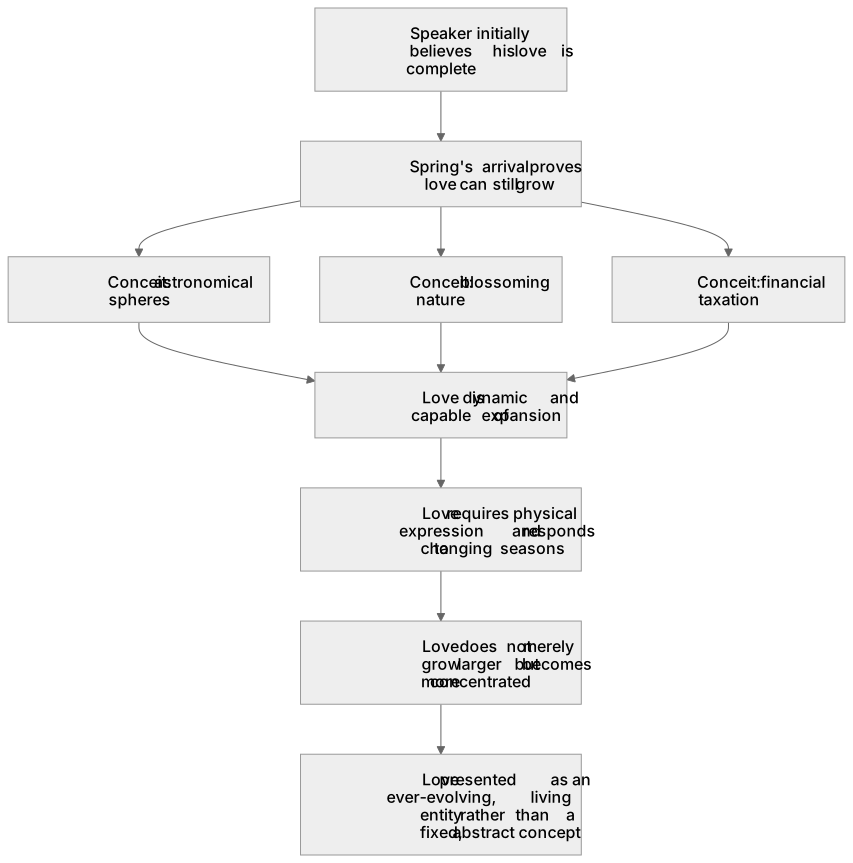
In 'Love's Growth', Donne challenges the Neoplatonic ideal of static, infinite love by arguing that true affection is dynamic and capable of expansion. The speaker initially believes his love is complete, yet spring's arrival proves it can still grow. Donne employs striking metaphysical conceits, comparing love's growth to astronomical spheres, blossoming nature, and even financial taxation, blending the spiritual with the physical. He argues that love is not purely ethereal; it requires physical expression and responds to the changing seasons. By concluding that love does not merely grow larger but becomes more concentrated, Donne masterfully redefines the boundaries of human affection, presenting it as an ever-evolving, living entity rather than a fixed, abstract concept.
What earns the marks
- Analyse the use of seasonal imagery, contrasting winter and spring, to represent the dormancy and subsequent awakening of the speaker's love.
- Evaluate the metaphysical conceits, particularly the comparison of love to financial concepts like taxes and astronomical spheres.
- Discuss the tension between Neoplatonic ideals of pure, unchanging love and Donne's assertion of love's physical, dynamic nature.
- Explore the structural shifts in the poem, noting how the stanza forms mirror the expansion and concentration of the speaker's feelings.
Common mistakes and how to put them right
Assuming the poem argues that the speaker's previous love was false.
Put it right: Recognise that he argues love was real but simply dormant, like wintering plants.
Ignoring the physical aspects of love in the poem.
Put it right: Ensure you discuss how Donne blends spiritual devotion with physical desire and earthly realities.
Misinterpreting the financial imagery as purely cynical.
Put it right by explaining how Donne uses taxation metaphors to illustrate love's inevitable, compounding growth.
Exam tips
- Compare the dynamic nature of love in this poem with the more static, eternal love presented in 'The Good-Morrow' or 'The Sun Rising'.
- Focus closely on the paradox in the opening lines, exploring how something supposedly infinite can still experience growth.
- Use specific terminology like 'Neoplatonism' and 'metaphysical conceit' when analysing Donne's philosophical arguments about love.
Try the lesson
The start of the Component 3: Poetry – Section B: Specified Poetry Pre- or Post-1900 – Pre-1900 – Metaphysical Poetry – John Donne Selected Poems (Penguin Classics, 2006): Love’s Growth lesson, made from checked teaching notes for this specification point.
Have a go first
What is the central argument about the nature of love presented in "Love's Growth"?
Listen
In 'Love's Growth', Donne challenges the Neoplatonic ideal of static, infinite love by arguing that true affection is dynamic and capable of expansion. The speaker initially believes his love is complete, yet spring's arrival proves it can still grow. Donne employs striking metaphysical conceits, comparing love's growth to astronomical spheres, blossoming nature, and even financial taxation, blending the spiritual with the physical. He argues that love is not purely ethereal; it requires physical expression and responds to the changing seasons. By concluding that love does not merely grow larger but becomes more concentrated, Donne masterfully redefines the boundaries of human affection, presenting it as an ever-evolving, living entity rather than a fixed, abstract concept. A strong answer earns marks for these points. Analyse the use of seasonal imagery, contrasting winter and spring, to represent the dormancy and subsequent awakening of the speaker's love. Evaluate the metaphysical conceits, particularly the comparison of love to financial concepts like taxes and astronomical spheres. Discuss the tension between Neoplatonic ideals of pure, unchanging love and Donne's assertion of love's physical, dynamic nature. Explore the structural shifts in the poem, noting how the stanza forms mirror the expansion and concentration of the speaker's feelings. A common slip: Assuming the poem argues that the speaker's previous love was false. Instead, recognise that he argues love was real but simply dormant, like wintering plants. Exam tip: Compare the dynamic nature of love in this poem with the more static, eternal love presented in 'The Good-Morrow' or 'The Sun Rising'.
See it
Key words
Say what each word means before you turn the card.
The dynamic nature of love
Try answering aloud or in your head before turning the card.
Spiritual versus physical love
Try answering aloud or in your head before turning the card.
Time and the changing seasons
Try answering aloud or in your head before turning the card.
The paradox of infinity
Try answering aloud or in your head before turning the card.
See every definition
- The dynamic nature of love
- The idea that true affection is dynamic and capable of expansion, rather than a static, infinite ideal.
- Spiritual versus physical love
- The blending of spiritual devotion with physical desire and earthly realities, since love is not purely ethereal and requires physical expression.
- Time and the changing seasons
- Seasonal imagery of winter dormancy and spring awakening, showing that love responds to the changing seasons and can still grow.
- The paradox of infinity
- The tension in the opening lines, where something supposedly infinite can still experience growth.
Label the diagram
Some boxes have lost their names. Pick the right name for each number.
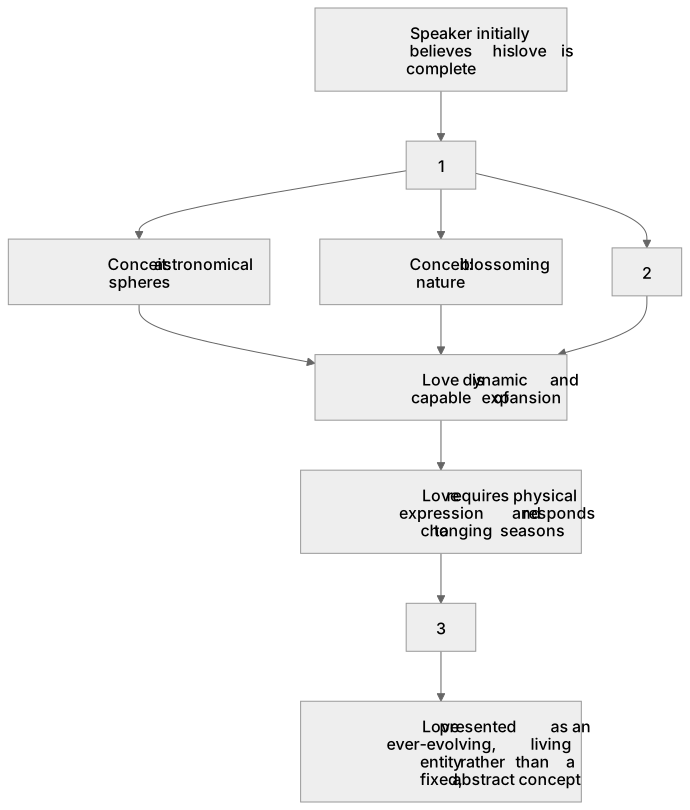
1Box 1
2Box 2
3Box 3
There is more to this lesson
The full lesson goes on to check your understanding and help you earn the marks. Create a free account to carry on, with your progress saved.
A week of Premium from your first lesson · Then the free plan continues · No card, no charge
Test your understanding of Component 3: Poetry – Section B: Specified Poetry Pre- or Post-1900 – Pre-1900 – Metaphysical Poetry – John Donne Selected Poems (Penguin Classics, 2006): Love’s Growth
Active recall beats re-reading. Take an instant quiz now to test what you’ve learned and lock it into long-term memory.
A week of Premium from your first lesson · Then the free plan continues · No card, no charge