Pearson Edexcel · A-Level · English Literature
Course version: 9ET0 · Version from Sept 2015
Poetry – Section B: Specified Poetry Pre- or Post-1900 – Pre-1900 –…
Full specification wording
Component 3: Poetry – Section B: Specified Poetry Pre- or Post-1900 – Pre-1900 – Metaphysical Poetry – John Donne Selected Poems (Penguin Classics, 2006): Twicknam Garden
"Twicknam Garden" explores the agony of unrequited love through the subversion of traditional pastoral imagery.
Checked against the Pearson Edexcel 9ET0 specification (opens in a new tab) on .
- Point 9 of 22
- 4 key terms
Study notes
From the checked teaching notes for this specification point.
The idea
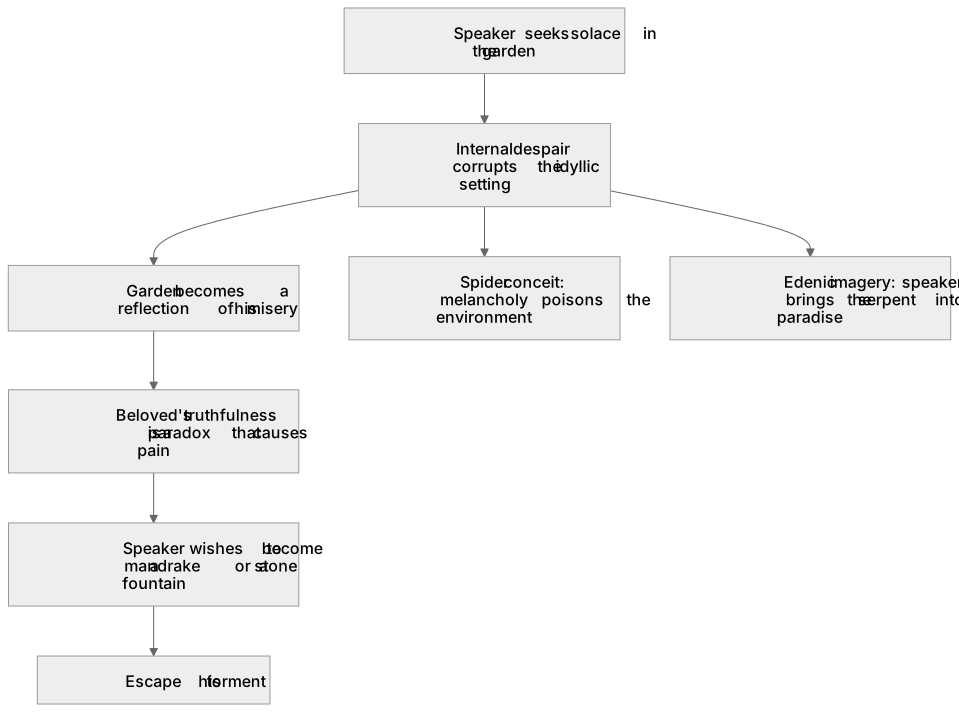
"Twicknam Garden" explores the agony of unrequited love through the subversion of traditional pastoral imagery. The speaker seeks solace in the beautiful garden, yet his internal despair corrupts the idyllic setting, transforming it into a reflection of his own misery. Donne uses the conceit of the spider to illustrate how the speaker's melancholy poisons the environment. The poem critiques the cruelty of the beloved, suggesting her truthfulness is a paradox that causes him pain. Ultimately, the speaker wishes to become a part of the garden—a mandrake or a stone fountain—to escape his torment, highlighting the destructive psychological impact of rejected love and the inability of nature to heal a broken heart.
What earns the marks
- Analyze the subversion of the pastoral tradition, where nature fails to provide solace and is instead corrupted by the speaker's grief.
- Evaluate the use of the spider conceit to represent how the speaker's melancholy transubstantiates beauty into poison.
- Explore the religious and Edenic imagery, particularly the speaker bringing the serpent into the paradise of the garden.
- Discuss the significance of the speaker's desire to transform into a senseless object, such as a mandrake or fountain, to escape emotional pain.
Common mistakes and how to put them right
Reading the poem as a straightforward celebration of nature.
Put it right: Analyze how the speaker's internal state actively corrupts and darkens the natural setting.
Overlooking the religious undertones.
Put it right: Identify the references to Eden and the serpent to discuss the theme of fallen grace.
Misunderstanding the spider metaphor.
Put it right: Explain that the spider represents the speaker's own toxic melancholy, not the woman he loves.
Exam tips
- Contrast the bitter, unrequited love in 'Twicknam Garden' with the mutual, triumphant love in 'The Good Morrow' or 'The Anniversary'.
- Focus on the sensory language and how visual beauty is juxtaposed with emotional agony to create a jarring tone.
- Discuss the patroness context of Lucy, Countess of Bedford, to add depth to the analysis of the unattainable woman, while keeping the primary focus on the text.
Try the lesson
The start of the Component 3: Poetry – Section B: Specified Poetry Pre- or Post-1900 – Pre-1900 – Metaphysical Poetry – John Donne Selected Poems (Penguin Classics, 2006): Twicknam Garden lesson, made from checked teaching notes for this specification point.
Have a go first
In "Twicknam Garden", how does the speaker's emotional state interact with the setting of the garden?
Listen
Twicknam Garden" explores the agony of unrequited love through the subversion of traditional pastoral imagery. The speaker seeks solace in the beautiful garden, yet his internal despair corrupts the idyllic setting, transforming it into a reflection of his own misery. Donne uses the conceit of the spider to illustrate how the speaker's melancholy poisons the environment. The poem critiques the cruelty of the beloved, suggesting her truthfulness is a paradox that causes him pain. Ultimately, the speaker wishes to become a part of the garden—a mandrake or a stone fountain—to escape his torment, highlighting the destructive psychological impact of rejected love and the inability of nature to heal a broken heart. A strong answer earns marks for these points. Analyze the subversion of the pastoral tradition, where nature fails to provide solace and is instead corrupted by the speaker's grief. Evaluate the use of the spider conceit to represent how the speaker's melancholy transubstantiates beauty into poison. Explore the religious and Edenic imagery, particularly the speaker bringing the serpent into the paradise of the garden. Discuss the significance of the speaker's desire to transform into a senseless object, such as a mandrake or fountain, to escape emotional pain. A common slip: Reading the poem as a straightforward celebration of nature. Instead, analyze how the speaker's internal state actively corrupts and darkens the natural setting. Exam tip: Contrast the bitter, unrequited love in 'Twicknam Garden' with the mutual, triumphant love in 'The Good Morrow' or 'The Anniversary'.
See it
Key words
Say what each word means before you turn the card.
Unrequited Love
Try answering aloud or in your head before turning the card.
Nature and the Pastoral
Try answering aloud or in your head before turning the card.
Melancholy and Despair
Try answering aloud or in your head before turning the card.
Betrayal and Truth
Try answering aloud or in your head before turning the card.
See every definition
- Unrequited Love
- The agony of rejected love, whose destructive psychological impact the speaker feels as he seeks solace in the garden.
- Nature and the Pastoral
- Traditional pastoral imagery that the speaker subverts, as the idyllic setting fails to provide solace and is corrupted by his grief.
- Melancholy and Despair
- The speaker's internal misery, which poisons the environment and transubstantiates beauty into poison through the spider conceit.
- Betrayal and Truth
- The cruelty of the beloved, whose truthfulness is a paradox that causes the speaker pain.
Label the diagram
Some boxes have lost their names. Pick the right name for each number.
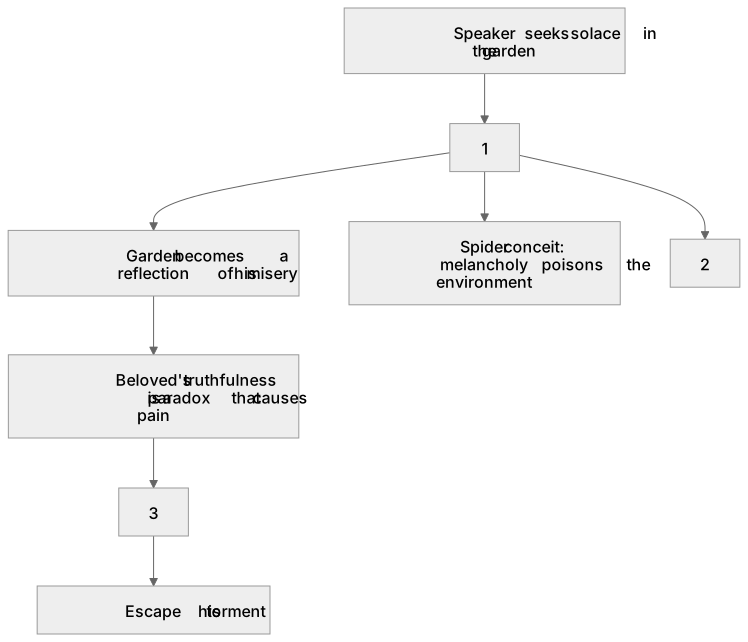
1Box 1
2Box 2
3Box 3
There is more to this lesson
The full lesson goes on to check your understanding and help you earn the marks. Create a free account to carry on, with your progress saved.
A week of Premium from your first lesson · Then the free plan continues · No card, no charge
Test your understanding of Component 3: Poetry – Section B: Specified Poetry Pre- or Post-1900 – Pre-1900 – Metaphysical Poetry – John Donne Selected Poems (Penguin Classics, 2006): Twicknam Garden
Active recall beats re-reading. Take an instant quiz now to test what you’ve learned and lock it into long-term memory.
A week of Premium from your first lesson · Then the free plan continues · No card, no charge