Pearson Edexcel · A-Level · English Literature
Course version: 9ET0 · Version from Sept 2015
Poetry – Section B: Specified Poetry Pre- or Post-1900 – Pre-1900 –…
Full specification wording
Component 3: Poetry – Section B: Specified Poetry Pre- or Post-1900 – Pre-1900 – Metaphysical Poetry – John Donne Selected Poems (Penguin Classics, 2006): The Ecstasy
In 'The Ecstasy', John Donne examines the profound union of two lovers whose souls temporarily leave their bodies to commune on a spiritual plane.
Checked against the Pearson Edexcel 9ET0 specification (opens in a new tab) on .
- Point 17 of 22
- 4 key terms
Study notes
From the checked teaching notes for this specification point.
The idea
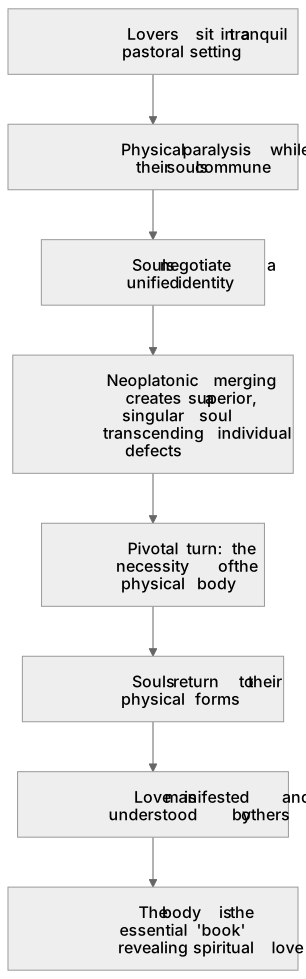
In 'The Ecstasy', John Donne examines the profound union of two lovers whose souls temporarily leave their bodies to commune on a spiritual plane. The poem opens with a tranquil pastoral setting where the lovers sit in physical paralysis while their souls negotiate a unified identity. Donne employs Neoplatonic philosophy to argue that this spiritual amalgamation creates a superior, singular soul transcending individual defects. However, the poem crucially pivots to argue for the necessity of the physical body. The souls must return to their physical forms so their love can be manifested and understood by others. The body is not a prison, but rather the essential 'book' through which the mysteries of spiritual love are revealed.
What earns the marks
- Analysis of the pastoral opening and the physical stasis of the lovers in contrast to the active dialogue of their souls.
- Exploration of the Neoplatonic concept of souls merging to form a perfect, singular entity that transcends individual flaws.
- Evaluation of the poem's pivotal argument that the physical body is necessary to express and actualise spiritual love.
- Discussion of the hypothetical 'bystander' who is purified by witnessing this transcendent union.
Common mistakes and how to put them right
Assuming the poem argues exclusively for spiritual love over physical love.
Put it right: Emphasise that the poem ultimately justifies physical intimacy as the necessary vehicle for spiritual connection.
Misunderstanding the term 'ecstasy'.
Put it right: Define 'ecstasy' in its original Greek sense (ekstasis) as the soul standing outside the body, rather than merely extreme happiness.
Ignoring the role of the observer.
Put it right: Address the significance of the hypothetical listener who is 'refined' by witnessing the lovers' spiritual dialogue.
Exam tips
- Contrast the initial physical paralysis of the lovers with the active, dynamic dialogue of their souls.
- Examine the use of alchemical and metallurgical imagery (such as the 'alloy') to describe the strengthening of the merged souls.
- Discuss how the poem balances the dichotomy between the physical and the spiritual, a central tension in metaphysical poetry.
Try the lesson
The start of the Component 3: Poetry – Section B: Specified Poetry Pre- or Post-1900 – Pre-1900 – Metaphysical Poetry – John Donne Selected Poems (Penguin Classics, 2006): The Ecstasy lesson, made from checked teaching notes for this specification point.
Have a go first
In John Donne's poem 'The Ecstasy', what is the primary setting described in the opening stanzas where the two lovers are seated?
Listen
In 'The Ecstasy', John Donne examines the profound union of two lovers whose souls temporarily leave their bodies to commune on a spiritual plane. The poem opens with a tranquil pastoral setting where the lovers sit in physical paralysis while their souls negotiate a unified identity. Donne employs Neoplatonic philosophy to argue that this spiritual amalgamation creates a superior, singular soul transcending individual defects. However, the poem crucially pivots to argue for the necessity of the physical body. The souls must return to their physical forms so their love can be manifested and understood by others. The body is not a prison, but rather the essential 'book' through which the mysteries of spiritual love are revealed. A strong answer earns marks for these points. Analysis of the pastoral opening and the physical stasis of the lovers in contrast to the active dialogue of their souls. Exploration of the Neoplatonic concept of souls merging to form a perfect, singular entity that transcends individual flaws. Evaluation of the poem's pivotal argument that the physical body is necessary to express and actualise spiritual love. Discussion of the hypothetical 'bystander' who is purified by witnessing this transcendent union. A common slip: Assuming the poem argues exclusively for spiritual love over physical love. Instead, Emphasise that the poem ultimately justifies physical intimacy as the necessary vehicle for spiritual connection. Exam tip: Contrast the initial physical paralysis of the lovers with the active, dynamic dialogue of their souls.
See it
Put it in order
Put these steps in the order they happen.
- 1. Pivotal turn: the necessity of the physical body
- 2. The body is the essential 'book' revealing spiritual love
- 3. Souls return to their physical forms
- 4. Lovers sit in a tranquil pastoral setting
- 5. Physical paralysis while their souls commune
- 6. Love is manifested and understood by others
- 7. Souls negotiate a unified identity
- 8. Neoplatonic merging creates a superior, singular soul transcending individual defects
Key words
Say what each word means before you turn the card.
The relationship between body and soul
Try answering aloud or in your head before turning the card.
Neoplatonism
Try answering aloud or in your head before turning the card.
Spiritual transcendence
Try answering aloud or in your head before turning the card.
Physical intimacy
Try answering aloud or in your head before turning the card.
See every definition
- The relationship between body and soul
- Donne examines lovers whose souls leave their bodies to commune spiritually, yet the souls must return to their physical forms so their love can be manifested and understood by others.
- Neoplatonism
- A philosophy Donne employs to argue that the spiritual amalgamation of the lovers' souls creates a superior, singular soul transcending individual defects.
- Spiritual transcendence
- The souls of the lovers temporarily leave their bodies to commune on a spiritual plane, forming a perfect, singular entity that transcends individual flaws.
- Physical intimacy
- The poem ultimately justifies this as the necessary vehicle for spiritual connection, since the body is the essential 'book' through which the mysteries of spiritual love are revealed.
Label the diagram
Some boxes have lost their names. Pick the right name for each number.
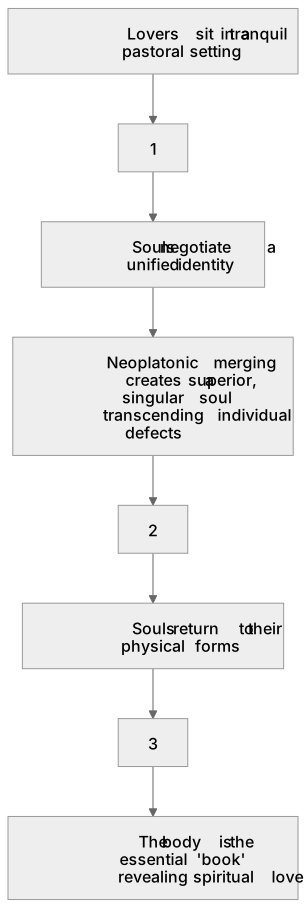
1Box 1
2Box 2
3Box 3
There is more to this lesson
The full lesson goes on to check your understanding and help you earn the marks. Create a free account to carry on, with your progress saved.
A week of Premium from your first lesson · Then the free plan continues · No card, no charge
Test your understanding of Component 3: Poetry – Section B: Specified Poetry Pre- or Post-1900 – Pre-1900 – Metaphysical Poetry – John Donne Selected Poems (Penguin Classics, 2006): The Ecstasy
Active recall beats re-reading. Take an instant quiz now to test what you’ve learned and lock it into long-term memory.
A week of Premium from your first lesson · Then the free plan continues · No card, no charge